Exploring science, technology and innovation.
- Tweets1.7K
- Following302
- Followers34
- Likes1.8K





ALT Red dual opposing jets coming from young stars fill the darker top half of the image. At bottom center is a glowing pale yellow, cave-like structure, its top tilted toward two o’clock, with a bright star at its center. The dust of the cave structure becomes wispy toward eight o’clock. Above the arched top of the dust cave, 3 groupings of stars with diffraction spikes are arranged. A dark cloud sits at the top of the arch of the glowing dust cave, with one streamer curling down the right-hand side. The dark shadow of the cloud appears pinched in the center, with light emerging in a triangle shape above and below the pinch, revealing the presence of a star inside the cloud. The largest jets of red material emanate from within this dark cloud, thick and displaying structure like the rough face of a cliff, glowing brighter at the edges. At top center, a star displays another, larger pinched dark shadow, this time vertically. To the left of this star is a more wispy, indistinct region.






ALT Photo from NASA's Perseverance rover shows a rocky slope, with two drill holes visible in a flat, foreground rock. Part of the rover's robotic arm -- and its shadow -- are visible at the left.

ALT Close-up photo from NASA's Perseverance rover shows a flat rock on Mars, with two drill holes where it has collected rock core samples. Also visible is a shallow patch of rock, about 2 inches (5 cm) in diameter, which has been ground flat by the rover's abrading drill bit.


ALT Image of the Phantom Galaxy, or M74, as seen by Webb in mid-infrared light. Delicate gray, webby filaments form a spiral pattern winding outwards from the center of the galaxy. These spiral arms of the galaxy are traced by blue and bursts of pink, which are the regions in which stars are forming. The very heart of the galaxy is colored blue and has speckles, which are young stars forming around the nucleus of the galaxy.


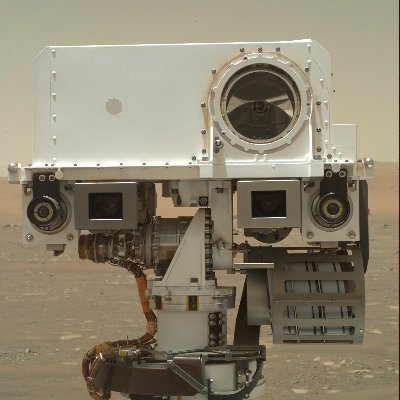
ALT NASA's Curiosity Rover poses for a selfie on Mars. The full body of the rover and it's rectangle head with circular camera "eye" look at you head-on. Curiosity's white body is coated in a layer of red Martian dust as it stands on the baren, rocky surface of the Red Planet. About 984 feet (300 meters) behind the rover, Vera Rubin Ridge rises up. Behind it lies the floor of Gale Crater, which Curiosity is exploring, and the northern rim of the crater. Just left of the rover are the two drill holes, called "Glen Etive 1" (right) and "Glen Etive 2" (left). Curiosity performed its first wet-chemistry experiment on a drilled sample at this location.