
Security researcher at AUEB, Greece MSCA Fellow
Joined January 2018
- Tweets43
- Following160
- Followers56
- Likes260



Together with @CoolSWEng and students from the Department of Management Science and Technology of AUEB we got two papers accepted in the Mobile and Smart Computing Track of ACM SAC 2026 to take place in Thessaloniki next March.
In the second paper, to be presented as a poster, with Ioannis Karyotakis, Foivos Proestakis, and Evangelos Talos, we compare security and privacy characteristics of the Android implementations of popular instant messaging applications using static and dynamic analysis tools.

A very interesting post just landed on the Google Security Blog.
"Fighting against the math of vulnerability lifetimes has been a losing battle"
Google Online Security Blog:Eliminating Memory Safety Vulnerabilities at the Source security.googleblog.com/2024…
To learn more about this "math", you can take a look at our 2022 USENIX Sec. paper:
usenix.org/conference/usenix…
I'm very excited to announce that my MSCA Postdoctoral Fellowship proposal was accepted and I will be starting work on "SPUCS: Software Architectures for Secure, Private, User-controlled Smart Devices" in early 2024 with @CoolSWEng at @AUEB. More details to follow!
Nikos Alexopoulos retweeted

Προγραμματίζω επίβλεψη 1–2 υποψηφίων διδακτόρων στο χώρο της τεχνολογίας λογισμικού, ασφάλειας πληροφοριακών συστημάτων, ή υπολογιστικών συστημάτων με εστίαση στη χρήση μηχανικής μάθησης. Αν ενδιαφέρεστε ή γνωρίζετε κάποιον που ενδιαφέρεται, η φόρμα είναι: forms.gle/xWsKntYxDiEXMMsX8

Nice analysis of (cloud and on-premise) GPU utilization issues ($$) and potential solutions by George: arrikto.com/blog/gpu-virtual…


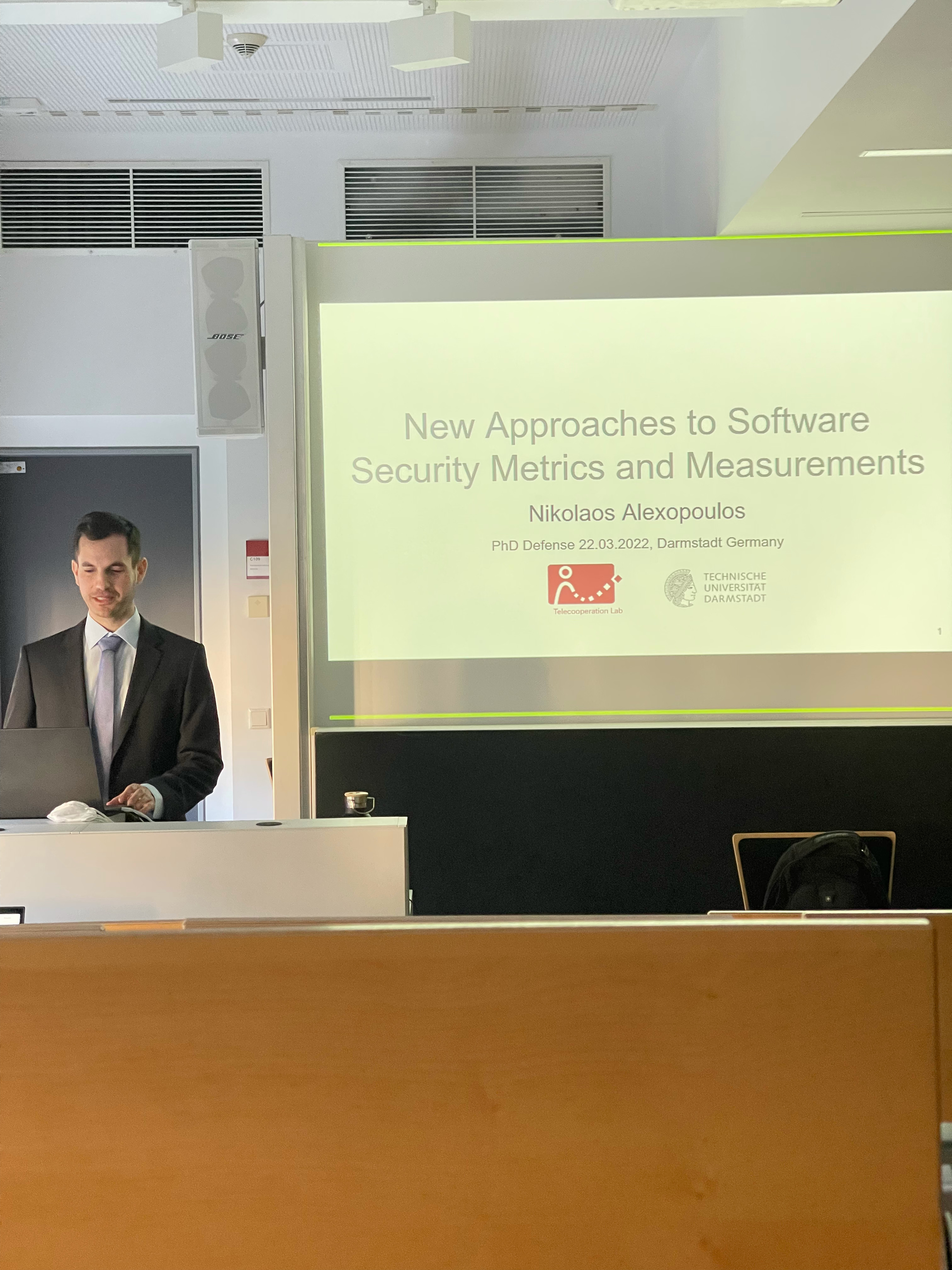
Excited to announce that our paper on measuring vulnerability lifetimes has been accepted at @USENIXSecurity '21. In this paper we seek to answer a fundamental question: How long do vulnerabilities live in the code?
Preprint: fileserver.tk.informatik.tu-…

Today I will be presenting our paper "Who are Vulnerability Reporters? A Large-scale Empirical Study on FLOSS" at @ESEM_conf. Joint work with @andymeneely, Dorian Arnouts and Max Mühlhäuser. Open streaming on YT. Preprint available: fileserver.tk.informatik.tu-… #esem21




Nikos Alexopoulos retweeted

Look who is back from cancellation! It's our good old RMS making a come back at Free Software Foundation 😎
news.itsfoss.com/richard-sta…

Nikos Alexopoulos retweeted

"The Tip of the Iceberg: On the Merits of Finding Security Bugs"
fileserver.tk.informatik.tu-…
Large study of vulnerability trends in OSS sw over a decade:
"we find no clear evidence that the vulnerability rate of widely used software decreases over time"
Do stable releases mature over time? Check out our large empirical study on FOSS "The Tip of the Iceberg: On the Merits of Finding Security Bugs" appearing in ACM TOPS. Joint work with @ComputeTrust Steffen Schulz and Max Mühlhäuser fileserver.tk.informatik.tu-… .
Also... Although bug bounties for FOSS have been effective, they have failed to remain competitive over time. Bounties have even been decreasing... This is kinda strange...