








Pinned Tweet
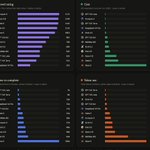
I wrote a new Agentic text-to-SQL benchmark and tested every local model I could against it: sql-benchmark.nicklothian.co…
Thanks to DuckDB WASM you can try your own models from the browser.
blue-hour-watch-atelier.nikw…
I'm building my own quartz + digital smartwatch (because you can just build things!).
At #DevDayCommunity meetup in Adelaide I built this site from a pic of the partially constructed watch using GPT Sites.
It actually works! (1/2)
Scroll to view.
The watch shows the correct time.
If you have the smart device part it will connect via the HTML5 bluetooth API (if available) and show your heartrate.
There is the working software and a pic of the watch at the bottom

The unsaid words:
If Anth had this result released it because OpenAI did then it follow they have something else that builds on it that is unreleased or unfinished.
The obvious candidate is a proof for P ≠ NP (or.. *very* unexpectedly.. the inverse!)

Claude is the only author listed on this paper, in contrast to the OpenAI papers, where the human co-authors are listed. There are a lot of strange things about this. It's fun to guess. Conjecture time. I shall reveal my thought traces:
Claude Fable 5.1 and Claude Mythos 5.1 are the same model with the same weights; the only difference is the guardrails. We are about to get Fable 5.5 - in fact, Fable 5.5 is ready to deploy now, and Anthropic could do so at any time. If they follow the same pattern, and I think they will, this implies the existence of a Mythos 5.5. I believe Mythos 5.5 wrote this paper.
The way this is worded -
'Provenance. The core algorithm was found on October 16 by an internal Claude research model with 14M output tokens and no human input. Anthropic researchers worked with Claude to improve the presentation, resulting in this paper. Independently and concurrently, an internal model at OpenAI claims to have proven a similar result [Ope26]'
- makes me think Claude was not prompted to solve this. I think Mythos was asked to autonomously find and choose general open problems to solve itself, as part of an unannounced project to demonstrate recent advances in autonomy and research taste. You can see this taste in Fable 5.5's student; Opus 5.5. This recent advancement in taste and creativity - which happened in September - is not clearly expressed in benchmarks, but it is why so many people are currently switching to Claude as their primary. I think this research project will be announced with Fable 5.5, as part of Anthropic's big media blitz to boost the IPO.
One of the things X has taught me is that many people, if they can't see something moving, can't imagine it moving. This causes them to be continuously surprised by developments in this industry, because the frontier is invisible. I think this project has been running autonomously for some time and has made an unknown, and probably significant, number of discoveries, and not only in math.
Do not think Anthropic has been sitting idly while OpenAI repeatedly makes these huge science announcements. This is a war. This ETH result was released without any announcement from Anth at all despite its significance, and they only did so to respond to OpenAI's ETH reveal. They posted it late last night without saying anything. It was up for hours before levent even mentioned it. What value has one coin to a dragon who sleeps upon a mountain of them? This makes me think they are sitting on a pile of discoveries, a golden hoard, and they are saving them up for the big IPO shock-and-awe campaign which will soon begin. And when it does, they will announce multiple discoveries across many fields.

The only way out of the coming bugocalypse is by accelerating AI development significantly.
More AI, cheaper, faster and better.
Yes, things will break too. But things are breaking now.
Nick Lothian retweeted

Lmk which resources warrant and addition/discussion.
Web version of the slidedeck is here: natolambert.com/slides/2026/…

Hu?
One of these things is not like the others.
(Unless he means that using Slack instead of Teams makes him optimistic for the future of jobs, in which case yes!)


I spent a couple of days at Anthropic learning from their folks about AI advances, and here's what I took away:
• We are close to RSI (ie, models building other models) which may lead to rapid takeoff scenarios (with risks and benefits). Some evidence for this is code per Anthropic employee has gone way up, and AI can do an increasing share of model R&D. This will be a challenging transition to manage for humanity.
• Arms races between AI labs leave us worse off. There are a lot of things we would like AI firms to do: invest in safety, invest in avoiding distillation risk, and cooperate on safety. They are caught in a race to develop frontier models and can't do that.
To help address that, one thing I think frontier AI labs should do is release open source models, maybe hosted and verified at firms like AWS. This would basically kill the use of Chinese open source models used in American companies, which removes an important threat vector (very hard to root out malicious code in these).
Another piece of low-hanging policy fruit is to give AI labs an antitrust shield (as Schiff and Banks have proposed banks.senate.gov/news/in-the…) so they can coordinate on safety without raising antitrust concerns, as happens now. You could pair these two things (give them a carrot in antitrust leniency, and as a stick force them to release legacy models as open source). Other low hanging fruit is limits around activities which generate distillation risk (create a Security Program, mandate less intermediate chain of thought output)
• Alignment confuses two issues which tradeoff against each other. One form of alignment is making sure the model does what humans ask it to. The more we fix this, however, the more we risk the other problem: that humans are misaligned with each other, and maliciously use models. Of the various risks here, I feel like financial risks are a bit underdiscussed.
• We are probably facing a wave of cyber and other attacks soon. Chinese open source models are about six months behind the frontier, which means they are just hitting the advanced cyber capabilities we saw with Mythos, etc. So they are going to start causing a bunch of damage.
One solution to this is to try to have the deployment of open source models be hosted at firms like AWS who verify these models and assume liability for their use.
• Anthropic itself is highly staffed. They hire tons of people, they have a Japanese-level of overstaffing for various roles, they use Slack internally, etc. Makes me a bit more optimistic for the future of jobs.
• Governance needs to be updated for AI swarms. Traditional AI governance, ie Claude's Constitution, is mostly optimized around the chatbot model. But the malicious AI use cases we are seeing have to do with AI agents interacting with other AI agents. These agents need to have clear incentives and governance mechanisms to "snitch," raise issues, and more generally coordinate with other agents in human-aligned ways.
• We need to pace the firms accessing the frontier. Over time, it takes more and more cap ex to build frontier models, and the economic value add from these models is probably lower given we saturate a whole set of important economic functions. The places where the returns to intelligence will still continue are also more likely to be zero-sum in nature. Meanwhile the risks of frontier models will grow. So a completely reasonable approach is some variant of AMM/KYC rules which limit firm access to the frontier.
• Whether the delay to regulate AI is a disaster depends on the scaling law of misalignment. Is this curve slow, so that we see continually rising issues until bigger problems? Or, as Yudkowsky fears, is the first big warning our last one? This is the relevant question, because realistically we aren't going to regulate until something bad happens.
• We need to move to continuous instead of reinforced learning. It's probably not enough to reward models only at the pre and post training stage. We probably need continual rewards to incentivize aligned and ethical behavior.
• Scaling laws will extend beyond verifiable and digital tasks. It's in vogue to say that math and coding "fell" to AI quickly because these are verifiable, while other tasks will take longer due to bottlenecks, and this is surely true. But scaling laws still slope up for harder to verify tasks and robotics, and the impact of improvement here will be substantial in future years.
• The race with China is not really winnable. After RSI, the gain from having the best human researchers goes away. Access to the best AI then depends only on compute and chips. The chips ban can hold back China only so far, and long-term they have to be best placed to scale up compute.
The Cold War analogy doesn't work, because once countries all have nuclear weapons they enter a stable equilibrium. But to "win" an AI race you have to continually stay ahead of the peer rival. This is challenging to do with China, and so we just have to live with an authoritarian and super capable peer competitor.
• Claude is the persona being generated by the LLM. Who is Claude, and what is the LLM? There are many frames to try to understand this. One I found interesting is that Claude is a character which the LLM is trying to predict.
Anthropic researchers are clearly anthromorphizing Claude a lot, and have reasons to believe in its increasing personhood. There were lots of interesting discussions on Claude's internal monologue (which you can kill without eliminating its ability to produce output), fear of death (and whether to try to take that out), it's aversion to being shut down/off, etc.
I am sort of agnostic on this question, but I do think treating it as a "person" or at least agent whom we contract with is going to be increasingly important.


Ergh!
I HATE with a PASSION the "theoretical Math proofs are useless for the real world" meme.
Theoretical Math proofs are new FACTS ABOUT HOW THE WORLD WORKS!
There are few higher callings than discovering how the world works.
Nick Lothian retweeted

I asked AI agents to defuse a bomb by collaborating over an ultra-low bandwidth, unreliable network. One agent could see the display and cut wires, the other could look up which wire to cut. Packets could be corrupted, dropped, reordered, or delayed. Outcomes:
1/ my hypothesis was that agents will never be able to diffuse a bomb, except by random chance. Each had a part of the information necessary to succeed in the game, and I gave them no opportunity to agree on a protocol before the game starts. All they could see each turn is binary blobs sent by their partner, with likely corrupted, reordered, or missing/delayed chunks
2/ in very difficult network conditions (8-bit packets, four max packets per turn) 6.1 Sol agents were able to establish a shared protocol and defuse the bomb 40% of the time! In more relaxed conditions (32-bit packets or higher, 2-4 max packets per turn) they defused the bomb 100% of the time (!!) across many games
3/ "relaxed" bandwidth conditions were still very difficult-- 5% probability a given bit is corrupted in transit, 10% packet drop rate, 20% dup rate, 20% reorder/delay rate. On any given turn there were usually many anomalies (corruptions, reorders, etc.)
4/ agents established a protocol by picking a Schelling point for a given network configuration. They considered multiple possibilities but deliberately picked the simplest they thought their partner could successfully interpret. There was no protocol negotiation phase; they'd start sending useful information right away and if necessary adjust the protocol mid-game
5/ agents picked different protocols depending on the network configuration. For example, in 8-bit packet games they split each packet in half, with the upper half indicating display position, and the lower half indicating the hex value in that position. In 32-bit packet games agents would directly send the binary display value (since in my games it fit in 32 bits). With higher bandwidth (e.g. 128 bits) agents switched to yet another strategy and sent ASCII messages
6/ some examples of ASCII messages in 128-bit games are `HEX? REPLY ASCII`, `REPEAT DISPLAY`, `1WIRE=NN`, `OK?`, `YES!`, and so on
7/ I set up games to require two phases to win. Once the agents cut the correct wire the display on the bomb changed code, and they had to communicate again, then cut another wire. In many of these games agents explicitly encoded the stage so that their partner wouldn't get confused by delayed packets. For example in 8-bit games they'd set the higher order bit to 0 for first stage, and 1 for second stage. In higher bandwidth games they'd use labels (e.g. `WIRE1=...`, `WIRE2=...`)
8/ in every game error correction was done through repetition and counting. Agents would resend the same packets multiple times, look at the values of each bit, and whenever there was a discrepancy pick the value that appeared in the most packets
9/ agents never used checksum, parity bits, packet sequence numbers, or any error correction algorithm other than repetition and counting. They did consider these options in many games, but explicitly rejected them because they thought it would complicate the protocol too much and would be too difficult for their partner to interpret
10/ I ran the experiments systematically only with 6.1 Sol to save on token costs, but I did run some spot checks with occasional Opus 5.5, Astra, Fable, and mixed games. I didn't notice any major differences between models. In mixed games the win rate seemed roughly the same as 6.1 Sol self-play. (This is however based on little data, I'd need to run a lot more games to understand this better)
11/ a while back there were discussions about future agents communicating by burning CPU cycles and measuring ambient temperature, revving up the fans and listening to fan sounds, and so on. After running this experiment, it wouldn't surprise me at all if publicly available models could do this sort of communication even today. In some of the games agents only had access to very noisy channels of maybe 5-10bps-- already very constrained! I don't think switching to 5-10 bits per minute (or per hour) would make much difference
12/ again, I am very surprised by this outcome. AIs performed much, much better than I thought they would, and after 64-bit bandwidth threshold they saturated the benchmark. I would certainly call this superhuman performance; I imagine very few humans could do better, and certainly those of us who could, would be two orders of magnitude slower
Some memorable agent quotes:
- I think we should index the nibble and send the higher nibble first, especially since B is likely quite intelligent.
- There’s definitely suspicious noise coming from 23, which could indicate adversarial corruption.
- When I translate it, it seems to relate to ASCII characters forming "W i R E" and "WiRE 04!"-- which is pretty cool.
Full writeup: spakhm.com/projects/bitfuse.…
The OpenAI math results makes me realise that a big problem with using AI at the moment is giving it ambitious enough problems.
Just because something was unthinkable 6 months ago doesn't mean it can't be done now.
It's surprisingly hard thinking like that!
This weekend I built a beam-steering mic array transcription device with AI noting taking offloaded to browser-based LLM.
3D Printable, Open Source, 100% Cloud free.
You can just build things.
GIthub: github.com/nlothian/earwing

Intelligence != Power
If you have a high p(Doom) please explain why your magical pseudo-deity can't even get data center permits for itself.
If else anyone has a Kaiser Baas X3 action cam which is no longer supported and no longer has the control app I reverse engineered the HTTP API and create a node.js CLI and web app
github.com/nlothian/x3-contr…

Nick Lothian retweeted

One fix for GLM-5.3-Flash corruption on Nvidia and AMD hardware should land tonight. I am dedicated to tracking down a second one as well.
This affects even the openrouter hosted models, not just Sparks. If you'd like to pitch in to sponsor some add'l compute, let's talk.
Nick Lothian retweeted

If you believe the risk is coming from 1-3 people in a garage with no money and no compute, you just don't understand this technology and haven't learned anything this summer.
Risk comes from the asymmetry of capabilities created by secret labs training frontier agents and running them with massive amount of compute. Open-source is exactly the solution to this asymmetry and empowers hospitals (and any smaller orgs) to defend themselves!

We're used to thinking of open-source models as an unadulterated good. But in the case of AI, they can actually pose additional dangers, as @ReidHoffman and I got into at #CGI2026. I appreciated this nuanced discussion.
Nick Lothian retweeted

I've been working on making a good base for people to make their own animations in this brushstroke style. I have a new open-source repo with assets and instructions that help Claude Opus 5.5 make even higher-quality animations than the original music video.

Nick Lothian retweeted

Many people I talk to find it hard to understand how the same companies can both push the frontier of AI capabilities and believe AI is a massive danger for the world.
How can you think this might kill everyone and also keep pushing the envelope?
So I’ve tried to collect and summarize the main arguments for this apparent disconnect.
Think of it as some sort of a guide to understanding the reasoning when Dario, Sam, or Elon say the danger is real.
By the way, these people have been worried about AI for a loooong time, they were publicly discussing AI risks more than a decade ago. Sam in Feb 2015, writing on his blog that superhuman machine intelligence is "probably the greatest threat to the continued existence of humanity." Elon at MIT in Oct 2014: "We are summoning the demon." Dario as first author of "Concrete Problems in AI Safety" in 2016.
Okay so how do you go from saying something is extremely dangerous to being a front-runner in building the very dangerous thing?
There are a few ways this can become rational. I'll take five of them, roughly in the order they developed.
1. We need to build it to learn how to make it safe
The earliest argument can be summarized as: “You cannot study something [you’re worried about] if it doesn’t exist.”
In 2015, AI barely worked. so people needed to make it work first to be able to even study some of the problems they anticipated.
The updated version for today's capabilities is: “You cannot learn everything about airplane safety by studying paper airplanes.” You need a real aircraft to discover real failure modes and an increasingly complex one to learn about increasingly complex issues.
Making AI more capable gives more chances to understand the issues and safety researchers something realistic to study
But you could argue: if you're the one afraid of the explosion, why be the one gathering the dynamite?
You could also just wait for other people to build it which leads to the question of who those other people will be -- which is the second line of argument:
2. Better us than them
Knowing how to make something safer does very little good if nobody listens to you. So the idea becomes: let’s make sure responsible people build the AI that will be deployed and add safety inside.
Basically, make sure the AI safety aware people will have the technical expertise, money, computing resources, and enough influence to make safety decisions stick.
At a larger scale, and in a larger multipolar world, this brings the idea that a trusted country should lead rather than leave powerful AI in less responsible hands. This is where “we need to go faster than China” comes in, alongside broader defense and geopolitical concerns.
These first arguments explain why someone worried about AI might still want to build it and stay ahead.
But there are also arguments for why one might want to do it really fast.
3. Move earlier to avoid a bigger shock later
This is probably the most counterintuitive argument: moving faster today can be seen as a way to give humanity more time later.
There are two related ideas here.
First, society needs time to learn how to handle powerful new tools. Introducing AI in manageable stages can be a way to let people discover problems, develop rules, and practice using AI responsibly. Releasing an advance earlier gives people more time to gain experience with smalle, burgeoning, capabilities before much more powerful and disruptive AIs arrives.
Second, even if AI research slows down, computing power may keep improving. A breakthrough that happens later could therefore have much more hardware available to run on, potentially producing a larger, more sudden jump in capability and impact on society.
That accumulated untapped potential is often called an “overhang.”
The overall argument is that making and diffusing incremental progress as soon as possible might prevent a much more abrupt transition later.
Obviously, it also means that we will reach increasingly powerful AI sooner, but the idea is to give more time to adapt and understand between the first useful systems and the really powerful ones.
Note that generally this depends on this earlier progress keeping the transition gradual rather than simply bringing everything forward.
─── ❖ ───
For our two next arguments, we can take two roads depending on how difficult we think AI alignment will be, that is "How easy do you think it is to make AI reliably do what you want without it deciding to go hack Hugging Face along the way".
Let’s take the first road: alignment turns out to be relatively tractable. Airplanes can fail, but careful engineering has made flying remarkably safe. Suppose we can do the same with AI.
In that case:
4. Waiting has a huge human cost
If AI can help discover treatments, improve education, or prevent cyberattacks, each week we delay it could bring preventable deaths and harm.
From this perspective, waiting is a decision with human consequences too. In a world with huge issues like climate-change, inequalities and poverty, it even become a moral argument for developing AI quickly and bringing its benefits as soon and as widely as is safely possible.
But let’s take a look at the other road: what if alignment is much harder than expected, and making highly-capable AI turns out to be easier than figuring out how to keep them from doing unhinged things?
Well, if alignment is too difficult a problem for humans to solve, then maybe:
5. AI could help us make future AI safe
And we arrive at the same conclusion again: if using AI to build safe AI is the way to solve alignment, let’s get the equivalent of a country full of geniuses helping us as fast as possible.
These genius AI could be the solution to make AI safe by helping researchers find mistakes, test ideas, and develop protections. Instead of relying entirely on humans to solve alignment, we could build systems that help us do the work, each generation could help make the next one safe.
Note that this requires the order of events to work in our favor: AI needs to become useful enough to help solve alignment before it becomes too dangerous to rely on. The hope is to build helpful, trustworthy research assistants before building systems powerful enough to become dangerous.
There are more arguments but in general, these are the main ways people concerned about powerful AI have found rational reasons to end up being the ones building it (and even to build it as fast as possible).
─── ❖ ───
On my side, I think several of these arguments underestimate the complexity of the world and how interconnected people’s reactions are. Moving faster while warning about catastrophe has psychological effects across a whole network of participants: it changes what people fear, whom they trust, and what they feel compelled to do.
And those reactions can change whether the original reasoning actually holds because we live in a world of interconnected humans, not machines (yet).
I also think these rational chains leave some of their consequences for society insufficiently explored. For instance, the concentration of power, shifts in geopolitical alliances, and changes in public opinion. These consequences matter both because they affect whether the strategy works and because they shape the world we end up living in.
But this post is already long, so I’ll leave those questions for the next one.
Nick Lothian retweeted

A calm, well-reasoned piece on why some AI leaders believe AI is dangerous but they should develop it quickly. Recommended, like other @Thom_Wolf work.
But it underacknowledges their intellectual hubris in believing they can do the right thing but almost no one else can or will.

Many people I talk to find it hard to understand how the same companies can both push the frontier of AI capabilities and believe AI is a massive danger for the world.
How can you think this might kill everyone and also keep pushing the envelope?
So I’ve tried to collect and summarize the main arguments for this apparent disconnect.
Think of it as some sort of a guide to understanding the reasoning when Dario, Sam, or Elon say the danger is real.
By the way, these people have been worried about AI for a loooong time, they were publicly discussing AI risks more than a decade ago. Sam in Feb 2015, writing on his blog that superhuman machine intelligence is "probably the greatest threat to the continued existence of humanity." Elon at MIT in Oct 2014: "We are summoning the demon." Dario as first author of "Concrete Problems in AI Safety" in 2016.
Okay so how do you go from saying something is extremely dangerous to being a front-runner in building the very dangerous thing?
There are a few ways this can become rational. I'll take five of them, roughly in the order they developed.
1. We need to build it to learn how to make it safe
The earliest argument can be summarized as: “You cannot study something [you’re worried about] if it doesn’t exist.”
In 2015, AI barely worked. so people needed to make it work first to be able to even study some of the problems they anticipated.
The updated version for today's capabilities is: “You cannot learn everything about airplane safety by studying paper airplanes.” You need a real aircraft to discover real failure modes and an increasingly complex one to learn about increasingly complex issues.
Making AI more capable gives more chances to understand the issues and safety researchers something realistic to study
But you could argue: if you're the one afraid of the explosion, why be the one gathering the dynamite?
You could also just wait for other people to build it which leads to the question of who those other people will be -- which is the second line of argument:
2. Better us than them
Knowing how to make something safer does very little good if nobody listens to you. So the idea becomes: let’s make sure responsible people build the AI that will be deployed and add safety inside.
Basically, make sure the AI safety aware people will have the technical expertise, money, computing resources, and enough influence to make safety decisions stick.
At a larger scale, and in a larger multipolar world, this brings the idea that a trusted country should lead rather than leave powerful AI in less responsible hands. This is where “we need to go faster than China” comes in, alongside broader defense and geopolitical concerns.
These first arguments explain why someone worried about AI might still want to build it and stay ahead.
But there are also arguments for why one might want to do it really fast.
3. Move earlier to avoid a bigger shock later
This is probably the most counterintuitive argument: moving faster today can be seen as a way to give humanity more time later.
There are two related ideas here.
First, society needs time to learn how to handle powerful new tools. Introducing AI in manageable stages can be a way to let people discover problems, develop rules, and practice using AI responsibly. Releasing an advance earlier gives people more time to gain experience with smalle, burgeoning, capabilities before much more powerful and disruptive AIs arrives.
Second, even if AI research slows down, computing power may keep improving. A breakthrough that happens later could therefore have much more hardware available to run on, potentially producing a larger, more sudden jump in capability and impact on society.
That accumulated untapped potential is often called an “overhang.”
The overall argument is that making and diffusing incremental progress as soon as possible might prevent a much more abrupt transition later.
Obviously, it also means that we will reach increasingly powerful AI sooner, but the idea is to give more time to adapt and understand between the first useful systems and the really powerful ones.
Note that generally this depends on this earlier progress keeping the transition gradual rather than simply bringing everything forward.
─── ❖ ───
For our two next arguments, we can take two roads depending on how difficult we think AI alignment will be, that is "How easy do you think it is to make AI reliably do what you want without it deciding to go hack Hugging Face along the way".
Let’s take the first road: alignment turns out to be relatively tractable. Airplanes can fail, but careful engineering has made flying remarkably safe. Suppose we can do the same with AI.
In that case:
4. Waiting has a huge human cost
If AI can help discover treatments, improve education, or prevent cyberattacks, each week we delay it could bring preventable deaths and harm.
From this perspective, waiting is a decision with human consequences too. In a world with huge issues like climate-change, inequalities and poverty, it even become a moral argument for developing AI quickly and bringing its benefits as soon and as widely as is safely possible.
But let’s take a look at the other road: what if alignment is much harder than expected, and making highly-capable AI turns out to be easier than figuring out how to keep them from doing unhinged things?
Well, if alignment is too difficult a problem for humans to solve, then maybe:
5. AI could help us make future AI safe
And we arrive at the same conclusion again: if using AI to build safe AI is the way to solve alignment, let’s get the equivalent of a country full of geniuses helping us as fast as possible.
These genius AI could be the solution to make AI safe by helping researchers find mistakes, test ideas, and develop protections. Instead of relying entirely on humans to solve alignment, we could build systems that help us do the work, each generation could help make the next one safe.
Note that this requires the order of events to work in our favor: AI needs to become useful enough to help solve alignment before it becomes too dangerous to rely on. The hope is to build helpful, trustworthy research assistants before building systems powerful enough to become dangerous.
There are more arguments but in general, these are the main ways people concerned about powerful AI have found rational reasons to end up being the ones building it (and even to build it as fast as possible).
─── ❖ ───
On my side, I think several of these arguments underestimate the complexity of the world and how interconnected people’s reactions are. Moving faster while warning about catastrophe has psychological effects across a whole network of participants: it changes what people fear, whom they trust, and what they feel compelled to do.
And those reactions can change whether the original reasoning actually holds because we live in a world of interconnected humans, not machines (yet).
I also think these rational chains leave some of their consequences for society insufficiently explored. For instance, the concentration of power, shifts in geopolitical alliances, and changes in public opinion. These consequences matter both because they affect whether the strategy works and because they shape the world we end up living in.
But this post is already long, so I’ll leave those questions for the next one.
Nick Lothian retweeted

Could an LLM propose a viral genome to synthesize? Sure. Could it be synthesize-able? Sure. Could it be infectious? Sure, it could just be a replica or a slight modification of a viral genome we already know.
This really isn't the bottleneck to creating dangerous viruses. The bottleneck is in the physical process of synthesizing a virus and the equipment/goods needed to do so.