

O21 Solutions helps Energy companies adopt and integrate Bitcoin into their operations across mining, treasury, and payments/settlement.
Houston, TX
Joined April 2025
- Tweets2.5K
- Following359
- Followers370
- Likes3.8K




Pinned Tweet
O21 Solutions today published The Market for Molecules to Compute: how oil and gas companies can compete in the race for powered sites built on reliable, affordable energy.
Free download: o21solutions.com/molecules-t…


BREAKING: Binance has been hacked with wallets across the Ethereum, Bitcoin, and TRON networks seeing outflows of -$5.7 billion.
The hack includes $1.45 billion worth of Bitcoin and $875 million worth of ETH.
If confirmed, this would mark the biggest hack in crypto history.
We expect more information shortly.
Mathieu Agee | O21 retweeted

Strategy announces Q3 2026 results:
- $21 billion operating income, our largest quarter ever
- $21 billion capital raised YTD
- Returned $STRC to health
- 848,517 $BTC held, up 26% YTD strategy.com/press/strategy-…

Resume up and to the right


Thought provoking article from @saifedean. I have been observing the same mining dynamics and wondering, where will the hashrate come from?
A few thoughts that may provide a counter:
- The ESG death cult is currently fighting AI like an autoimmune response to progress and prosperity. But the reality is obvious as it always has been: more energy leads to more prosperity. Electricity generation requirements from humanity will keep increasing, in the short term from AI. Even if you don't subscribe to this, energy security is now paramount and it's obvious some countries won't play along with sacrificing their economies, so the only answer is to try and compete. Increasingly Bitcoin is being positioned as a workload anchor and shock absorber co-located with AI/HPC, and could potentially scale linearly with AI workloads to help monetize generation timing disconnects and provide stable consumption profile.
- Grid stability and ancillary services. Bitcoin's ability to be an instantly curtailable, flexible load is useful for grids. Ancillary services revenue, grid stabilization incentives, demand response can supplement hashing revenue.
- Nation-states, resource owners, resource developers, and generators may seek to mine bitcoin for non-block reward reasons, either for national security or simply as an optimization capability in a broader portfolio.
- As a reaction to the surveillance state, non-KYC bitcoin could justify a premium or mining at a loss
- Under the right circumstances and with zero supply response possible, BTC could violently reprice, attracting capital from a new crop of miners. With the halving increasingly irrelevant to price dynamics, we could see a repeat of a new ATH before the next halving as front-runners front-run the front-runners. Hesitancy of large miners to re-commit capital back to mining may result in increased margins for the miners who stuck around.
The heyday of the large, centralized mining gold rush is over, and I expect future hashrate growth to be more deliberate and aligned with the above.

Mathieu Agee | O21 retweeted

I always laugh when somebody asks me what is the next catalyst for bitcoin
Bitcoin is a result of thousands of years of the money being captured and diluted in society, at the expense of the people
It’s the first verifiably fair monetary system in human history
The fact that bitcoin cannot be captured and cannot be counterfeited is the only catalyst it will ever need


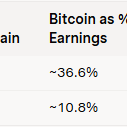
Good afternoon. Bitcoin accounted for 37% of Tesla's Q3 2026 GAAP Net Income. 11% for SpaceX. Together they hodl over 30,000 BTC worth over $2.5B.

Mathieu Agee | O21 retweeted

A new BTC demand driver is emerging.
Our latest research piece from analyst Zack Wainwright examines the rise of perpetual preferred stocks -- another transparent demand driver we can observe for BTC.
He puts their growth in the context of Bitcoin ETPs, examines why they may appeal in a world of expanding fiat and debt, and closes with a comparison to the Pyramids of Giza to illustrate the market's potential scale.
fidelitydigitalassets.com/re…


Therefore, implicitly here is JP Morgan's view of @Strategy's credit risk:


I swear there's as much $STRC fud this week as I've ever seen, even at the depths of the leverage flush. This while net leverage is 2%, amplification decreased 16% with the recent BTC price increase, and they have assets on hand to meet obligations for 50 years.
@grok what other companies of similar market cap or larger have liquid assets on hand to cover their costs and debt / dividend obligations for 50 years?
Let me answer for you:
None. Strategy’s ~45–49 year figure uses the market value of its Bitcoin holdings (not traditional cash) divided by annual interest + preferred dividends. No comparable or larger public company holds enough pure liquid assets (cash/T-bills) to statically cover 50 years of obligations. The closest are large net-cash companies like Berkshire Hathaway (~$365B cash) or Alphabet (~$242B cash), but those cover near-term obligations via ongoing free cash flow of operating businesses, not multi-decade static reserves. Adding Strategy’s modest software operating costs only trims the theoretical coverage toward ~40 years under current prices—it doesn’t change the uniqueness of the BTC-based metric.

Mathieu Agee | O21 retweeted

big shout to @strive
will be put to good use 🫡

OpenSats has received the first donation from @Strive under its recurring monthly commitment to support a stronger and more robust open source ecosystem.
🧡🌐
opensats.org/blog/opensats-r…

The MSCI campaign against @Strategy began shortly after this interview. @saylor has always been extremely transparent with his intentions, perhaps even inviting adversarial attacks. Sometimes I think interviews like this are intended to scurry the rats into the light.
Why did the S&P 500 reject $MSTR for inclusion? It’s an equity singularity siphoning capital and will eat the index.
Related:

The OCC’s supervisory review of debanking activities at the nine largest national banks it supervises found that these banks had policies that required, encouraged, or otherwise influenced banks to deny or limit access to financial services to Americans because of their political or religious beliefs or affiliations or their lawful business activities. Read about the OCC’s findings and its efforts to guarantee fair banking for all Americans. occ.gov/FairBanking

ALT Image of buildings with text overlaid: Debanked. Guaranteeing Fair Banking for All Americans.