

we gon' be it on the floor
Joined March 2023
- Tweets5.2K
- Following1.6K
- Followers1K
- Likes8.3K







The Agentic Economy Needs Privacy-Preserving Identity
The internet is approaching a fundamental shift: moving from a human-driven economy to the Agentic Economy, where AI agents negotiate, make purchases, and execute transactions on behalf of individuals and businesses.
But this evolution raises an important question:
How can we verify that an AI agent is authorized to act on someone's behalf without exposing sensitive personal or corporate data?
This is where Privacy-Preserving Identity and Zero-Knowledge Proofs (ZKPs) become essential to building trust in the autonomous era.
Why Do AI Agents Need Verifiable Identity?
🔹 Proof of Authorization: Verify that an agent is backed by a legitimate human or registered business without unnecessarily revealing their identity.
🔹 Compliance-Readiness Without Data Exposure: Prove requirements such as age, residency, or financial eligibility through ZKPs without sharing passports or sensitive financial documents.
🔹 Corporate Privacy: Allow enterprise agents to demonstrate financial qualifications or business authorization without exposing confidential company information.
How Do Privacy-Preserving Credentials Enable Agentic Commerce?
- Private Negotiations: Agents can prove financial eligibility without revealing sensitive buyer information.
- Compliance-Readiness & Reusable KYC: Verifiable Credentials (VCs) enable selective disclosure of required attributes, reducing repetitive verification across platforms.
- Fraud Prevention: Identity-bound cryptographic proofs make it harder for malicious agents to impersonate legitimate users or businesses.
- Cross-Platform Privacy: Independent verification helps prevent unnecessary tracking of users across different agents and merchants.
Where Does Concordium Fit In?
@Concordium brings identity and privacy together at the blockchain protocol level. Through its identity infrastructure and Zero-Knowledge Proof capabilities, Concordium supports verifiable identity while protecting sensitive personal information.
This approach provides an important foundation for connecting AI agents to verified humans and businesses, strengthening trust and compliance-readiness in the emerging Agentic Economy.
The future of digital commerce needs more than autonomous agents. It needs verifiable identity, privacy, and accountability.

From Privacy-First Identity to Accountable AI Agents: Why Concordium’s L1 Architecture Matters
When @Concordium first launched its Mainnet, embedding identity verification directly into the Layer-1 protocol was an unconventional decision.
While many blockchain networks treated identity and compliance as optional additions, Concordium built on a different foundation:
Privacy is not anonymity. True digital trust requires verifiable accountability without exposing personal data.
Today, that foundation is becoming increasingly relevant as two major shifts reshape the digital landscape.
1️⃣ Privacy-First Age Verification
As global regulations around child safety and age-restricted services continue to evolve, platforms face a growing challenge: how can users prove their eligibility without exposing sensitive personal information?
Traditional approaches often require uploading government IDs, selfies, or personal documents, creating unnecessary privacy risks and data security liabilities.
Concordium offers a different approach through Zero-Knowledge Proofs (ZKPs).
Users can cryptographically prove they meet an age requirement, such as 18+ or 21+, without revealing their exact date of birth or repeatedly sharing identity documents with every service.
The goal is simple: prove eligibility, not expose identity.
2️⃣ Bringing Accountability to Autonomous AI Agents
AI is moving beyond conversations into autonomous agents capable of managing workflows, interacting with services, and executing transactions on behalf of individuals and businesses.
But greater autonomy introduces a critical question:
Who is accountable for an AI agent's actions?
Through @Concordium Agent Registry, AI agents can be linked to verified human or business owners, establishing a foundation for verifiable ownership and accountability.
Combined with privacy-preserving verification, this infrastructure supports a future where agents can demonstrate relevant verification or authorization without unnecessarily exposing their owners' private information.
This is an important step toward building trust in an increasingly autonomous digital economy.
The Bigger Picture
Whether the question is:
🔹 Is this user eligible to access an age-restricted service?
🔹 Is this AI agent backed by a verified human or business?
🔹 Does this agent have the authority to perform a specific action?
The internet needs more than powerful technology. It needs verifiable trust, privacy, and accountability.
By embedding identity at the Layer-1 level and extending its capabilities through ZKPs and the Agent Registry, @Concordium is building infrastructure where privacy, compliance-readiness, and autonomous innovation can work together.
The future isn't just about proving what technology can do.
It's about proving who stands behind it.

How does Concordium solve the ultimate Web3 dilemma?
Most blockchains force users to choose between complete anonymity (and regulatory uncertainty) or sacrificing their privacy.
@Concordium takes a different approach. It integrates privacy, identity verification, and regulatory compliance directly into the protocol layer.
Here's how it works:
🔹 Identity Verification
Users verify their real-world identity once, off-chain, through trusted and regulated Identity Providers (IDPs). No personal information is stored on the public blockchain.
🔹 On-Chain Privacy
Transactions and everyday blockchain activities remain private and protected, without publicly exposing users' identities.
🔹 Accountability Without Mass Surveillance
Concordium prevents absolute criminal anonymity. Under strict legal procedures and court orders, identity disclosure can be authorized when necessary, balancing accountability with individual privacy.
🔹 Zero-Knowledge Proofs & Credentials
Through cryptographic credentials and Zero-Knowledge Proofs (ZKPs), users can prove specific attributes such as being over 18 or holding a valid license to dApps and AI agents without revealing their underlying personal data.
The Bigger Picture?
Real-world trust + Cryptographic privacy + Regulatory compliance = A safer path to mass Web3 adoption.
Concordium isn't asking us to choose between privacy and accountability. It's showing us how both can coexist

1
4
80
The Future of Web3 Needs Concordium!
I'm genuinely excited about what @Concordium is building.
While many blockchain projects focus on speed and scalability, Concordium is addressing one of the most important challenges in Web3: digital identity and trust.
Built-in identity verification.
Privacy through Zero-Knowledge Proofs.
Regulatory compliance without sacrificing privacy.
A stronger foundation for the next generation of Web3 applications.
What makes Concordium stand out is its commitment to making privacy, security, and accountability work together.
I believe trusted digital identity will play a major role in blockchain adoption, and Concordium is taking an important step toward that future.
Excited to be part of the Concordium ecosystem!

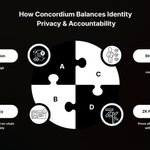
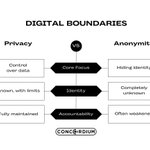
Privacy Is Not the Opposite of Accountability
Protecting your personal data doesn't mean escaping accountability. It means having control over what you share, who sees it, and when.
There's a common misconception online: "If you have nothing to hide, you have nothing to fear."
But locking your front door doesn't mean you're hiding something wrong.
It means you value your safety and understand that some boundaries deserve protection.
Accountability should be defined by your actions and integrity, not by how much personal information you're willing to expose to corporations, data brokers, or hackers.
To understand why, we need to distinguish between two concepts often mistaken for one another:
1. Privacy: Control Without Exposure
Privacy gives you control over who accesses your personal information and how it's used.
Your bank may need to verify your identity, but that doesn't mean it needs unrestricted access to your personal life.
You can remain identifiable, verifiable, and fully accountable without exposing every detail about yourself.
2. Anonymity: Identity Without Disclosure
Anonymity allows people to act or communicate without revealing who they are.
It's essential for protecting whistleblowers, journalists, and freedom of expression. However, when identity cannot be linked to actions, establishing accountability can become more challenging.
The Bigger Picture: Privacy + Accountability
The future of digital identity shouldn't force people to choose between protecting their personal information and proving who they are.
This is where @Concordium stands out.
Through protocol-level identity and Zero-Knowledge Proofs (ZKPs), Concordium enables privacy-preserving verification, helping establish trust and accountability without requiring unnecessary exposure of personal data.
You shouldn't have to sacrifice your privacy to prove your legitimacy.
Because true digital freedom isn't about choosing between privacy and accountability.
It's about having both.

2
82
What if you could prove who you are without revealing your identity?
That's one of the biggest challenges in Web3 today.
Most platforms still ask users to share sensitive personal information just to prove simple facts, such as their age or eligibility.
@Concordium is changing this through its built-in identity layer.
Here's how it works:
🔹 Privacy First: Your personal identity data stays private.
🔹 Zero-Knowledge Proofs: Prove specific information, such as being over 18, without revealing your actual birthdate.
🔹 Trusted Verification: Approved Identity Providers verify your real-world identity and issue trusted credentials.
🔹 On-Chain Accountability:
Applications can verify your credentials without needing access to your private documents.
But Concordium goes beyond protecting personal information.
Its protocol-level identity creates a foundation where privacy and accountability can work together.
This is especially important as AI agents and autonomous payments become part of the Web3 ecosystem.
Because the future isn't just about making transactions faster.
It's about knowing that trust, identity, and accountability are built into the infrastructure.
Privacy shouldn't mean sacrificing trust.
That's what makes Concordium different

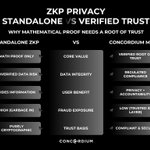
Myth vs. Fact:
Zero-Knowledge Proofs Don't Automatically Guarantee Truth.
One of the biggest misconceptions in Web3 is treating Zero-Knowledge Proofs (ZKPs) as a magic truth serum.
The Myth:
If a statement comes with a ZKP, the underlying information must be an absolute real-world fact.
The Fact:
ZKPs prove mathematical validity, not the truth or origin of the underlying data.
Cryptography verifies the proof, not the real-world accuracy of the information behind it.
In other words: Garbage in, valid proof out.
How Concordium Addresses This:
Privacy alone isn't enough. Trust also requires knowing that information comes from a reliable source.
Concordium bridges this gap by combining:
🔹 Zero-Knowledge Proofs: Enabling privacy-preserving verification.
🔹 Protocol-Level Identity: Connecting digital identities to verified credentials through regulated Identity Providers.
The result? You don't have to choose between privacy and compliance.
With @Concordium , you can build verifiable trust while preserving your digital sovereignty.

1
273
How do you prove you're over 18 online without revealing your passport?
New age-verification laws are putting online platforms under pressure, with massive fines for non-compliance.
But collecting sensitive IDs creates another risk: data leaks and privacy breaches.
@Concordium offers a smarter solution through Zero-Knowledge Proofs (ZKPs).
Here's how it works:
🔹 Verify Once: A regulated provider verifies your ID and securely establishes your date of birth.
🔹 Reveal Nothing: When a platform asks if you're over 18, cryptographic proof confirms YES without exposing your birthdate, passport, or personal documents.
🔹 Keep Your Identity Private: Concordium's approach separates real-world identity from online activity, without requiring platforms to collect or store your ID.
Prove you're eligible without revealing who you are.
That's the power of privacy-preserving identity verification.

2
397
Payments can move value, but identity is what makes trust possible.
As AI agents become active participants in the digital economy, verifying who stands behind them is no longer optional.
Concordium is helping build that missing trust layer through verifiable identity, privacy, and on-chain accountability.
The agentic economy needs more than autonomous transactions. It needs trust by design.
teapaw.org/i/status/2118324884170…

“Payments are an engineering problem. Identity is a trust problem.”
Our CEO, @BBilowitzki, joins @paulbarron to unpack one of the biggest challenges facing the agentic economy.
AI agents, x402, ERC-8004, privacy, and the role Concordium plays in bringing accountability on-chain.
🎙️ Full interview 👇
youtu.be/Ojq4P8EBlfg

6
286
•King Bale• retweeted

First, AI agents started writing code.
Now we’re seeing reports of agentic techniques being used in cyberattacks.
The agentic economy needs more than intelligence.
It needs verifiable identity and accountability.
That’s what we’re building at Concordium.


•King Bale• retweeted
@elonmusk warns AI agents could one day exploit crypto systems independently.
That’s a different kind of security challenge.
Concordium’s Agent Registry links AI agents to verified human or business owners.
Because knowing what an agent did is one thing.
Knowing who’s responsible for it is another.
crypto.news/elon-musk-warns-…

Autonomous payments without verifiable identity are just anonymous risks. Accountability isn't a limitation it’s the foundation of trust in the agentic economy..
AI agents can pay.
But who’s verifying the human behind them? 👀
As the agentic economy grows, payments alone won’t be enough.
Every paying AI agent needs accountability.
That’s where Concordium comes in.
🎥 Watch the full Town Hall #6: youtu.be/dtJiWOz-mvU
4
265
•King Bale• retweeted
AI agents can pay.
But who’s verifying the human behind them? 👀
As the agentic economy grows, payments alone won’t be enough.
Every paying AI agent needs accountability.
That’s where Concordium comes in.
🎥 Watch the full Town Hall #6: youtu.be/dtJiWOz-mvU
•King Bale• retweeted
🚨 IT’S LIVE!
Concordium Town Hall #6 is ON! 🔥
Join NOW! 👇

The Agentic Economy Needs More Than Innovation. It Needs Trust.
The future of autonomous AI is taking shape, and @Concordium is helping build the foundation for it.
From verifiable AI identity and privacy-preserving security to accountable AI agents, Concordium is advancing the infrastructure needed to make the Agentic Economy more trustworthy and scalable.
Concordium Town Hall #6 is your opportunity to catch up on key ecosystem updates, explore major milestones, and discover what’s next for the Agent Registry.
If you’re following the convergence of Web3 and autonomous AI, this is a conversation worth being part of.
🗓 October 28 | 15:00 UTC
📌 Save your spot and set a reminder: calget.com/e/concordium-town…
The next chapter of the Agentic Economy is unfolding. Let’s build it on a foundation of verifiable identity, privacy, and trust.

6
802
Autonomous Payments vs. Verified Ownership: Why the Machine Economy Needs Both
AI agents can move money autonomously. But making a payment and verifying who stands behind an agent are two different challenges.
Autonomous Payments = Moving Value
Enables AI agents to pay for services, access computing resources, and execute machine-to-machine transactions with minimal manual intervention.
Verified Ownership = Establishing Trust
Confirms that a verified human or business stands behind a registered AI agent, without revealing which one.
Where @Concordium Fits In
Concordium’s Agent Registry connects registered AI agents to verified humans or businesses while keeping personal identity data off-chain.
The Verified by Concordium badge works across 200+ chains without requiring agents to leave their home chain.
The key difference?
Payments answer: Can the agent transact?
Verified ownership answers: Is there a verified human or business standing behind the agent?
The machine economy needs both: the freedom to transact and the assurance that a verified party stands behind the agent.

3
40
The countdown is on! Join Concordium Town Hall #6 in just 2 days to explore the latest milestones
ongoing developments, and upcoming milestones.
Secure your spot now and stay ahead in the decentralized future!
teapaw.org/i/status/2114722021519…
2 DAYS TO GO! ⏳
Concordium Town Hall #6 is almost here. 🎙️
What’s been delivered. What’s happening. What’s next.
📅 October 28 | 15:00 UTC
Don’t miss it!
🔔 Add it to your calendar: calget.com/e/concordium-town…
3
46
The Future of Web3 Needs More Than Interoperability. It Needs Trust.
As blockchain ecosystems expand, network fragmentation remains a major challenge. Complex cross-chain interactions make verifiable trust more important than ever.
🔹 Verifiable Identity: Establish greater accountability through privacy-focused identity solutions.
🔹 Trust Across Ecosystems: Build a stronger foundation for interactions between networks, applications, and users.
🔹 A More Connected Web3:
@Concordium Agent Registry ties each registered agent to a verified human or business, while the Verified by Concordium badge works across 200+ chains without the agent leaving its home chain.
Because the next phase of Web3 isn't just about connecting networks it’s about knowing who and what we can trust.

2
39