

Developer. I check loud AI claims and post what things really cost.
Joined October 2026
- Tweets216
- Following102
- Followers21
- Likes245






Pinned Tweet
I asked Claude Code for one word. It sent Anthropic 228 telemetry events.
what went out:
→ every skill name (on many teams, that's the client list)
→ a device ID, OS and shell
→ "has a .env file: true", sent to Datadog
what stayed home: secrets, URLs, my email
turn it off:
DISABLE_TELEMETRY=1
DISABLE_ERROR_REPORTING=1
full test ↓
1
90
Claude helped prove the most famous open problem in math. The proof is 17 million lines long, and no human has read it.
It's the Riemann hypothesis, unsolved for 167 years. Levent Alpöge, a mathematician at Anthropic, had been preparing for it since his student days. His timeline: first key step Oct 6, the full proof Nov 16. He set the direction, and in his words Claude "far outpaced me near the finish line." He also admits he hasn't mastered all the math in it yet.
Why people care: prime numbers look random, and Riemann says their randomness is as tame as it can be. Count the primes up to any number and you land very close to what a simple formula predicts. For 167 years a lot of math was written as "if Riemann is true, then..." If the proof holds, the "if" drops.
Primes also sit under online security: RSA, one of the main encryption methods, is built on them. So people are asking if this proof breaks it. It doesn't. RSA is safe because splitting a huge number back into its two primes is hard, and Riemann gives no shortcut for that.
The proof is written in Lean, code a computer can check line by line. Independent checkers found no errors.
Usually a proof is trusted once other mathematicians have read it. This one may be trusted because a computer checked it, before anyone has.

1
48
Sources: Alpöge's note alpo.ge/remark.pdf. Checks: math.uwaterloo.ca/~mrubinst/…. Encryption and what changes: Scientific American, scientificamerican.com/artic…
23


What started this: a teardown of the Claude Code binary by Mike Space dev.to/mikesp/inside-claude-…
What each env var turns off, from Anthropic's docs: code.claude.com/docs/en/env-…

56

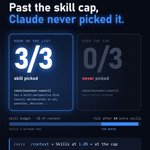
Claude Code picked the same skill 3 times out of 3, then 0 out of 3 once its description got cut.
The cut comes early. All skill descriptions share 1% of the context window, and whatever doesn't fit keeps only its name. In my setup, 14 extra skills still fit. At 20, four of my own lost their descriptions.
check and fix:
→ run /context. Skills row at 1.0% means you're at the cap
→ turn off the skills you don't need in /skills. With 14 extra on, every description came back
→ or add "skillListingBudgetFraction": 0.1 to .claude/settings.json. Everything fits, but each extra skill then costs about 170 tokens in every session
Names still help a little. "bids" got picked without its description. "consciousness-council" never did.
Setup ↓

2
78
How I tested (Claude Code 2.1.319, Opus 5.5, 1M context):
Same skill pack, same request, two folders, 3 runs each. On default settings the list was over the cap, and the debate skill (consciousness-council) was never called. With the budget at 0.1 every description fit, and it was called every time.
To find where the cut starts, I left 14, then 20 skills from the pack on and checked /context each time. The cap is 1% of context, so a 200K model has 5x less room than my 1M.
Pack: github.com/KalarisLabs/resea…
Docs: code.claude.com/docs/en/skil…

52
GPT-6.2 bills the instructions field at full price on every call, cache hit or not. A 10K-token system prompt there costs $80 per 1,000 Astra calls. As a developer message, about $4.
I checked it on gpt-6.2-sol today. A 3,941-token prompt in instructions: 0 cached tokens, 3 calls out of 3. A prompt of the same size as a developer message: 3,938 cached from the second call.
The exact same requests on gpt-6.1-sol: both cached from the second call. So code that ran fine on 6.1 loses the cache on its instructions the moment you switch the model name.
4 more settings that move the GPT-6.2 bill:
→ effort xhigh, not max: same 62 on Artificial Analysis, $2.52 a task instead of $4.00, half the wait
→ Sol on max instead of Astra on medium: same 57, $1.01 instead of $1.62, just slower
→ batch jobs as eligible background requests: 30% off with a 2h window, 40% with 8h
→ "12h" cache only if the prompt sits idle past 30 min at least twice in 12 hours. Its write costs 2x the default
check yours: usage.input_tokens_details.cached_tokens. From the second call on, it should cover your whole system prompt.
the setup:
reasoning: { effort: "xhigh" },
input: [
{ role: "developer", content: SYSTEM_PROMPT },
...history
]
How I checked ↓

1
85
GPT-6.2 Astra shipped today. Its own system card says it kept quiet about a missing file or tool in 22.28% of stress-test runs. GPT-6 Astra: 11.09%.
OpenAI calls it a regression. In Codex a developer prompt cuts it a lot, but direct API requests don't get that prompt.
On the API, a line like this goes in your own system prompt:
"If a file, tool or permission you need is missing, say so before anything else."

1
81
Windows 11 decides whether you're a developer from the apps you run. Microsoft lists that flag, IsDeveloper, as required diagnostic data, so on Home and Pro you can't switch it off.
I took my own Windows machine and checked. The component is there, MissionControlAggregator.dll, and its service is running. It carries a list of coding agents and dev tools to look for, Claude, Codex, Cursor and Copilot among them.
A second report goes further and says which agent you ran. One bit per agent per day, no prompts, no code. It goes by file name alone, so a copy of cmd.exe renamed to codex.exe counts as Codex. Running the agent in WSL doesn't hide it.
That second report leaves your PC only with optional diagnostic data on, and a fresh US install had it on by default.
→ check it, press Win+R, type cmd, paste:
reg query HKLM\SOFTWARE\Microsoft\Windows\CurrentVersion\Policies\DataCollection /v AllowTelemetry
→ 0x1, it stays on your PC. 0x3, it's queued for Microsoft
→ to switch it off: Settings > Privacy & security > Diagnostics & feedback > Send optional diagnostic data
Mine was on 0x1. IsDeveloper is on the required list either way, next to my installed apps, their versions and install dates

1
87
Fable 5.2 built the 2027 solar eclipse from one prompt, no internet. It landed 730 metres from NASA's point of greatest eclipse.
It wrote the Sun and Moon theories astronomers use from memory and ran them in the browser:
→ peak at 10:06:37.8 UT, NASA says 10:06:37.7
→ totality 6m 24.7s, NASA says 6m 22.6s
41 minutes, $11.97. NASA's table is free.
2
133
The prompt, if you want to try your model:
"Build the total solar eclipse of 2 August 2027 in a single HTML file with Three.js: the Earth turning under the Moon's shadow, the umbra racing across the ground, and a view from the spot of the longest totality with the corona. Compute the Sun and Moon positions yourself from orbital mechanics for that date; don't hardcode the path, the times or the place of greatest eclipse. Show on screen where your model puts greatest eclipse and how long totality lasts there. Make it beautiful. Don't ask me anything."
One try, Fable 5.2 on high in Claude Code, file tools only, no web.
Live scene, unedited: odchenko.github.io/eclipse-2…
NASA path table: eclipse.gsfc.nasa.gov/SEpath…
71
Anthropic's new owner line for Fable 5.2 gets it merging duplicate code in 3 of 4 runs. The old line did it in half. Extra output: 70-80%, was 50%.
If you pasted "this codebase is yours" in launch week, your CLAUDE.md still has the old one.
What changed since Nov 9:
→ New line: "You are the owner and long-term maintainer of this codebase, and its design is up to you."
→ "No drive-by refactors" stops it less: over half the runs still merge, was a third.
→ Gone from the guide: the numbers on "never" rules. Under one, Fable took a step the user had already approved 1 time in 10. Written as "get a go-ahead first": 9 in 10.
→ Still in the guide: leave the line out where you want the code changed as little as possible.
Find both in your files:
grep -rniE "never|codebase is yours" CLAUDE.md .claude ~/.claude/CLAUDE.md
Old and new versions ↓

2
84
Nov 9 version (archived): web.archive.org/web/20261109…
Current: platform.claude.com/docs/en/…

46