

We help agriculture & livestock businesses: Track emissions | Boost biodiversity | Achieve compliance 🌱
Dublin, Ireland
Joined January 2021
- Tweets15
- Following209
- Followers161
- Likes0



We have been awarded the Young Innovator of the Year prize by @Entirl! Thank you for the support and guidance. Big things to come! farmersjournal.ie/farm-carbo…
ODOS retweeted

What an exciting finale! We're thrilled to announce that the winner of The Ireland Funds Business Plan Competition 2021 is Carbon Harvesters. 2nd goes to
BIONICS and 3rd is ECLIPSE. Huge congratulations and thanks to each fantastic participating team! #IrelandFundsBPC

That is a great question, David. We aim to maintain productivity as we believe sustainability must not compromise profitability. For example, when reducing chemical fertiliser, we determine how we can provide the missing nitrogen through strategies such as clover or multispecies.
Hi Juan David! Thanks for the question. Our LCA was modelled using inputs from the Irish National Inventory Report, IPCC tier 2 and 3, Central Statistics Office, FAO, Teagasc, GaBi, and Ecoinvent among others.
1

ODOS retweeted

Two startups, Carbon Harvesters and Cano-ela, won a personalized training day with the Venturelab team on the @EPFL_en campus and industrial visits in the area, during the Global Food Venture Programme (GFVP) Pre-Incubation Bootcamp from @EITFood venturelab.ch/Carbon-Harvest… #EITFood
Hi Hannah, fertiliser inputs are constant with some decrease in emissions due to low emissions slurry spreading and protected urea. Imported feed inputs oscillate with time. There was a big drop after 2013 and started to increase again in 2016. We are now at 2013 levels again.
Milk production has increased by 5% since 2012. Fertiliser inputs are roughly constant and now farmers use low emissions slurry spreading and some protected urea. Concentrate usage has increased by an average of 3% per unit product. Manure emissions have increased.
1
Average Irish carbon footprint using a cradle-to-gate approach is 1.11 kg CO2-eq/kg FPCM including land use. Concentrate share is 7% including land use (600 kg DM/cow/year). Fertiliser application and manufacture share is 8% and 10%, respectively.
1
1
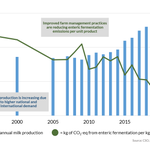
Hi Hannah, we agree (Fig 1). We are not saying total emissions are decreasing but that the rate of CH4 emissions per unit product is decreasing. This is because milk production per cow is increasing at a higher rate (Fig 2) due to N inputs but also improved management.


1

