

I help early-stage B2B SaaS and AI founders go from first customers to 7 figures | Host of The SaaS Podcast (500+ founder interviews → https://xitter.cf/t.co/KmflAgVtsW
Sarasota, FL
Joined August 2008
- Tweets2.5K
- Following169
- Followers5.2K
- Likes1.8K





Pinned Tweet
Your SaaS has blind spots.
I built free tools to help you find them:
→ Revenue Ceiling Calculator: See if your churn is quietly capping your growth
→ Founder Archetype Quiz: Discover the fatal flaw holding you back
5 minutes. Zero fluff.
tools.saasclub.io/

Your MVP is almost ready. Just a few more bugs to fix. But nobody has told you they'd pay for it yet.
A founder told me exactly that on a call recently. When I suggested a prototype instead, they pushed back: "If I can build an MVP in a few weeks, why bother with a prototype?"
A prototype looks and clicks like the real app, but nothing works behind the screens. An MVP actually does the job: customers put their own data in and get a real result.
So an MVP is a promise. Once someone depends on it, you own every bug they hit. A prototype lets you ask for a commitment before you owe anyone anything.
Marius Meiners did exactly that when he started Peec AI. He built a clickable prototype with v0 in a day and a half, showed it to potential customers, and asked them to sign a non-binding letter of intent through DocuSign. 8 signed, and Antler wired him $100K on the strength of those signatures.
People are polite. They'll tell you your idea sounds interesting and never think about it again. But nobody opens DocuSign and reads the fine print for an idea they don't care about.
P.S. I break down a founder coaching moment like this every week in the newsletter. Link in my profile.
If your price isn't written down anywhere, the buyer will set it for you.
Shahar Azulay walked into groundcover's first pricing call asking for $100K. He walked out at $10K a year. "What are we negotiating against?" he told me.
So a few months later, groundcover put its price on the website: $30 per host per month.
And this week's Founder Playbook breaks down how he used it.
Key Takeaways:
1. Put a price on your website. Price by something the buyer can count before the call, like hosts, seats or locations.
2. Discount against it. Give up to 70% off if you need to, and keep the website price the same. Buyers know you're early. "They can get 70% discount. It's fine, right?"
3. Get something back. Even his $10K first deal came with a commitment for 3 years.
4. Don't fight over price. If the buyer holds the cards, "it's better to defocus, take the deal and move on to the next customer."
5. Don't re-price old deals. He never planned to 10x those early contracts. Your next customer has never seen the old price.
It works best when you sell to companies under about 1,000 employees. Enterprise deals still get negotiated one by one.
P.S. I break down a founder playbook like this every week in the newsletter: saasclub.io/email

His prospects kept giving him advice on his own product. They didn't think he was selling.
That was Shahar Azulay's first few months at groundcover, long before it got to 8-figure ARR. He'd pitch, and the other side would come back with "Great, so my feedback is, you know, you should do that and that and that."
"I wanted to get out of the friend zone," he told me.
He'd opened a lot of those calls with "we would love to show you what we're building." That's how you ask for a favor, not a purchase.
And from the inside, those calls feel like they went well. People were engaged and full of ideas. Then you notice nobody asked what it costs.
In the clip, he explains why he thinks that's fine early on, and what changed it.
P.S. I share founder lessons like this every week in the newsletter. Link in my profile.
A low first price is a problem you can fix later. No customers isn't.
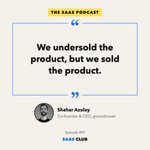
@shahar__azulay asked for $100K on @groundcover_com's first deal and closed at $10K a year. He still thinks "we did the right thing." Those early deals taught him how to run legal and security reviews, and gave him logos and references for the next call. And groundcover went on to cross 8 figures in ARR.
This is from an interview I did with Shahar on The SaaS Podcast.
P.S. I share founder lessons like this every week in the newsletter. Link in my profile.

ALT Quote card: "We undersold the product, but we sold the product." - Shahar Azulay, Co-founder & CEO, groundcover
He built an 8-figure ARR company. On his first deal, he asked for $100K and got talked down to $10K.
@shahar__azulay had been an engineering manager his whole career. 3 months after co-founding @groundcover_com, he was walking into his first pricing call with no idea what to charge.
The night before, at 10pm, he and his co-founder got an early investor on the phone to figure out a number. They knew a company that size paid 6 figures for Datadog, so $100K felt about right.
Then the CFO offered 3 years at $10K a year.
"Yes, okay, we'll take it."
"We didn't even know how to negotiate back then," Shahar told me. "What are we negotiating against?"
But he kept closing. It took about 50 customers to get groundcover to $1M ARR.
You won't know what to charge until someone pays you. So get the first one signed, even at a tenth of what you asked.

A founder I advise showed me a prototype of her product. She had a meeting coming up with a big prospect, and she wanted to know: is the design good enough, or does it need more work?
The design was fine. She walked me through the whole flow, someone takes the training, gets scored, gets certified, and she'd built it well.
But halfway through I stopped looking at the design. The meeting was with the head of training, and the HR director was sitting in. Neither of them takes the training. They decide whether to bet on her product.
So I asked her: if they say yes, how will they know it's working? How will they show their boss it paid off? How many people finished the training, how many never started, where they're stuck?
She'd built the whole demo for the person who takes the training, not for the two people in the room. She thought about it for a moment, and then realized what she really needed was a screen where they could see the answers to those questions.
So the plan changed on that call. Forget the design polish. Spend the week building that screen.
Make it easy for the buyer to bet on you.
P.S. I write up how I think through founder problems like this every week in the newsletter. Link in my profile.
He closed $10,000-a-month deals without ever opening a deck.
Ross Andrew Paquette ran the early demos at Maropost himself, on the way to $50M in ARR.
And he wasn't a natural salesperson. "I just picked up the phone quite a bit more than anybody else and figured out how to do like a decent product demo and then that turned into a really good product demo."
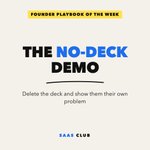
This week's Founder Playbook breaks his demo down.
Key Takeaways:
1. Keep discovery short. "A simple discovery", in his words. A few questions to find what they're trying to fix, then stop.
2. Delete the deck. "There was no decks or anything like that. It was really heavily focused on the outcomes."
3. Demo their situation. Every demo was personalized to what the prospect just described.
4. Run it yourself. Ross designed much of the product himself, which "gave me a bit of an edge". Nobody you hire in year one will know it like you do.
Whatever you sell, you can run the same meeting: a few minutes on their problem, then show them that one thing working.
P.S. I break down a founder playbook like this every week in the newsletter: saasclub.io/email

"I know very few founders who can actually sell. They can sell investors, but if you put them on the phone to do an actual product demo, it probably wouldn't be that great."
That's Ross Andrew Paquette. He closed most of Maropost's deals himself for years, and the business is at $50M in ARR today.
Raising money and selling to customers feel like the same skill. They're not. Investors buy the story. Customers buy what the product does for them.
And in the clip, he breaks down how he ran those demos: no deck, a few questions, then a demo of whatever the prospect had just described.
P.S. I share founder lessons like this every week in the newsletter. Link in my profile.
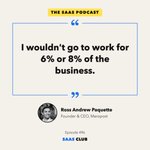
3 years after taking their money, he wrote a $37 million check to buy his investors back out.
Ross Andrew Paquette never needed the money. Maropost was growing without it. So when I asked him why he paid that much to undo the deal, I expected a numbers answer.
But that's not how he thinks about it. Running a company takes so much out of you that, in his words, even owning all of it "sometimes doesn't feel enough". So he made sure he owned a stake worth the effort.
He's at $50M in ARR now and still owns most of the company.
This is from my interview with Ross on The SaaS Podcast.
P.S. I share founder lessons like this every week in the newsletter. Link in my profile.


2 customers were paying him $10,000 a month. And the product kept falling over.
@RossAndrew started @Maropost from his apartment in 2011. The plan was 10 customers at $50K a year. No funding, no real team, just a part-time developer who kept disappearing for days at a time.
And Ross was the entire support team. He'd sold those customers "24 hour live chat which is basically just me" and a 5 minute response time.
So flying anywhere terrified him. He'd sit on the runway holding his phone up for signal, dreading the hours he'd be unreachable if the platform went down. Not that he could fix it from his seat. But he could answer.
And at $10,000 a month, someone always answering is most of the reason those 2 customers stayed.
That bought him time to fix the real problem. He posted the job online, and the first developer to reply rebuilt the platform in 2 or 3 weeks. That developer is Maropost's CTO today, and the business is at $50M in ARR.
Early customers don't expect a perfect product. But they do expect someone to answer.
Turning podcasts into short clips used to take real skill. Now it's a feature. The same thing is coming for SaaS.
Every month, 100+ people email me offering to turn my podcast and YouTube videos into shorts. A few years ago, that took real editing skill and hours of work.
Now tools like OpusClip can do a large chunk of it in minutes. When the barrier to entry collapses like that, the market floods.
→ More vendors
→ More cold emails
→ More price pressure
I was talking to my video editor about this recently. My take: the market splits in two.
At one end, editors use the same AI tools their clients could use and sell convenience. Send me the link, and I'll handle the rest. That can work, but you're competing on price with software and every other editor using the same tools.
At the other end, editors move upstream and become producers. It's a different job for a different client. Instead of selling clips to anyone with a podcast, they work with companies that have bigger budgets and care whether the content grows the business.
A producer doesn't wait for someone to send a link. They decide what's worth clipping and what the hook should be. They track which ideas are landing and plan what to make next. And when the client asks what all this content is doing for the business, they have an answer.
The dangerous place is the middle. That's the editor who just cuts clips, selling a task clients are starting to believe software can do for them.
Which brings me back to SaaS. If your product just does a task, the price of that task is falling. And more of your customers are wondering if they could do it themselves with an AI tool.
If a customer pointed AI at everything your product does, what would they still pay you for?
P.S. I write about this every week in the newsletter. Link in my profile.
How do you get to $100M in revenue when your buyers have never heard of you?
Rodney Robinson co-founded @TabaPay, the payment processor behind fintechs like Dave. Fintechs don't take bets on unknown vendors. They ask their bank and the card networks. As Rodney put it: "They don't know me from Adam."
So instead of chasing buyers, he made himself valuable to the people they already call. Almost every customer now arrives inbound.
The 4 takeaways:
1. Name who your market actually trusts. Write down the 3 parties your buyer would call before they'd ever call you.
2. Solve a problem for that party, not just their customers. TabaPay runs the processing its buyers' banks rely on.
3. Bring them something new. Every fintech TabaPay signs brings Visa volume it had never seen. That makes TabaPay an asset.
4. Staff for the calls, not the hunt. Rodney wants salespeople who can "speak super intelligently to inbound calls" instead of chasing cold ones.
For Rodney, it was banks and card networks. For you, it might be an agency, a platform, or the consultant your buyers already pay.
I break down one founder playbook like this every week: saasclub.io/email

ALT Founder Playbook of the Week cover: The Borrowed Trust Method. Your buyers already trust someone. It isn't you. Go make that person money.
Rodney Robinson signed a personal guarantee on his house to get @TabaPay its first sponsor bank. His wife didn't know.
A payment processor can't exist without a sponsor bank. Banks solve for risk, and a 3-person startup has no capital to park as collateral. So Rodney put up his house.
That first bank was the door. Today, TabaPay processes for banks across the country, and they send fintechs to him.
P.S. More founder lessons like this every week in the newsletter. Link in my profile.
📌 Check out the full interview here: saasclub.io/495
Key lessons we cover in the podcast:
🎯 Build what the incumbent is forbidden to build
🤝 Make the trusted party your sales channel
💰 Solve revenue before expense
🐟 Chase minnows, not whales
⚡ Reliability is the product for infrastructure
📉 Price for commoditization
