

OSINT on Middle East security, conflict & energy. Military-analytical lens. Independent. No affiliation. No advocacy. What to watch, and why.
Middle East
Joined January 2026
- Tweets3.7K
- Following473
- Followers2.2K
- Likes284
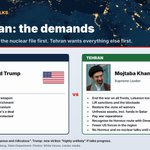







Here's where the talks actually stand, side by side.
Washington's terms are about the bomb. No nuclear weapon, a meaningful cut to enrichment and an end to 60% enriched uranium. The blockade stays in place until Iran agrees.
Tehran's terms are about everything else. It wants the war ended on every front including Lebanon, sanctions and the blockade lifted, frozen money released, war reparations paid, its own shipping route through Hormuz recognised, and fewer US forces in the region. Until then, it says, Hormuz stays shut and there are no nuclear talks.
Each side wants its priority dealt with first, and neither is offering to go second. Rubio called Tehran's terms "outrageous and ridiculous". Trump says more strikes are unlikely if talks progress.
That gap is what Qatar's Prime Minister was carrying into the White House today.

636
Evening update, Mon 9 Nov. The oil market is pricing a deal that Washington's own top diplomat says isn't close. Brent is down to around $95 as Qatar's prime minister takes Iran's two-day offer into the White House tonight. I think the market's running ahead of the politics, and Lebanon is still the sticking point.
Washington. Sheikh Mohammed bin Abdulrahman Al Thani meets Trump at the White House today, reportedly asking for more time for diplomacy. The reported outline is Hormuz reopening in return for the blockade being lifted and about $8bn of frozen Iranian funds released. Neither government has confirmed the terms. Rubio, on his way to the G7 in Paris, called some of Iran's demands "outrageous and ridiculous" and said they're not on the verge of a breakthrough. Trump says he sees no reason to escalate.
Tehran. Iran's foreign ministry calls the two-day proposal a "sign of goodwill", and says IAEA inspectors visited Bushehr. If that's confirmed, it's the sort of step the bridge deal needs. But Araghchi still ties everything to an end to the war "on all fronts". That means Lebanon, and it's the condition that has stalled every round since June.
Hormuz. Iranian state TV claims four tankers were "halted" in the strait over the past 24 hours. No ships named, nothing independent yet.
Oil. Brent's down about 3.5% today after its steepest weekly fall since the start of Covid. Traders are pricing restraint, not a reopened strait. The timing of Trump’s 60 Minutes piece helped.
Israel. Herzog has handed the mandate to Gadi Eisenkot, with 67 MKs recommending him. Trump calls him and Netanyahu "very similar" on policy. I wouldn't expect Israel's Iran line to shift much whoever ends up in the chair.
Abu Dhabi. The US–Russia–Ukraine talks go ahead tomorrow and Wednesday as planned. Ukraine's delegation is on its way, and Moscow confirms Medinsky leads.
Overnight, watch for any readout from the White House meeting, and whether anyone outside Tehran confirms the IAEA visit.

Three US carrier strike groups are about to share the same waters. The Bush has been out since March, the George Washington arrived in August, and the Roosevelt left Singapore on Saturday heading west. At normal transit speed she should reach the Arabian Sea around 15 or 16 November.
Three carriers is the headline, but they don't sail alone. Each carrier brings its own escorts. Across the three groups that's at least eight cruisers and destroyers are named with the carrier groups, and independent trackers count 13 destroyers and a cruiser across the region. There's usually an attack submarine with each group too, which the Navy never announces. Behind them are the oilers and supply ships that keep the fuel, food and missiles coming. That's likely close to 20 US ships working from the Arabian Sea. The warships that used to be based in Bahrain moved out before the war started, so this is quite a large part of the US Navy in the region.
On paper the Roosevelt is coming to relieve the George Washington. The Bush is past 220 days at sea and can't stay forever. So this looks like a short overlap rather than a long build-up.
My read is that the short overlap is the point. For a few weeks the US can put three air wings and around 200 aircraft into one theatre, with the escorts carrying room for around 800 missiles between them, from Tomahawks for targets ashore to interceptors for air defence. There have been at least two carriers here since the war began in February, and three once already, in April. That's the kind of mass a sustained campaign needs, and it won't be there in the new year. With three on hand again and the clock running on the Bush, they'd be mad not to make use of it.
None of that means the decision has been made. But if Washington wants its threats taken seriously in Tehran, the next few weeks are when they'll carry the most weight.

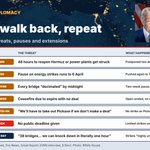
Yesterday Trump said a deal with Iran was close and new strikes were "highly unlikely". In the same interview he said the US has 38 bridges in its sights that it could "knock down in literally one hour".
That push and pull has been the pattern all year. In March Iran got 48 hours to reopen Hormuz or see its power plants struck. The deadline was paused, moved twice, then swapped for a two-week ceasefire hours before it ran out. In April the ceasefire was extended with no end date. In July it was Pickaxe Mountain: "We'll have to take out Pickaxe if we don't make a deal." No strike followed.
The threats aren't always empty. In June last year Trump gave Iran two weeks and struck two days later. Qeshm has been struck twice this month.
But seen from Tehran, the lesson of this year is that most deadlines slide. That makes waiting a sensible strategy. Talks become a way to buy time rather than close a deal, and each new threat carries a bit less weight than the one before.
A deal needs either a deadline Tehran believes or an offer it can sell at home. Without one of those, expect more rounds of talks with more threats in between.

President Herzog has handed Gadi Eisenkot the mandate to form Israel's next government. 67 MKs backed him, 46 backed Netanyahu.
If you're trying to work out whether he's a hawk or a dove, start with his record. He commanded the Golani Brigade, then Northern Command after the 2006 Lebanon war. As army chief from 2015 to 2019 he ran the "campaign between the wars", years of Israeli strikes on Iranian forces and weapons shipments in Syria. Before he left the post he said publicly that Israel had struck thousands of targets.
He also wrote the Dahiya doctrine. Villages used to launch rockets at Israel would face disproportionate force. It came out of the fight with Hezbollah and still shapes how Israel plans for Lebanon.
The war is personal for him. His son Gal, 25, was killed fighting Hamas in northern Gaza in December 2023, while Eisenkot sat in the war cabinet. His nephew was killed the next day.
So he isn't soft on Iran's partners. Where he parts company with Netanyahu is a direct war with Iran itself. He has said a strike is only justified if Tehran moves toward a bomb, and that regime change has to come from inside Iran. He's also said Netanyahu "is not fit to carry out another operation".
The numbers are tight. He has 28 days, with a possible 14-day extension. He needs 61 seats and his bloc holds 48, which leaves the religious parties holding the key.
If he can't get there, Israel goes to an election with Netanyahu staying on as caretaker.
For those of us living in the Gulf, that's the part to watch. Eisenkot knows what Israel can and can't sustain. He's seen how many interceptors a long fight eats, how long reservists can be kept away from their jobs and families, and how much depends on Washington staying on side. That makes him a hard sell on a war with Iran that has no clear end. A caretaker heading into an election might be quicker to act.

Morning update, Mon 9 Nov. The new moon lands today, the night US officials reportedly flagged as best for a restart, and Trump has just called more strikes "highly unlikely". I believe the direction, not the guarantee. He tied it to Iran signing "a very strong agreement", and Tehran's answer is still its own two-day plan.
Washington. Trump told CNN on Sunday "it depends on whether or not they sign a very strong agreement" and that he thinks it "will not be necessary". In the same interview he claimed the US could take out 38 bridges in an hour. Pressure and offer together has been the pattern all month. Rubio is in Paris for the G7 foreign ministers today and tomorrow.
Tehran. Araghchi answered on X that Iran's "2-day proposal stands", with an end to the war "on all fronts" as a requirement, and warned Iran would "rain down hell" if Washington chose war. "All fronts" means Lebanon. That's the condition I'd expect to slow any text coming out of Doha.
Hormuz. UKMTO logged late reports of two incidents on Saturday: a tanker on fire about 8 nm northwest of Khasab with its crew evacuated, and another struck by an unknown projectile outbound through the strait, crew safe. The IRGC claims two tankers struck mines on "unauthorised routes". Projectile or mine, nobody has shown either yet. The same day CENTCOM says US forces disabled the bulker Huda in the Gulf of Oman for trying to run the blockade. Both sides are tightening the water while the talking goes on.
Israel. Herzog handed Gadi Eisenkot the mandate on Sunday after 67 incoming MKs backed him. He has up to six weeks, and Netanyahu hasn't signalled he'll step aside. Netanyahu stays in charge as caretaker while that plays out, so Israel's hand on Iran doesn't change this month.
Saudi Arabia. The coalition says it intercepted Houthi ballistic and cruise missiles aimed at Riyadh on Sunday morning. Reuters reports a tower in the King Abdullah Financial District was damaged, origin not yet identified.
US, Russian and Ukrainian delegations are due in Abu Dhabi tomorrow and Wednesday as planned, with Moscow sending a stronger team than last time.
Today I'm watching two things: whether anything moves under tonight's dark sky, and whether Doha gets a written reply from either side before Rubio leaves Paris.

The third carrier is on its way. USS Theodore Roosevelt pulled into Singapore late on 5 November with the cruiser USS Chosin and the destroyers Paul Hamilton and Decatur, its last stop after the Keen Sword exercise off Japan. Trackers have it leaving on 8 November.
From Singapore to the Arabian Sea is about 2,750 nautical miles. At a normal transit speed of 16 to 18 knots, it's through the Six-Degree Channel around 10 November, south of Sri Lanka around the 12th and in the Arabian Sea around 15 to 16 November. That's when I'd count it as ready to fly missions.
For a while there'll be three carriers in theatre: Roosevelt, George H.W. Bush and George Washington. That last happened in April. Don't expect it to last long. When George Washington relieved Abraham Lincoln in August, the overlap was a matter of days. Washington arrived around 20 August, and by the 22nd Lincoln was already out in the Pacific, 266 days into its deployment.
The Bush is the one I'd expect to go home. It left Norfolk on 31 March and is past 220 days. George Washington, based in Japan, is at about 170.
The Navy will be watching the Bush's numbers closely. The modern record belongs to the Gerald R. Ford: 326 days, which ended in May. That beat Lincoln's 295 days from 2019 to 2020. For the Bush to match Lincoln's old mark it would have to stay out until 20 January, and to match the Ford, 20 February.
Nobody wants that. Long deployments wear out ships and people. The Ford had a fire in March that wrecked around 100 berths and sent it to Croatia for repairs, on top of long-running trouble with its toilet system. Every extra month at sea pushes back maintenance, and nearly half the Navy's 11 carriers are already in the yards. Lincoln's crew dealt with food and water shortages, delayed mail and very few port visits, and the Navy faced questions about sailors' mental health.
Then there's Christmas. A second record-breaking deployment in a year, with families waiting in Norfolk over the holidays, is exactly the story the Navy will want to avoid. The transit home takes about three weeks. If the Bush leaves the region in early December, it's home around Christmas at roughly 265 days.
So the window to watch is the overlap. Three carriers for a week or two is the strongest hand Washington will hold, and it won't hold it for long.

Evening update, Sun 8 Nov. Both sides are tightening the screws while Qatar says a deal is closer than it looks. UKMTO logged two tankers in trouble at the mouth of Hormuz within an hour last night, and this morning a Houthi attack on Riyadh damaged an Aramco office building. I think both are squeezing for terms before anyone signs.
Hormuz. UKMTO put out two late reports today for last night. At 23:20 Gulf time a tanker caught fire 8 nm northwest of Khasab and its crew were taken off. An hour later another tanker was struck by an unknown projectile while heading out through the strait. Its crew are safe and no spill has been reported. UKMTO filed the Khasab fire as suspicious activity, not an attack, so nobody has established what started it. The IRGC claims three "non-compliant" tankers exploded and caught fire, and it still hasn't named one. If two of those three are the ships UKMTO logged, that's the closest Iran's claims have come to the record in weeks.
Riyadh. The Houthis attacked Riyadh this morning. Saudi Arabia's energy ministry says falling shrapnel caused minor damage to an Aramco office building, with no injuries. Images from the financial district show windows blown out across several floors of the Aramco Tower, which fits what a Reuters witness described. A photo can't tell you whether that was a large piece of an intercepted missile or something more, and I wouldn't call it from one. The coalition says it intercepted ballistic and cruise missiles aimed at Riyadh, the Eastern Province and the south. The Houthis claim six operations, including on Aramco sites in Riyadh and Khurais. A strike on the capital's business district is a step up from airports and border positions, even if the damage was limited. The Houthis also claim coalition air strikes near Sanaa killed 33 people yesterday. That's their figure and nobody has verified it.
Washington. CENTCOM has set up Task Force Iron Gate to go after Iran's land routes and the Caspian. It's about 20 people based in Tampa, so for now it reads as sanctions enforcement. I'd want to see aircraft or ships assigned to it before calling it a land blockade. CENTCOM also says a US aircraft disabled the St Kitts-flagged cargo ship Huda in the Gulf of Oman after it left an Iranian port. At the same time Qatar's PM says there's been "significant progress" and Washington still wants a deal after the midterms.
Israel. Herzog has tasked Gadi Eisenkot, not Netanyahu, with forming a government. He has 28 days, to about 6 Dec, and he's ruled out the Arab-led parties, so his road to 61 is narrow. Netanyahu stays on as caretaker, and that's who'd be at the table for any Iran decision this month.
Markets. Brent settled at $98.32 on Friday after its steepest weekly fall in years on deal hopes. Monday's open is the first test of whether this weekend's tanker fires and the attack on Aramco's Riyadh office change that.
The US–Russia–Ukraine talks in Abu Dhabi are still set for Tuesday, and Kyiv has named its delegation.
New moon is tomorrow.
Overnight I'm watching for a vessel name behind the IRGC's claim and for anything from Doha with a date on it. I still haven’t ruled strikes before the markets open on Monday in the US.

16
3,811
Was Qeshm the start, or a one-off? Late on Friday the US struck Iranian air defences on Qeshm Island, and Trump called it "limited". The difference between a single strike and the opening of a campaign shows up in public, and you can check most of it yourself.
Scale. A limited strike is one night and a site or two. A campaign is several nights and a long target list.
Airspace. After a limited strike Iran might close its skies for a few hours. A campaign brings notices piling up across the region.
The skies. Watch the tankers. A campaign needs fuel in the air, and the tankers and cargo jets moving east show up on public trackers.
Washington. "We are talking to Iran" is limited-strike language. A campaign gets CENTCOM briefings and a named operation.
Embassies. Security alerts, like the one State issued on Saturday, are a step. Ordered departures are the step that matters.
Iran. After a limited strike, Iran claims and then waits. After the opening of a campaign, it launches.
On what's public so far, this sits in the left-hand column. The US says its strikes are limited, Washington says it's still talking, and the pressure is going economic: on Saturday CENTCOM set up a task force to go after Iran's land and Caspian supply routes. If two or three of these signals flip to the right, it's a different story.

Morning update, Sun 8 Nov. Washington is squeezing Iran harder while Qatar tries to sell a two-day bridge deal, and I think the squeeze is meant to shape what Tehran says to Doha. On Saturday a US aircraft disabled a cargo ship in the Gulf of Oman that CENTCOM says tried to run the blockade.
Gulf of Oman. CENTCOM says the St Kitts-flagged ship had called at an Iranian port, ignored repeated warnings and tried to break the blockade more than once. The crew were told to clear the targeted spaces before an aircraft put precision munitions into the stern. No casualties reported. That's a step up from turning ships back. UKMTO separately logged an incident involving "military forces" and a bulk carrier in the Gulf of Oman the same day. I'd expect it's the same event, though nobody has said so.
Iron Gate. CENTCOM's commander, Adm. Brad Cooper, set up Task Force Iron Gate on 7 Nov: about 20 people in Tampa working with other agencies to stop Iran moving weapons and sanctioned goods overland and across the Caspian. It's small, and it's sanctions enforcement with a military badge. It also tells Tehran the blockade won't be traded away cheaply. CENTCOM says the blockade has kept more than $25bn of Iranian crude off the market.
Doha. The Qatari bridge deal is still the only text on the table. Reuters reports day one would see the blockade lifted, some frozen funds released and IAEA inspectors let into bombed sites, with Hormuz reopening on day two and uranium talks after that. Iran is reviewing it, but officials say nuclear talks wait until its core conditions are met. Trump on Friday: "We are talking to Iran. We have been." That came hours after US strikes on Iranian air defences near Qeshm, which he called "minor".
Hormuz. The IRGC claims two more tankers were set alight on Friday, again with no ship named. The confirmed record is bad enough. A seafarer was killed aboard the Velos Sapphire on Thursday, according to her owner. Oil traders are betting on a deal anyway: Brent settled at $98.32 on Friday, down about 16% on the week.
Israel. Herzog has picked Gadi Eisenkot, not Netanyahu, to try to form a government, with the formal mandate expected today. He gets 28 days, extendable by 14. Netanyahu is calling for a national unity government. I think a month of coalition-building in Jerusalem leaves the Iran decision even more firmly in Washington's hands.
Abu Dhabi. The US–Russia–Ukraine talks are still set for Tuesday and Wednesday. Moscow has named an expanded delegation under Medinsky, and Kyiv says Umerov leads for Ukraine.
My call: if Iran's reply to Doha hasn't leaked by Wednesday, the pressure stays at sea and on the borders rather than in the air. More ships disabled, more designations.
Watching today: Eisenkot's mandate, and whether Tehran answers Iron Gate at sea or through Doha.

This morning the State Department told Americans across the Middle East to be extra vigilant. For any company with staff here, that's the kind of change that moves it up a ladder most people never see.
Most assume companies decide on the night whether to pull staff out. In a well-run organisation that decision was made months earlier.
The ladder runs like this. Monitor, where it's business as usual with the security team watching closely. Restrict, where non-essential travel in and out stops. Stand fast, sometimes called hibernation, where staff stay home or at a secure site with a week of supplies, cash and a daily check-in. Relocate, which means moving to a safer site, usually inside the same country. Evacuate. That's the last resort because it's expensive and very hard to undo.
What moves a company up the ladder is a set of triggers agreed in advance, while everyone is calm. The usual ones are a government changing its travel advice, airspace closing, fighting spreading into an agreed area, or infrastructure failing. Setting them early matters because fear distorts judgement on the night.
Then it's logistics. Once airspace closes, commercial seats disappear within days and charters get scarce and expensive. In March, International SOS reported demand twelve times its normal level, the most it had seen in 40 years. Overland routes to an airport in a neighbouring country become the way out, which only works if staff hold the right visas. Insurance needs checking before anyone needs it.
Good plans let people leave early if their own sense of risk is exceeded. They plan for local staff and families as well as expats. And they don't count on an embassy evacuation, especially for staff who aren't that embassy's citizens.
The hardest part is timing. The right moment to move is usually while commercial flights are still running.

Evening update, Sat 7 Nov. The US has taken its blockade of Iran onto land. CENTCOM's new Task Force Iron Gate will go after weapons, dual-use kit and cash moving across Iran's land borders and the Caspian. Add last night's "minor" strike on Qeshm and the pressure is clearly rising while the talks carry on. So far Tehran has answered with phone calls.
CENTCOM. Adm. Cooper says the task force will "further constrain Iran's ability to finance terrorism, rebuild weapons factories, and replenish their military." It's based in Tampa and works with other US agencies, so for now it's a coordination cell rather than troops on a border. The blockade at sea has been about oil. This one goes after the overland routes Iran would use to rearm, and I think that matters more for what a ceasefire looks like than anything that happened at Qeshm.
Qeshm. Iranian state media reported two explosions in the Suza area. Trump says the US took out "a little bit of an anti-aircraft device" in "about 15 minutes, maybe five." CENTCOM has said nothing on the strike and no casualties have been reported. Iran claims it shot down a US drone over the island on Friday, which Washington hasn't confirmed.
Isfahan. Several explosions were reported around Isfahan this morning. Local TV reportedly put them down to the disposal of unexploded ordnance, something Iran has been doing there since the spring. Some witnesses said these sounded different, and there's no official statement yet. I wouldn't read anything into it until there is.
Tehran. Araghchi has spoken to 12 foreign ministers in 48 hours and is calling for regional security arrangements without outside powers. The army spokesman claims Iran's forces are on higher alert and stronger than at the start of the war. I wouldn't mistake that for calm.
Doha. Qatar has rejected reports that the talks had failed and says its mediators remain in close coordination with both sides. Trump spoke to the Emir on Friday night.
Hormuz. The IRGC claims two more tankers struck mines on Friday. No ship has been named and maritime authorities haven't confirmed it. UKMTO did log an explosion at a tanker's waterline 16 nm east of Khasab (crew safe). The manager of the tanker attacked north of Qatar on Thursday has confirmed that a seafarer was killed.
Saudi Arabia. The coalition says it intercepted a Houthi cruise missile aimed at the Riyadh region today. That followed two ballistic missiles towards Najran and drones over the Makkah and Riyadh regions on Friday. No casualties reported.
Israel. Eisenkot has 67 recommendations to Netanyahu's 46. Herzog names his candidate tomorrow.
Elsewhere. The US–Russia–Ukraine talks in Abu Dhabi are still on for Monday. Umerov leads Kyiv's delegation and Medinsky leads Moscow's.
Tonight I'm watching whether Tehran answers Iron Gate in its own name. A blockade on land is harder for it to shrug off than one strike on an island.
I am off to a black tie ball. Still expect something to happen this evening. Life continues as normal, until it’s not.

If strikes on Iran start, the first hour will be chaos online. This is the order things usually show up, and how much weight to give each.
Videos of blasts in Iranian cities. Some real, some recycled from earlier rounds. X blows up. Hold off.
Washington or Israel confirms. From here it’s real.
Shelter alerts. Israel’s Home Front Command switches to emergency rules and embassies across the region message their citizens.
Airspace shuts and airliners scatter on the trackers. Iraq already has a daytime military restriction running 7 to 11 Nov.
Iran’s internet drops. NetBlocks and Cloudflare Radar usually catch it within minutes.
Iran answers. An IRGC statement first, launches after, or vice versa.
The proxies. Whether the Houthis, Iraqi militias and Hezbollah join in, and how fast, tells you how wide this gets.
Hormuz. On ship trackers, tankers slow, anchor up or turn back. Oil reacts when markets open.

The government warnings have started.
teapaw.org/travelgov/status/21188…

Governments warn their own people before they warn anyone else. That makes travel advisories one of the best public tells there is.
The US has already reached the top step once this month. On 21 October it ordered non-emergency staff and families out of Saudi Arabia, citing Houthi attacks, and said the order covered Saudi Arabia only. Russia has been advising its citizens against travel to Iran for most of the year.
So watch for the next move: the US extending ordered departures to other countries in the region, or the UK, France, Germany, Russia or China doing the same. In June 2025 the US moved staff out of Baghdad a day or two before Israel struck Iran.
If two or three of them move in the same week, someone knows something.
It has started as anticipated. Expect the language to tighten over the coming days.
teapaw.org/travelgov/status/21188…

Middle East: Americans currently in the Middle East should exercise heightened vigilance due to the increased threat of armed attacks by Iranian-supported Houthis and Iranian efforts to target U.S. government officials in the region. Be aware of potential flight cancellations, airspace closures, and travel disruptions. Read the latest country-specific alerts at travel.state.gov/en/internat…

ALT Security Alert Middle East. Sign up for alerts: step.state.gov
623
Morning update, Sat 7 Nov. Trump has confirmed the US struck Qeshm again, calling them "minor strikes" on an Iranian air-defence site. Claims online that the talks have collapsed are false: Qatar says both sides are still working towards a deal. So it's strikes and talks at the same time again, with Monday the day to watch.
Qeshm. Iranian media say two missiles struck the Suza area late Friday. Trump said the US "knocked out" an anti-aircraft device in "about 15 minutes, maybe five". State TV reports no casualties. Tehran claims it shot down a US drone over the island, though its own outlets can't agree whether it was an MQ-1 or an MQ-9. Like this week's earlier strikes on Qeshm, this was small and local. I don't read it as the start of a campaign.
Doha. Posts claiming Qatar's prime minister had declared the talks dead spread fast overnight. Qatar's media office says his remarks were "deliberately distorted" and that he'd said "both sides are continuing to work towards a deal". That's the record, and I'd trust it over a screenshot. Iran is still reviewing Qatar's proposals, but says it won't discuss the nuclear file until its conditions are met. Trump says "we've made a lot of progress".
Washington. Stephen Miller takes over from Susie Wiles as White House chief of staff on Monday. He's one of Trump's closest loyalists, and he made his name on immigration, not Iran. I'd read the change as Trump keeping his course after Tuesday's midterms. The Iran decision still sits with Trump and his national security team. Monday is also the date Fox News reports the military favours for renewed strikes, citing the new moon. That's one outlet citing unnamed officials, so I'm treating it carefully.
Hormuz. UKMTO logged a tanker reporting an explosion at the waterline 16nm east of Khasab on Friday. The crew is safe and the ship is still under way. Velos Tankers says a seafarer has died after Thursday's explosion aboard the Velos Sapphire.
Abu Dhabi. Putin confirmed on Friday that the US–Russia–Ukraine talks go ahead on Tuesday.
What to watch. Today I'm watching for an Iranian response to Qeshm. So far Tehran has only claimed a drone shot down. If it hits back, I'd expect it at sea first, with another tanker incident near the strait. I'm also watching whether Iran's answer on the Qatar proposals reaches Doha before Monday, when Miller starts as chief of staff and the new moon arrives. If Monday comes and there's no reply, I'd take the reported strike date more seriously.

If you’re watching the region on a flight tracker this weekend, some of what you see won’t be real. GPS jamming and spoofing are constant here, and they leave three fingerprints. All three on the card are real captures.
The jump. A plane suddenly shows up somewhere it can’t be. Here, a flight to Tel Aviv is plotted as if it’s heading for Beirut. Around Israel, Beirut airport is where most spoofed positions land.
The circle. Ships plotted in a neat ring, sometimes on dry land. This one shows vessels circling over a gas plant on Iran’s coast near Asaluyeh.
The dashed line. When a plane’s GPS signal is jammed, Flightradar24 falls back on MLAT, working out the position from ground receivers, and the track changes. This one’s over the Black Sea, which shows how far the interference reaches.
None of that is news on its own. What to watch is change: interference switching on somewhere that’s normally quiet, or spiking where it’s usually steady. Flightradar24’s GPS jamming map and gpsjam.org show it day by day.

2
30
5,355