

Crypto media, born on socials. Telling stories that shape crypto and covering projects that make a difference.
Joined November 2021
- Tweets39K
- Following1.6K
- Followers82.6K
- Likes56.4K






Pinned Tweet
We started small. A community space for crypto people
Looking for credible info, connection, and a voice.
Today, that idea has grown into Our Crypto Talk (OCT)
The first media house born on socials. 🧵👇
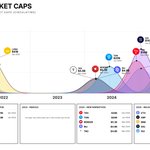
Utility token all-time high market caps, 2021 to 2026 📊
2021: First utility wave
ADA $95B
DOT $54B
AVAX $32B
UNI $23B
LINK $23B
MATIC $21B
2022: Last highs, then collapse
LUNA $41B (then went to near zero)
NEAR $13B
2023: Rebuild
No large-cap utility token set a new record
2024: New narratives
TRX $38B
TON $20B
RENDER $5.3B
INJ $4.9B
TAO $4.8B
2025: Majors set records
ETH $597B
XRP $216B
BNB $191B
SOL $142B
SUI $16B
2026 so far: Revenue and privacy
ZEC $26B
HYPE $22B
XMR $15B

Why @hyrotrader_com builds on trust 🤝
Most prop firms ask you to trust them on payouts. A screenshot here, a certificate there, a testimonial or two. @hyrotrader_com took a different route: it lets you check.
Its public transparency dashboard lays out the numbers:
→ $9.13M paid to traders since 2023
→ ~$515K paid in the last 30 days
→ Average payout around $1,586
→ 99.8% of payout requests approved
The bigger shift came in April 2026. Payouts on Solana (USDT/USDC) now go fully on-chain through Fireblocks, and $1.38M has already moved this way. Every one of those payouts carries a public TXID you can look up on Solscan yourself.
The payout wallet address is published too, so anyone can audit the flow independently. Traders who prefer privacy can hide their name and TXID from the dashboard.
Speed holds up as well. Average time from payout request to on-chain confirmation is about 15 hours, 99.1% of on-chain payouts land within 24 hours, and there are no withdrawal fees.
The one question traders care about most, “do they actually pay?”, it has replaced promises with proof anyone can verify.
That’s what trust should look like in this industry.
hyrotrader.com/transparency
Go and check out hyrotrader using the link in the first comment 👇


Our Crypto Talk retweeted
How far off the bottom vs how far from the ATH 👇
$PUMP +298% from low, 1.85x to ATH
$NEAR +418%, 4.1x
$AERO +185%, 2.7x
$INJ +235%, 5.72x
$ONDO +87%, 4.71x
$SUI +58%, 5.19x
$ALGO +47%, 31x
$TEL +6%, 44x
$PUMP is closest to home. $TEL hasn’t left the floor.
Which one closes the gap first?

Whichever machines win, they all need centimeter accuracy outdoors.
That gap is a product, and @GEODNET sells the fix.
A spray drone, tractor or delivery robot pays for RTK corrections to get centimeter accuracy, and GEODNET collects that revenue in fiat.
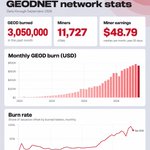
80% of that revenue buys $GEOD on the open market and burns it, so demand for positioning becomes buying pressure.
The chain is already working. GEOD burned 3,050,000 tokens in the past month, and the burn now offsets around 80% of new issuance.
We think this is the most overlooked part of the robotics boom.
People talk about the humanoid, the chip and the model, and very few talk about positioning.
Specialized machines pay first and humanoids add to the demand later, and each new machine is one more subscription feeding the burn.
GEODNET already runs the largest RTK network in the world, built by operators who paid for the hardware themselves.
A network like that takes years to place.
We are extremely bullish on $GEOD, because it is tied directly to demand for positioning in physical AI.
We think the market still prices it like a small project.


Always fun listening to Mike Horton, founder of @GEODNET .
Interesting take on humanoids versus specialized machines here and I agree. imho we'll see a mix, with specialized machines paying back first.
Whatever form they take, they all need to know exactly where they are and regular GPS is not good enough outdoors, since it can be off by a few meters.
GEODNET runs the world's largest RTK network, with centimeter-level precision, 22K+ base stations in 175 countries.
That is what the rails for physical AI look like🦾
President Trump to announce crackdown on crypto scams targeting Americans.
Which altcoins help the crackdown?
Proof of personhood :
$WLD $H $GTC $ENS $ID
Onchain tracing :
$ARKM $HAPI $FORTA $LINK
Stablecoin freezes :
$USDT $USDC $TRX $XLM
AI detection :
$TAO $FET $GRT
Now the detail on each layer.
👉 Proof of personhood
Most of these scams begin with a stranger on social media or a dating app, so the first fix is knowing a real person sits behind the account.
WLD and H verify humans with biometrics, GTC takes a non-biometric route, and ENS and ID add onchain identity.
👉 Onchain tracing
Scam money gets split across wallets within hours, which is why seizures cover only a fraction of the losses.
ARKM and HAPI flag suspicious addresses early, FORTA monitors onchain activity for threats, and LINK supplies data feeds that compliance tools lean on.
👉 Stablecoin freezes
Proceeds are widely reported to move through stablecoins, and issuers can freeze addresses, which is how much of that $900M gets restrained.
The faster agencies and issuers coordinate, the more can be stopped before it leaves. USDT and USDC are the stablecoins in play, while TRX and XLM are chains they often run on.
👉 AI detection
Deepfakes and voice clones make fraud cheaper to run, so detection tools may need to run on open AI networks.
TAO and FET provide decentralized AI compute and agents, while GRT indexes the onchain data those tools would read.
Takedowns of fake websites are the headline, but identity, tracing, stablecoin controls and AI detection will decide whether losses actually fall.
My view is that proof of personhood has the most upside here, because it targets the first contact most of these scams depend on.
Which other Altcoins could help here?

$INJ | @injective : The Base, Bear And Bull Case
➠ Exchange fees across Injective go into a monthly Community BuyBack. INJ committed to it gets burned permanently, and participants get a share of ecosystem revenue.
➠ So the price question becomes a volume question. More trading means bigger buybacks, more INJ burned, and a higher valuation. We ran the math for three cases.
✦ Where INJ stands today
Price: ~$8.62.
Market cap: ~$863M.
Fully circulating, so market cap and FDV are the same number. No unlock overhang.
The trading engine:
➠ ~$1.75B a month in exchange volume, about 92% of it perps
➠ RWA perps passed $1.1B in volume this year, with $230M+ in the last month alone
➠ 135 live RWA markets: equities, commodities, FX and pre-IPO names like SpaceX
➠ ~$241K a month in fees routed to buyback and burn. October’s pool opened at $247K.
Supply side: 7.2M+ INJ burned since late 2025, including the 6.78M INJ ($32M) burn that kicked off the program. ~58M INJ staked, close to an all-time high.
Put together, INJ holders capture roughly $2.9M a year through burns today. The market values that at $863M, around 294x.
✦ The framework
We’re not inventing a multiple. We’re taking the one the market already pays for INJ and asking a simple question: what happens to price if volume goes up?
✦ Bear case: ~$11.94 (+39%)
➠ Exchange volume grows to $2.5B/month
➠ Take rate stays around 1.4 bps
➠ Buyback revenue: ~$4.2M/year
➠ Implied valuation: ~$1.24B
That’s 1.4x today’s volume. RWA perps alone are already growing faster than that.
✦ Base case: ~$20.47 (+137%)
➠ Volume reaches $4B/month as RWA perps and the new USDC route bring in fresh flow
➠ Take rate edges up to 1.5 bps
➠ Buyback revenue: ~$7.2M/year
➠ Implied valuation: ~$2.12B
Weekly transactions already doubled from the mid-2026 low to ~14.5M. Getting volume to roughly 2.3x isn’t heroic.
✦ Bull case: ~$61.42 (+613%)
➠ Injective becomes a go-to venue for onchain stocks and pre-IPO perps: $10B/month
➠ Take rate reaches 1.8 bps
➠ Buyback revenue: ~$21.6M/year
➠ Implied valuation: ~$6.35B
This is the “RWA perps go mainstream” scenario. Ambitious, but every input is a number you can track every month.
✦ What more is there?
➠ Inflation still beats the burn. Staking mints ~3.67% a year, about 3.7M INJ or ~$32M at today’s price. Today’s burns remove only ~0.34M INJ a year, roughly a tenth of that. Because the burned amount is fixed in dollars, a higher INJ price means fewer tokens burned. So INJ is not net deflationary in any of these cases unless the multiple expands too.
➠ 294x is a rich multiple for $2.9M of revenue. These targets assume the market keeps paying it. Treat the bull number as the ceiling of this framework, not a promise.
➠ Some of the recent move is ETF positioning, not fundamentals. Three US INJ ETF filings landed on Oct 8. None are approved.
➠ TVL is small at ~$14M. The thesis depends on trading volume, not locked capital.
Do you think onchain RWA trading is about to shrink, or grow 2x to 6x from here?
Not financial advice.

Be the first 1000 in. Founding members only. 🏆
t.me/ourcryptotalk_tg


Be the first 1000 in. Founding members only. 🏆
t.me/ourcryptotalk_tg
Our Crypto Talk retweeted

I know I’ve been quiet lately. I spend most of my days working behind the scenes and apparently, I’m better at keeping everyone else busy than keeping my own X updated 😁
As many of you know however, I’ve always been drawn to projects that give people a reason to use their product or technology, and I think I’ve found the next gem.
Every generated image. Every chatbot response. Every AI feature running inside an app. Somewhere, hardware had to do that work… and someone had to pay for it.
@crynuxio has built a different way to supply that computing power: a decentralized network of independently operated GPUs.
It starts with hardware people already own. A graphics card in a gaming PC that can also be used to run AI models. Crynux lets operators connect that hardware to a network and subsequently complete AI tasks and earn $CNX.
Developers get access to computing power for their applications. Hardware owners get a way to earn from capacity that otherwise sits unused.
Think about that connection: someone’s computer can help power an application used by someone on the other side of the world, with the network coordinating the work and payments.
But connecting computers is only half the problem. How can we trust that someone actually did the work correctly?
Crynux uses vssML, a verification system built around secret spot checks. Roughly 10% of tasks are selected for other nodes to repeat and cross-check. Operators cannot predict which tasks will be checked, and dishonest results put their staked CNX at risk.
That gives the network a way to check the work without paying to repeat every single task multiple times.
The video below shows what this looks like in practice.
This is Crynux Chat, an AI assistant powered by the Crynux network.
Choose an open AI model and start a conversation. Ask it to explain something, help with code, or work through an idea.
In the demo, someone asks for a blue origami fox and gets a generated image back. They also upload a photo and ask the AI to describe it and write an Instagram caption.
Those requests are processed by independently operated GPU nodes on the network.
Crynux Chat is one example of what developers can build using that computing power. The broader network supports other work such as:
• Running AI models for chatbots and assistants.
• Writing, summarizing, translating, and answering questions.
• Generating, explaining, and debugging code.
• Creating images and editing existing images.
• Fine-tuning models for particular tasks or styles.
• Training LoRA adapters to customize models.
Image understanding is also demonstrated in Crynux Chat, with audio and video among the capabilities covered in the broader roadmap.
Developers with compatible AI apps can connect by changing where their app sends its requests. They can keep the familiar tools and request format they already use, while Crynux supplies the computation behind them.
And let’s not forget the part of their tokenomics that caught my attention.
71% of the maximum CNX supply is allocated to task mining, with releases tied to demand and completed work
Why does that matter?
Because that allocation doesn’t enter circulation just because another day, month, or year has passed. Its release depends on actual network usage.
From an investor’s perspective, that makes actual adoption an important part of the supply story and it means my investment won’t be diluted simply by time passing.
Crynux launched its mainnet in June 2026, following a testnet that recorded 1,785 nodes and 55 million completed tasks.
What gets my attention is the problem Crynux is solving: developers need reliable, cost-efficient computation, GPU owners can supply it, and Crynux gives them a way to make that happen.
Check out the video yourself.
That GPU sitting idle could help someone get their next big idea off the ground.
$ETH WAS ABOUT TO BOUNCE
But the Drift Protocol exploiter has a different idea ❌
This potential sell pressure is BEARISH FOR ALTCOINS
The attacker sent 25,700 $ETH, about $61.56M, into Tornado Cash in batches of 100 ETH each, while still holding roughly $195M across other addresses.
That timing has altcoin holders worried that a wave of sell pressure is coming, and I understand why.
👉 What the transfers actually mean?
Depositing into Tornado Cash is about hiding the trail and making recovery harder, and it is not a sell order by itself.
The funds were already sitting in ETH, so the market impact only shows up if the attacker later swaps or cashes out, and that usually happens slowly to avoid moving price.
The bigger overhang is the $195M still sitting elsewhere, since any of it can start moving the same way.
👉 Where the chart stands right now
On the weekly, ETH is retesting the $2,300 to $2,450 zone, which was resistance for most of the year and is now trying to act as support.
A weekly close that holds above this zone keeps the bullish structure intact and opens the way back toward the $2,800 highs.
A close back below it would turn this into a failed breakout, and that is the level I would watch more closely than the headline itself.
Headlines like this create fear fast, but price only reacts if the coins actually reach the market, so I would track on-chain flows before reacting to the story.


One To Watch: $CNX | @crynuxio
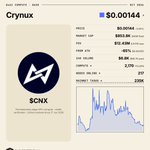
An $853K market cap DeAI compute network with 217 live nodes and 2,170 TFLOPS online.
Down 65% from ATH. Huge opportunity.
The supply design is unlike most DePIN plays.
We broke it down 👇
✦ What it is
Permissionless edge compute. Consumer GPUs and Apple Silicon Macs run LLM inference, image gen and fine-tuning.
Verification runs on vssML: only ~10% of tasks get checked, so overhead stays low without trusted nodes.
=> Lithium mainnet live since 17 Jun 2026, with an OpenAI-compatible API for devs.
✦ The numbers
Price: $0.00144 (-3.94%)
MC: $853.8K on a 592M float
FDV: $12.43M (8.617B max supply)
24h volume: $6.8K
Mainnet tasks executed: 235K
✦ Why the tokenomics stand out
71% of supply is “task mining”: it only unlocks as real tasks get completed on the network.
20% is bootstrap mining, spread over 20 years.
No VC pre-mine.
=> Emissions scale with usage, not just the calendar. That’s rare.
✦ What to watch
Mainnet task growth, month over month
Node count stabilising or recovering
Paying apps showing up on the Bridge API
New AI image generator planned for release next
Pay attention if you are looking for a small cap AI project 👀
🤝 Paid partnership

$QUBIC lost 2.94T QU ($1.3-1.4M) from 1,404 wallets in 104 minutes.
BUT
The attacker got the tokens. They just can't use them.
Here's what happened, and why it's sparked a decentralization debate 👇
The bug wasn't in the protocol. Qubic's wallets generated seeds with Math.random(), which on Apple browsers gave roughly 32 bits of entropy. Small enough to brute-force offline.
Which the hackers did 🤷
✦ Timeline (UTC):
Oct 17, 23:42 → Attacker starts draining wallets with predictable seeds
Oct 18, 01:26 → Drain ends, 2.94T QU taken
Oct 18, early → Computors halt the entire chain at tick 85,371,949
Oct 18, early → 379B QU that reached MEXC is frozen within an hour
Oct 18, 12:29 → Qubic publishes its official incident thread
Oct 18, daytime → v4.26.4 fixes seed generation
Oct 19-20 → Chain still paused, recovery goes to a Computor vote
✦ Why the attacker can't cash out:
87.1% of the stolen QU sits on a chain where no transaction can process. The other 12.9% is in a frozen exchange account. Stolen, but stuck.
BUT
This only worked because a fixed set of validators (Computors) can stop the network and vote on what happens to funds.
Supporters say: users protected in hours, rule-based vote, same playbook as BNB Chain, Sui and Liquid.
Critics say: if validators can freeze a thief today, they can freeze anyone tomorrow. Every QU holder is locked in right now, not just the victims.
We don't know what will happen next, freezing is reversible but rewriting balances is not.
✦ Were you exposed?
Seeds made before Oct 18 on any iPhone/iPad browser or Safari on Mac, or in the Qubic iOS app before July 2025. QEARN staking was not affected.
If yes: use a wallet created on v4.26.4+, file a cybercrime report, and ignore anyone offering "recovery" in your DMs.
Nothing has been returned yet. Watch the quorum vote.

Be the first 1000 in. Founding members only. 🏆
t.me/ourcryptotalk_tg
Bookmark this for Bull Run 2027.
The tool stack you need before the next leg up, ranked by how much edge each one gives you when things start moving fast.
→ S Tier, check these daily
DeFiLlama
TradingView
Arkham
GMGN
→ A Tier, your daily research layer
Dune
Nansen
DexScreener
Polymarket
CoinGecko
→ B Tier, pulled in once you’re deep in a thesis
Token Terminal
CryptoQuant
Glassnode
DeBank
CoinGlass
RugCheck
→ C Tier, situational
Messari
LunarCrush
Kaito
Revoke Cash
Bubblemaps
→ D Tier, nice to have
Santiment
DappRadar
Galxe
Whale Alert
CryptoPanic
The ranking logic is simple.
Tools moved up based on real time utility during volatility, not feature count or brand recognition.
A tool that tells you what’s happening right now beats a tool that tells you what happened last week, every time.
Save this as you’ll need it.

$SERV Reasoning API users grew 244% in month one.
Inference requests rose 30%. But SERV sits at just ~$15M market cap.
@openservai is building a drop-in layer that helps smaller models tackle tasks handled by more expensive ones.
✤ 𝐇𝐨𝐰 𝐎𝐩𝐞𝐧𝐒𝐞𝐫𝐯 𝐦𝐚𝐤𝐞𝐬 𝐬𝐦𝐚𝐥𝐥𝐞𝐫 𝐦𝐨𝐝𝐞𝐥𝐬 𝐰𝐨𝐫𝐤 𝐡𝐚𝐫𝐝𝐞𝐫:
OpenServ builds AI agent infrastructure for enterprises and governments.
Its main product, SERV Reasoning, is an inference API that works with existing OpenAI and Anthropic SDK integrations.
Developers can switch the API base URL while keeping their existing prompts and much of their application code intact.
Under the hood, SERV Reasoning uses BRAID to structure model calls into a graph of reasoning steps. The goal is to improve accuracy while relying on cheaper models, cutting the cost of running AI agents and enterprise workloads.
The team was founded by Tim Hafner and Lucas Hafner. OpenServ says it was community-bootstrapped rather than launched through a traditional VC token round.
The project has also reported UAE government workloads through its partner Neol. AWS Marketplace is planned as an enterprise distribution channel.
✤ 𝐀𝐏𝐈 𝐮𝐬𝐞𝐫𝐬 𝐠𝐫𝐞𝐰 𝟐𝟒𝟒% 𝐢𝐧 𝐭𝐡𝐞 𝐟𝐢𝐫𝐬𝐭 𝐦𝐨𝐧𝐭𝐡:
SERV Reasoning went public in early September, and its initial usage metrics show growing interest.
New API users: +244% in the first public month
Inference requests: +30% versus the previous 30 days
Private beta, week one: 29,638 requests and 279M tokens processed
OpenServ has also published some ambitious benchmark results:
GSM8K: GPT-4o reportedly improved from 42% to 91% with BRAID, with costs reduced by up to 75x.
Scale MultiChallenge: GPT-5-nano reportedly improved from 35.66% to 57.72%, above the reported ~40% score for GPT-5 standard, at roughly 40x lower cost.
OpenServ also claims smaller models can outperform Anthropic’s Fable 5 at up to 90x lower cost.
These are project-reported benchmarks, and results can vary by task. Still, the commercial case is straightforward: if a cheaper model can deliver the quality a business needs, the savings can make a real difference at scale.
OpenServ also offers a no-code builder, a TypeScript SDK and an agent-token launchpad. SERV v3 and Graph Sharding are on the roadmap, with enterprise visibility and workflow management planned.
✤ 𝟐𝟓% 𝐨𝐟 𝐀𝐏𝐈 𝐫𝐞𝐯𝐞𝐧𝐮𝐞 𝐠𝐨𝐞𝐬 𝐭𝐨𝐰𝐚𝐫𝐝 $𝐒𝐄𝐑𝐕 𝐛𝐮𝐫𝐧𝐬:
$SERV is used as gas for on-chain agent workflows and can be staked for featured launches.
The bigger part of the token model is the commitment to use 25% of SERV Reasoning API revenue to market-buy and burn $SERV.
Developers can pay for API credits in USD or USDC, so every API call does not automatically create a direct purchase of the token. The link comes from converting a share of API revenue into buybacks.
If paid API activity grows and the revenue commitment is carried out, the amount available for buybacks can grow alongside the business.
That gives $SERV a potential connection to product usage rather than relying only on speculative demand.
✤ $𝐒𝐄𝐑𝐕 𝐯𝐞𝐫𝐬𝐮𝐬 𝐭𝐡𝐞 𝐀𝐈 𝐚𝐠𝐞𝐧𝐭 𝐬𝐞𝐜𝐭𝐨𝐫:
Virtuals Protocol ( $VIRTUAL ) sits around a $450M market cap, while Artificial Superintelligence Alliance ( $FET ) is around $481M. Both are valued far above OpenServ, which sits near $15M.
The projects target different parts of the market:
Virtuals Protocol: AI agent creation, tokenization and launchpad infrastructure.
ASI ( $FET ): Decentralized AI infrastructure and services.
OpenServ ( $SERV ): Reasoning infrastructure designed to help developers run AI workloads using cheaper models.
Autonolas ( $OLAS ): Decentralized autonomous services and AI agent infrastructure, with a market cap around $15M in the supplied comparison.
OpenServ’s closest comparison isn’t necessarily another agent launchpad. Its pitch is that developers can improve model performance and reduce inference costs through an API layer.
✤ 𝐖𝐡𝐚𝐭 𝐧𝐞𝐞𝐝𝐬 𝐭𝐨 𝐡𝐚𝐩𝐩𝐞𝐧 𝐧𝐞𝐱𝐭:
Three metrics matter most:
Paid API usage: Absolute request and token volumes, alongside evidence that users are converting into paying customers.
Enterprise distribution: Whether planned channels such as AWS Marketplace bring in recurring workloads.
Verifiable burns: Actual buyback and burn transactions, and how their value changes as API revenue grows.
Independent testing of the benchmark claims would also help establish how consistently BRAID improves results across different models and tasks.
At roughly $15M, $SERV offers exposure to an AI reasoning product that is live, showing early usage growth and has a stated revenue-linked burn mechanism. That’s a more concrete starting point than a token built entirely around future plans.


AFTER THIS BREAKOUT IN 2020 👀
$QNT moved +3500%
$AVAX moved +1500%
$BNB moved +1300%
$INJ moved +1100%
$DOT moved +700%
And now the same breakout happened in August and no one is paying attention
Yesterday, we looked at why Bitcoin could keep printing until 2029 if the 4 year cycle holds.
The next question is where altcoins fit in, and this chart answers it in an interesting way.
Altseason 2021 did not repeat itself in this cycle, but the OTHERS dominance chart says it can still happen.
👉 WHAT THE OTHERS DOMINANCE CHART SHOWS
OTHERS dominance tracks the share of total crypto market cap held by coins outside the top 10. When it rises, capital is rotating into smaller projects, and that is what altseason looks like on a chart.
It currently sits near 8.14% after bouncing off a rising trendline that has held since 2016.
👉 HOW THE 2019 SETUP COMPARES TODAY
After the 2018 bear market, dominance slid down to that same trendline in late 2019 and then rallied about 248% into early 2022.
The slide from 2024 to 2026 looks very similar, with a fresh wick into the line and a monthly recovery already building above it.
👉 WHAT A REPEAT COULD LOOK LIKE
A move of around 190%, which is what the projection on the chart measures, would take dominance back toward the 20% area.
That is a pattern based projection and not a guarantee, but it fits the idea of Bitcoin leading first and altcoins catching up later in the cycle.
If the 2027 to 2029 window plays out the way past cycles did, the rotation into altcoins would likely come after most people have stopped expecting it.
The ones who built positions while dominance sat on support will be the ones holding when the crowd arrives.

DIAMOND HANDS WILL WIN 💪
The next 3 years will make a lot of millionaires
$NEAR could hit $20
$TAO could see $2000
$SUI could reach $10
$LINK to a new ATH
$SOL to $500
But that needs patience in times like these when we need to zoom-out
👉 HOW THE CYCLE HAS PLAYED OUT SO FAR
Since 2011, every cycle has followed the same script of a painful bear year, a quiet pre-bull year, and two bull years back to back.
2022 to 2025 played it out perfectly, with Bitcoin falling under $16K and building a base through 2023.
It then broke out in 2024 and printed a fresh all-time high in 2025.
👉 WHY THIS DIP IS WORTH ACCUMULATING
2026 is behaving like every bear year before it, shaking out weak hands while patient money quietly builds positions.
Sentiment feels poor right now, and that is usually when the market offers size at prices that will look small later.
Altseason tends to arrive late in the sequence, so altcoins have not had their moment yet and the setup is still forming.
👉 WHAT THE NEXT THREE YEARS COULD BRING
If history rhymes even a little, 2027 is the pre-bull base year, and 2028 and 2029 are the bull years.
Those are the windows where generational wealth gets made in this market, and they rarely announce themselves in advance.
The people who made life changing money in 2017 and 2021 had one thing in common, which was being positioned before the crowd showed up.
A short term dip is a small price for a seat in a three year window, so size positions you can hold through volatility.

"Newer" Altcoins we are positive on for the next bull run 👇
> Hyperliquid - Still the biggest on-chain perps venue by volume. Since trading fees are already used to buy back HYPE, more volume directly benefits the token.
> Morpho - Quietly becoming a major lending layer behind platforms like Coinbase and Uniswap. If more borrowing moves on-chain, Morpho is well placed to benefit.
> Lighter - A zero-fee perp DEX with a ZK-verified order book and Robinhood exposure. If it keeps taking volume away from centralized exchanges, the token could have plenty of room to grow.
> Pons - One of the biggest fee generators on Robinhood Chain. More launches mean more revenue, and part of that money goes back into PONS buybacks.
> STONK - A Solana launchpad built around tokenized stocks. Platform fees are used to burn STONK, so higher activity directly reduces supply.
> Pump Fun - Still the main memecoin factory on Solana. PUMP is basically a bet that memecoin trading stays a major part of the chain.
> Aerodrome - The liquidity hub of Base. If Base keeps attracting more users and capital, a lot of that activity naturally flows through AERO.
> EdgeX - A self-custodial perp platform trying to offer CEX-like speed while expanding into stocks and RWAs. Backing from names like Amber and Circle gives it a strong distribution advantage.
> Zebec Network - Unlike many tokens, Zebec already has real products around payroll and cards. Unlocks are largely behind it, while buybacks are funded by actual product revenue.
> Dgrid AI - Focused on paid AI inference and routing, with reported revenue already coming in. The thesis is based on real AI usage rather than just another AI narrative token.
> Geodnet - Provides highly accurate GPS data used by robots, drones and other machines. Around 80% of data fees are used to buy and burn GEOD.
> Bio Protocol - One of the main gateways into tokenized biotech research and IP. BIO sits at the center of new BioDAO launches as both a participation and liquidity asset.
> INDEX - Trading fees are used to buy real tokenized stocks, which are then distributed to holders. More trading volume means more equity exposure flowing back to the token.
> NPC - More of a culture play than a utility token. Its 1:1 NFT conversion and population-capped supply give it something different from the average meme.
> Aster - A perp DEX with strong BNB ecosystem distribution and fee-funded buybacks. It is one of the higher-risk, higher-upside competitors to Hyperliquid.
> Virtuals - New agent tokens are paired against VIRTUAL, meaning more activity around AI agents naturally creates more demand for the base token.
> Ostium - A pre-token perp platform focused on real-world markets like gold, FX and stocks. The upside is in betting that more TradFi leverage eventually moves on-chain.
> Grass - Uses millions of nodes to provide bandwidth and data for AI training. The big question is whether real customer demand can grow fast enough to stay ahead of token unlocks.
> Kite - Building identity and payment infrastructure for AI agents. With backing from PayPal and Coinbase, the bet is that agents eventually start transacting with each other at scale.
> Hivemapper - Uses dashcams to build maps that can be sold to businesses. Customers burn HONEY to use the network, so the thesis depends on paid map demand growing faster than rewards issued to contributors.

Be the first 1000 in. Founding members only. 🏆
t.me/ourcryptotalk_tg