Papers.Data.Code (@papersdatacode) header
Papers.Data.Code (@papersdatacode) profile picture

Only meaningful ML signals. Papers, repos & datasets. Selected, not collected. Home of The Weekly ML Signal → https://teapaw.org/t.co/wUFGgFytuv

Joined April 2026
Photo by Papers.Data.Code (@papersdatacode)Photo by Papers.Data.Code (@papersdatacode)Photo by Papers.Data.Code (@papersdatacode)Photo by Papers.Data.Code (@papersdatacode)Photo by Papers.Data.Code (@papersdatacode)Photo by Papers.Data.Code (@papersdatacode)Photo by Papers.Data.Code (@papersdatacode)Photo by Papers.Data.Code (@papersdatacode)Photo by Papers.Data.Code (@papersdatacode)Photo by Papers.Data.Code (@papersdatacode)
Too much ML to keep up with? We pick what's worth a look. Daily picks of ML papers, repos and datasets, here on X. The week's best by email every Monday: The Weekly ML Signal → papersdatacode.com/?utm_sour… The full feed on Telegram → t.me/papersdatacode Every pick, archived → papersdatacode.com/archive?u… Selected, not collected.
1
1
7
701
Weekly Top · Nov 02 – Nov 08 Follow for next week’s top 📄 Paper: Proving and Improving the Platonic Representation Hypothesis with JEPAs It proves cross-modal JEPA encoders align up to rotation and beats 72B LMs with 42x fewer samples. 💻 Repo: hyz317/HairDeck Unlike most single-image 3D tools, it outputs hair cards, spring-bone rigs, and GLB/VRM exports together. 📊 Dataset: Axion1-0/axion-training-data Unlike mostly evaluation benchmarks, it releases 18,363 full agent-training trajectories plus 484 RL tasks with verified tool-use. Full issue: papersdatacode.com/issues/12…
29
What's the last ML paper that made you stop and actually read it, past the abstract?
27
📋 ML Weekly Recap · Nov 02 – Nov 08 ⚡ Trends ▸ Benchmarks increasingly target long-horizon, real-world agent and robotics evaluation ▸ Unified multimodal models replace modality-specific stacks with shared representations or schemas ▸ Inference efficiency advances emphasize streaming, speculative decoding, and adaptive runtime routing 🧭 TL;DR 📄 Proving and Improving the Platonic Representation Hypothesis with JEPAs Randall Balestriero, Yann LeCun Proves cross-modal alignment and beats giant LMs with 42x fewer samples 📄 arxiv.org/abs/2610.39302 ⭐ Mika Practical on-device Android automation across apps without APIs or cloud ⭐ github.com/wangzan101/Mika 💡 Agents are moving from toy tasks toward real-world, verifiable workflows. → t.me/papersdatacode_digests
36
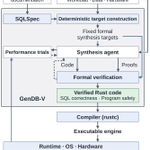
💻 GenLang-V/GenDB-V Builds verified Rust query engines for a schema or hot query template by translating SQL to a fixed spec, then generating code and proofs checked by Verus. Key points: • Up to 61.3× over DuckDB and 28.3× over Umbra on SEC-EDGAR • 51.6× over DuckDB and 22.0× over Umbra on TPC-H 22 queries • Verus proves correctness, memory safety, arithmetic safety, no data races Shows AI can synthesize database engines that are both formally verified and substantially faster than mature systems on targeted workloads. ⭐ 15 stars
1
55
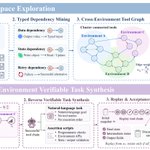
📄 ToolSpace: Scaling Tool-Centric Environment Synthesis for Long-Horizon Agents by Guanting Dong (@kakakbibibi), Zhichao Sun et al. A trace-first framework that replaces data-centric environment synthesis with execution-witnessed tool graphs and replay-verified task generation across environments. Key points: • Qwen3.6-35B-A3B improves from 23.0 to 41.0 avg; 43.2 with RL • GLM-5.2 improves from 44.6 to 56.6 avg across 7 benchmarks • On Pro benchmarks, 7 frontier models drop by up to 38.2 points Real execution-witnessed tool composition is a stronger primitive for training and benchmarking long-horizon agents than synthetic, LLM-judged environment graphs.
1
1
1
142
💻 inclusionAI/IDM Runs 1-step or 2-step text-to-image sampling from one checkpoint and improves text-heavy prompts using EMA feature-moment matching plus internal DMD. Key points: • 94.25% LongText-CN and 90.20% LongText-EN at 2 NFE • 0.25s at 1 NFE and 0.30s at 2 NFE on one A100, BF16 • EMA moment loss adds +0.41 LongText-EN over internal DMD alone Shows that a generator's own EMA features can replace an external encoder for moment matching in few-step text-to-image distillation. ⭐ 240 stars
1
27
📄 Route Anything: A Study of Model and Policy Routing for General-Purpose AI Systems by Pengfei Zhou, Yixing Ma et al. Per-input routing across heterogeneous models and robot policies, optimized for quality-cost tradeoffs and trained on candidate outcome prediction. Key points: • Oracle routing beats best fixed by 5.4 pts across 24 benchmarks • Learned routers gain 2.1 pts on video generation vs best fixed • Robot routing reaches 71.6% vs 70.5% best single policy with 24% less time Shows that much of the gain in general-purpose AI systems comes from input-level orchestration of specialized candidates, not from picking one globally best model.
1
1
86
💻 wangzan101/Mika by @wangzan101 Operates Android apps and websites from chat prompts, using a background screen so you can keep using the phone while it works. Key points: • No Mika server; screen data goes only to the configured model provider • Works with any app via screen understanding, not per-app APIs • Compatibility self-check runs 12 checks in about a minute Shows that a practical cross-app Android agent can run locally on the phone while staying usable during execution. ⭐ 6.6k stars
1
42
📄 Library of Layers (LoL): Adaptively Ordering Transformer Layers at Runtime by Abdellah Rahmani (@arahmani_AR), Sean McLeish (@SeanMcleish) et al. A router selects the next block from a shared layer library at each depth, so execution order changes per input instead of staying fixed. Key points: • Safety probe on sequence-level routing features reaches 0.95 AUROC • Maze strategy control hits 99.79-100% correct forced-strategy traces • Sudoku forced routing yields 99.5-100% requested-strategy accuracy Shows that layer order can be a learned, controllable part of transformer computation rather than a fixed architectural choice.
1
2
4
231
📄 CUA-Master: Scaling Computer-use Agents through Open-World Recursive Improvements by Xinlei Yu, Gen Li et al. Open-world video workflows become seed tasks, then reusable primitives synthesize controllable GUI/CLI tasks with rollback-based data collection. Key points: • 80.2 avg on OSWorld Verified, competitive with top closed-source agents • 43.9 avg on WeaveBench, above UI-Mate-27B's 18.3 • 25.0 full-pass on Agents' Last Exam, above Qwen-CUA's 5.3 Shows open-world seeded, recursively targeted data generation scales computer-use agents better than closed self-improvement alone.
1
1
69
📄 Wave Forcing: Towards Speed-of-Light Streaming Video Generation by Yijie Jin, Yuxuan Liu et al. Pipelines chunk denoising and history refresh across replicas, using causal access to cleaner in-flight chunks to sustain continuous video output. Key points: • 134.8 end-to-end FPS and 147.6 DiT FPS on 8 H200s with 4-step WF • 5-step WF: 81.64 VBench Total vs 81.15 for Rolling Forcing • Long-video Dynamic 91.45 vs 36.63 for Rolling Forcing; Subject 97.10 vs 92.75 Shows streaming video generation can reach near-real-time throughput without giving up long-horizon motion or subject consistency.
1
82
📄 On the SPOT: Enhancing Speculative Decoding for Diffusion Language Models via Commit-Order Prediction by Eliezer Shlomi, Eliron Rahimi et al. A learned commit-order drafter for DLMs that reuses stale token predictions and verifies drafted state trees exactly with shared-noise sampling. Key points: • Up to 3.4x throughput vs standard decoding on SDAR-8B • Uses 16-36% fewer target forwards than Spiffy on SDAR-8B • SPOT-Sets adds 59% avg throughput over threshold decoding alone For diffusion LM decoding, predicting where to commit next matters more than predicting the token itself.
1
125