

Joined August 2023
- Tweets92
- Following78
- Followers23
- Likes536



Pinned Tweet
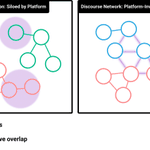
This is a new way of thinking about user networks: birds of the same feather don't simply tweet together; they *think* together. Connecting users via latent narratives lets us model with less data and break from arbitrary platform boundaries.
Paper here: arxiv.org/abs/2505.21729

Excited to share that our paper on Density-Guided Response Optimization has been accepted to ACM FAccT!
We show that local density in embedding space encoded recoverable community preference signal, and this can be used for alignment without explicit preference annotations

Had a great time last week at the Oxford Internet Institute’s (@oiioxford) Future of Social Media Research workshop!
I presented my work on cross-platform discourse networks — moving past platform silos to a unified view of the online information ecosystem.

Patrick Gerard retweeted

Grateful for the opportunity to speak yesterday at the Oxford Internet Institute during the Future of Social Media Research workshop!
I presented Narrative Networks, my system for using transformer models, multilingual embeddings, and network analysis to track ipropaganda!

Patrick Gerard retweeted

✨ Very overdue update:
I'll be starting as an Assistant Professor in CS at University of Minnesota, Twin Cities, Fall 2026. I will be recruiting PhD students!!
Please help me spread the word! [Thread] 1/n

Patrick Gerard retweeted
Similar trajectory with COVID lab-leak/Fauci narratives—claims about NIH gain-of-function research and intentional virus creation.
Telegram ⚪ + Truth Social 🟣 dominate early and throughout Later gains ground on Twitter 🔵 and TikTok 🔴
Very similar pattern :0
New paper + interactive dashboard on the 2024 US election information ecosystem.
Building on the original discourse networks work with @Hans_Hanley, @LucaLuceri, @emilio__ferrara, we can understand+visualize the online landscape as a unified system across platforms.

When emergence occurs, users tend to have +290% more active cross-platform neighbors discussing the narrative than when it doesn't.
This proximity signal makes cross-platform prediction tractable—no diffusion modeling required.
Take a look for yourself!
🎛️ Dashboard: patrikgerard.github.io/cross…
📄 New Paper: arxiv.org/abs/2510.09464
🌐My Website here: patrickgerard.co
Really curious what patterns you find when exploring the data