

Managing editor, American Banker. Author, The Almightier. Last of the Duke Street kings. Opinions mine own. Email: [email protected]
Joined March 2009
- Tweets37.3K
- Following1.8K
- Followers33.1K
- Likes5.8K




Pinned Tweet
Pub Day!
My new book The Almightier is out today. Already the top new release in Amazon’s money section, it’s a history of money you haven’t heard before: how money came from religion, eventually broke free from religion and how money became its own morality. And how maybe we can do better.

I graduated college some decades ago, but I remember thinking even then that four years was one year too long. Don’t get me wrong, I enjoyed the hell out of that fourth year, but I didn’t need it.


The US is almost $80 trillion in debt. There is no normal solution to that problem. We need an un-normal solution. I wrote about one for The New York Times: cancel the debt. All of it. After all, that's what they used to do in the ancient world.
Gift link: nytimes.com/2026/08/22/opini…

Paul Vigna retweeted
.@bancosantander finalized its acquisition of @WebsterBank Financial on Thursday, marking the closure of the largest U.S. bank M&A deal to be announced this year.
Following the completion of the acquisition, the head of @SantanderBankUSoperations said the bank is planning to take the integration process slowly. More here: sbrew.link/fSitXSop #MandA #BankAquisitions

If AI really is going to reorder society, these are the questions we need to ask. And the key problem is that the incentives of our economic system are completely misaligned to an AI-driven world of abundance.

A few days ago, I watched an interview between @elonmusk and @TheEconomist discussing the future of artificial intelligence, work, and politics.
Like so many conversations about AI, it was fascinating.
And like so many conversations about AI, it completely missed what I believe is the most important question of our time.
Musk argued that within a few years artificial intelligence will perform most economically valuable work. Human labor will become increasingly unnecessary. Productivity will soar. Society will eventually distribute the wealth created by intelligent machines through some form of universal income.
The interviewer pushed back—but mostly on politics.
Should Musk have this much influence?
Is he becoming too powerful politically?
Should technology leaders shape public policy?
Reasonable questions.
But not the essential one.
The essential question is this:
Who gave technology permission to redesign human civilization?
Not simply our economy. Our civilization. Because replacing work is not merely an economic event. It is a human event. For thousands of years, work has been far more than income.
Work is purpose.
Work is dignity.
Work is discipline.
Work is contribution.
Work is where strangers become teammates.
Work is where young people become adults.
Work is where communities are built.
If artificial intelligence removes work from hundreds of millions of people, then the conversation cannot begin with Universal Basic Income.
It has to begin with human meaning.
Because money has never been the deepest purpose of work.
People who believe it has generally misunderstand both economics and humanity.
The second undiscussed issue is even more uncomfortable.
Suppose Musk is right.
Suppose AI really does create extraordinary abundance.
Who exactly do we trust to manage that transition?
Governments?
Corporations?
Technology companies?
Media?
Financial institutions?
Look around. Trust in nearly every major institution has collapsed. That may be the defining political fact of our time.
The tragedy is that this collapse in trust leaves society unable to answer the very questions AI now forces upon us.
If governments are not trusted, who regulates AI?
If regulators are captured, who enforces competition?
If technology platforms become civilization-scale monopolies, who prevents unprecedented concentrations of power?
And if nobody is trusted…
who decides?
This is where the conversation becomes dangerous.
Because artificial intelligence naturally concentrates power. The largest models become better because they have the most data. The most users. The most capital.
The most computing power. The most government contracts.
The largest platforms become larger still.
The first trillionaires emerge not because they invented a better consumer product, but because they own the intelligence infrastructure through which everyone else must live, work, learn, communicate, and transact.
That isn’t simply wealth. That is civilizational leverage.
Yet somehow this remains largely undiscussed.
Instead we argue about personalities. We argue about politics.We argue about the latest social-media controversy.
Meanwhile the architecture of the next civilization is quietly being built.
The irony is that I recently witnessed something that reminded me what may ultimately save us.
The World Cup.
For a few weeks, billions of people temporarily stopped living inside algorithms and political tribes.
Strangers embraced. Families gathered. Cities came alive.
People remembered something remarkably simple:
Human beings are happiest not when they are optimized.
They are happiest when they connect and belong.
No artificial intelligence can replace that. No algorithm can manufacture it. No platform can own it. That is why I remain optimistic.
Paul Vigna retweeted
The @BLS_gov released its latest jobs report on Friday morning showing the economy shed 23,000 jobs in July, though a decline in the number of Americans seeking work meant the #unemployment rate also declined to 4.1%.
The reading likely maintains the status quo for policymakers on the #FederalOpenMarketCommittee who have been more concerned about inflation than the job market in recent months. More here. sbrew.link/oXAw5Cwn


Even though I’m on this app, I had no idea Elon was all PO’d about Nolan’s Odyssey. You know why? Because I never look at the For You feed, and I blocked Musk years ago.
If you want this place to be remotely tolerable, do those 2 things.
theguardian.com/film/2026/ju…

It’s time for a modern amargi. Blanket debt forgiveness. It’s time to retire global debt and start over.
Would that be kind of insane? Sure. Yes, there are a lot of logistics. But it’s no less insane and certainly less destructive than a financial collapse or runaway inflation.

A trillion dollars so Meta’s AI bot can write “happy birthday” with some emojis for me.
I’m not sure what’s worse. The money and resources wasted on this drivel or the assumption that I can’t come up with “happy birthday” on my own.


A trillion a year to get “hasn’t accelerated in a way we expected.” The AI meltdown is going to be epic.

Meta’s $META Zuckerberg says AI development hasn’t accelerated in way we expected, per Bloomberg
When I was a high school freshman, in New Jersey, in 1982, in my *English* class, we read the Bible.
The difference, I suspect, is my teacher was very clear that we were reading this as literature, not religion, and offered to discuss it with anybody who objected.

BREAKING: The Texas State Board of Education has voted to make Bible passages required reading in public schools. abcnews.link/kgCyNtB

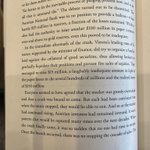
From Liaquat Ahamed’s “1873”:
“Each had been convinced that when the music stopped, they would be able to exit.”
He’s talking about Vienna in, well, in 1873. But he might as well be talking about today, this morning, this very minute.

“Even if you earned it, you still owe.”
Tupac would have made a great economist. He actually got it.
open.substack.com/pub/paulvi…
This is not the first time we’ve had to coin a new word to describe a new class of wealthy. And it ended very, very badly. There’s a lesson there for all the Elon fanboys. Elon, too, for that matter.
open.substack.com/pub/paulvi…