





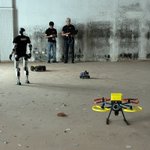


UBR-001 will be put to the test. Finding a suitcase in a hectic environment. 1.5k people waitlisted…


To celebrate @JensenHuang's cute Micro Duck moment today at @NVIDIAGTC, the @ubroboticsai team decided to speed-launch a store with a limited edition of 100 open source micro ducks 🦆
Reserve yours here: store.ubrobotics.com.


When @jensenhuang asks for a somersault, you deliver. 🦆
See how AI agents on NVIDIA RTX Spark help bring @huggingface's Microduck from simulation to the real world.
UBR-001 @ubroboticsai UGV class charging and final sanity-checks for @prototype_cap GTC after-party tmrrow

Pedro Oliveira retweeted

@bhorowitz: the two skills silicon valley has underrated are creativity and the ability to create and maintain relationships. both are about to matter more.
the second one is what we're building noticed for.
Hardware is hard. m

AI is on track to become a superhuman hardware designer, but design is only the beginning. The interface between bits and atoms is lossy, and turning designs into real hardware gets harder at every level:
1. Sourcing off-the-shelf parts that work together (a 2006 Falcon 1 engine test was delayed by one capacitor, in stock 6,000 miles away)
2. Custom parts, where a master machinist translates CAD into machine instructions
3. Assemblies, where every part can meet its drawing and still not fit
4. Outside vendors (even SpaceX has 591 employees with supply chain titles)
5. Doing all of it at a scale of 1,000,000
"Superhuman AI might be great at pure design, meaning at defining the platonically ideal part for a particular job, but struggle with 'design for manufacturing,' or finding a point design that meets the requirements while remaining easy to build/procure and inexpensive."
Full piece from a16z's Christian Keil on what it takes to turn AI-designed hardware into the real thing: a16z.news/p/superhuman-hardw…


Team @ubroboticsai got the first place at the EUDIS hackathon. Thanks @TEKEVER for the mentorship and gift.
Next: going to Berlin for @NVIDIAGTC.


Pedro Oliveira retweeted

Asked a Lisbon friend to back @UmbraCash in the @OctantApp round.
He asked who I was fighting.
Guess OnRing Lisbon left quite a mark on the crowd this July!


We now have flying cars.
Can we have private payments by default?
Back Umbra v2 and other projects in @OctantApp’s privacy round so we can unlock the 100 ETH matching pool. Round closes Oct 21.
And small contributions count the most!
Let's build Privacy City together 👇


after seeing the insides of several factories and warehouses in Europe and US, this is very true.
physical AI is received with default scepticism by factory and head office teams
it’s our job to deploy fast and prove with data that their physical business will benefit immensely from implementing AI + robotics.
inevitable.

many builders in physical AI are focused on deployment. you may have noticed how little robots are actually deployed by leaders of the space.
we are so, so early.
i've been working on this issue for some time. drop your own experience below, soon to be many in-person group discussions on this topic. here is my current read:
-only 30,000 robots are deployed per year in the US across sectors. mostly programmed, not learned models. china does 10x that. its growing fast, but the obstacles are still there
-the advantages of learned robotic models currently struggle to outperform programmed robotics in industrial environments. expect hybrid solutions to blend the strengths of the two
-contract manufacturing, or high mix would greatly benefit from adaptive robotics, but the contract manufacturing space in the USA is..broken. fixing it to deploy becomes a whole economy solution.
-dependability and capex remain the barriers to entry, building a deployment that survives those plus future regulation, liability, and maintenance is how you win
-most industrial spaces lack the data readiness or network infra to support learned robotics. this is a huge problem that labs have either chosen to solve themselves in a fragmented way or avoid wholesale by adding local compute. big opportunity.
-large labs that have focused on model & hardware development are struggling to divert focus to deployment, for good reasons. if you find a way into market, consider that your moat for now.
-as LLMs, world models compete with classical architectures you will see these labs begin to focus on getting deployment partners. picking the right stack is less important than getting the right customers. treat the bitter lesson as your own litmus for vendor choices.
all the companies you admire or consider to be saturating the opportunity are not even close to scaled deployment, you are sitting on the ground floor. get building.


Pedro Oliveira retweeted

Robotics research output is accelerating
More accessible and cheaper hardware, tooling, talent and capital waves, better general purpose models are all major contributors here

Looking to purchase a startup ticket for @SlushHQ 2026. If someone is dropping theirs, lmk.