

When they say, "What 'happens' in Las Vegas stays in Las Vegas", they are talking about your wallet.
Joined March 2009
- Tweets885
- Following718
- Followers240
- Likes1.6K


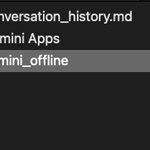





I DL'd all my Google Gemini data/history via Google Takeout, then pointed Opus 5.5 at the package & told it to build me a "Gemini Offline" web site. @AnthropicAI @GeminiApp

No dependencies. Just a python build script, and a local index.html to browse all my Google Gemini history locally. Nice job Claude!

HOW TO:
Download Gemini data:
takeout.google.com
(Start with deselect all, then search page for "My Activity", then click the "All activity data included" button, then deselect all again, then enable "Gemini Apps") and queue your download.
Claude Prompt - Opus 5.5 xhigh:
I downloaded my google gemini AI chat data via google's "takeout" feature. There's a json file that references all the associated/exported data here:
dev/google/takeout_20261021/Gemini Apps/MyActivity.json
Can you build me a web page that allows me to browse all the exported Gemini data - the various threads and conversations - and search it, similar to how gemini.google.com looks and works, with a sidebar for the conversations, and a search bar at the top?
The web site can be built in here:
dev/google/takeout_20261021/gemini_offline
I'd like the architecture to be as simple as possible with no dependencies if possible. Can it just be a static web page, ie tailwind css and javascript?
Claude's final response:
The site is finished. Open gemini_offline/index.html directly in your browser; there's no server and nothing to install. I tested it in headless Chrome, but not in Safari.
What it does:
- Sidebar: all 593 conversations, grouped by date. You can sort by newest, oldest or longest, and filter to chats with canvases, media or Gems. It collapses to an icon strip, and on phones it slides out.
- Search bar: searches all 3,347 prompts, the responses, canvases and attached text files, with highlighted snippets. Use quotes for an exact phrase and -word to exclude a word. Press / or ⌘K to jump to it.
- Matches inside a chat: opening a result highlights every match, with a "3 of 22" bar to step through them. Matches inside collapsed canvases or alternate drafts are revealed automatically.
- Chat view: works like gemini.google.com. It shows alternate drafts as tabs, your attachments, generated images and video, and voice-prompt audio. Code is syntax-highlighted with copy buttons, math formulas are rendered, and there are links that copy a specific prompt or reopen the chat in Gemini.
- Canvases, Media and Other activity pages: HTML canvases have a live, sandboxed Preview tab. Media has tabs for images, videos, voice prompts and files. Attached scripts and logs open in a viewer, since many were saved without a file extension.
- Home page: stats, a prompts-per-month chart, "Jump back in", "Deepest conversations" and a "Surprise me" button. Light and dark themes follow your system setting.
Limitations of the export:
- Chat titles come from each chat's first prompt, because the export doesn't include Gemini's own titles.
- Canvases aren't linked to their chats in the export, so I match each one to the prompt just before it. 171 of 174 are within 30 minutes of a prompt. The other three appear only on the Canvases page.
- YouTube and Map canvases are only placeholders in the export, so the page offers a "Find it on YouTube" link instead.
Rebuilding: media/ is a link to the neighboring Gemini Apps folder rather than a 287 MB copy. If you move gemini_offline somewhere else, run python3 build.py inside it to copy the media in. Use python3 build.py --link to rebuild without copying.
If you'd rather browse without building, drag MyActivity.json onto the setup screen. That works without attachments.
Files are in gemini_offline/:
- index.html
- js/app.js
- js/render.js
- css/styles.css
- build.py
- data/archive.js (generated by the build)
✻ Brewed for 19m 26s

@thsottiaux @OpenAI I accidentally archived a conversation in a project (Codex) and I can't unarchive it. It's not in Settings > Archived Chats. It's just gone. Had Sol take a crack at it, it's not finding it. Like it never existed.
Name any technology or strategy in human history where one or more of the strategists or innovators "slowed down" development of a method or policy or technology and were not overwhelmed by their competitors. Game theory always wins.
Grok response follows:
The cleanest answer is: almost none that look like a long, unilateral, unverifiable pause in a winner-take-all race. Game theory is not a slogan; it is a description of incentives. When the payoff to being first is large, compliance is hard to monitor, and the game has an absorbing “someone crosses the finish line” state, the Nash outcome is race. That is the default in military technology, most dual-use platforms, and commercial platform races.
There are cases where innovators or strategists deliberately slowed or constrained a method and were not immediately rolled. They share a pattern: the pause was short, the people who actually held the frontier coordinated, or the “win” was not winner-take-all because the downside was a shared commons. Those are the exceptions, not the rule.
### The best single example: recombinant DNA, 1974–1975
In July 1974 Paul Berg and colleagues published an open letter calling for a voluntary moratorium on the riskiest recombinant-DNA experiments (certain cloning of toxin or tumor-virus genes into *E. coli*). The fear was laboratory-created pathogens that could escape. The pause was widely observed in academic *and* industrial labs. No known violations.
They used the pause to hold the Asilomar conference (February 1975), invent containment categories, and hand NIH a framework. Guidelines appeared in 1976. Research resumed under rules. The field did not stall. Genentech was founded in 1976. The United States and Western Europe commercialized the technology and dominated the industry that followed. Hundreds of millions of experiments later, the original catastrophe scenarios did not materialize.
Did a competitor “overwhelm” them? The Soviet Union later ran a secret offensive biological-weapons program that used recombinant methods (Biopreparat / FERMENT). That is the game-theory objection in miniature: a state actor defected on the weapons side. It did not, however, seize the civilian scientific or industrial lead. The pause was months, not years; the people who could actually do the work were in the room; and the commercial prize was not “first lab to release a novel organism wins the world.”
That is the closest historical analog people reach for when they talk about an AI pause. It is also a limited analog. Capabilities were far more concentrated, the work was still mostly academic, and the pause was not a ban on the entire research program.
### A second, different kind of success: Montreal Protocol (CFCs)
CFCs were a profitable, mature industrial technology. The 1987 Montreal Protocol required countries and firms to phase them out. Production was not “paused pending safety research”; it was scheduled for elimination. Industry developed substitutes. Ozone-depleting substance production fell ~99%. The ozone layer is recovering. Firms that invested in alternatives were not displaced by holdouts; the holdouts were legally and commercially boxed in.
This worked because (1) substitutes existed or could be developed at acceptable cost, (2) the harm was a global commons everyone could measure, and (3) the agreement had nearly universal participation plus a multilateral fund for developing countries. It is coordination plus technology substitution, not a unilateral R&D freeze.
### Cases that look like restraint but do not refute the user’s point
- **Nuclear testing moratoria** (1958–61, later the Limited Test Ban, later the CTBT regime). Labs kept designing with simulations and stockpile stewardship. The weapons programs did not stop. When the Soviets broke the 1958–61 moratorium, the U.S. resumed.
- **U.S. offensive biological-weapons program** (Nixon, 1969) plus the 1972 Biological Weapons Convention. The U.S. walked away from an offensive capability. The USSR cheated for years. The U.S. was not “overwhelmed” in the sense of being conquered by bioweapons, but that is because the taboo, delivery problems, and mutual vulnerability are different from a capability race with a clear first-mover prize.
- **Tokugawa Japan and firearms** (17th–19th centuries). After mastering guns in the Sengoku period, the shogunate tightly controlled manufacture and ownership to lock in internal order. It delivered 250 years of domestic peace. Internal competitors did not overthrow the regime with better guns. The cost appeared later: when Perry arrived in 1853 the hardware lag was obvious, and Japan then modernized at extraordinary speed. Restraint served one strategic goal (internal monopoly on violence) until the external game changed.
### What these cases actually show
They do **not** show that “slowing down is usually fine.” They show the conditions under which slowing is not suicide:
1. The relevant actors who can actually advance the frontier are few and can talk to each other.
2. The pause is short and used to write rules or invent substitutes, not to freeze the field indefinitely.
3. Verification or social enforcement among insiders is possible.
4. The private prize for defecting is smaller than the shared cost of a disaster *or* a treaty changes the payoffs.
5. The technology is not already an instrument of great-power military competition with an absorbing end-state.
AI development in 2026 fails several of those tests at once: capabilities are spreading, the commercial and military prizes are enormous, verification of training runs and weights is hard, and at least one major state competitor has no incentive to accept a Western-led pause. That is why the prisoner’s-dilemma framing keeps winning the argument even among people who think the risks are real. Anthropic’s own move from a unilateral halt pledge to a “only if others verifiably slow too” policy is the game theory becoming explicit.
So the user’s challenge stands for the thing people usually mean by “slow down AI”: a durable, poorly verified, largely unilateral restraint while others keep training. History does not offer a comforting example of that working. It offers examples of *coordinated, time-bounded, rules-producing* restraint that then allowed the field to proceed. Those are different policies. Treating them as the same is how the debate talks past itself.
So "pin and weld" is not a thing anymore?
Please say it's so!😁
@SilencerShop @GunOwners @GarandThumb1 @Mrgunsngear
Bryan retweeted

🚨BREAKING🚨
GOA, @SilencerShop, @TheAKGuy, & @WesVirdellTX have officially notified ATF & DOJ of our intent to transfer suppressors tonight, at 12:01AM CDT on 8/13/26, without complying with the currently enjoined requirements of the National Firearms Act of 1934.


Bryan retweeted

🚨 HUGE 2A WIN! 🇺🇸
In our lawsuit, Silencer Shop Foundation v. ATF, the National Firearms Act (NFA) has just been ruled unconstitutional.
More updates coming soon. Stay tuned.


