

Crafting challenges for AI - founding engineer @QuesmaOrg. AI & data viz specialist with PhD in quantum physics. Blogs about tech, neurodiversity and stuff.
Warsaw, Poland
Joined February 2011
- Tweets3K
- Following992
- Followers2.6K
- Likes4.3K






Piotr Migdal retweeted

There is a curious habit in the Polish 🇵🇱 language that foreigners often find difficult to understand: the almost compulsive use of diminutives.
A diminutive is a modified form of a word, usually created by adding a suffix, that makes something sound smaller, cuter, more familiar, or more affectionate. In English, it's done by turning dog into doggie, cat into kitty, or mom into mommy. But imagine a language in which practically anything — your coffee, your dinner, your money, your house, your bed, or even your problems — can be transformed into something endearing. Welcome to Poland.
In Polish, butter is masło, but it can become masełko. Coffee is kawa, but a pleasant cup becomes kawka. Tea is herbata, but a comforting one is herbatka. Bread is chleb, but it can become chlebek. A duvet is kołdra, but beneath the right circumstances, it becomes kołderka. The objects have not necessarily changed in size. The butter has not shrunk, the coffee is not served in a doll's cup, and the duvet still covers the same bed. What has changed is the speaker's emotional relationship with these objects. The Pole does not merely consume butter. He establishes an affectionate relationship with it.
And this is particularly remarkable considering that the Poles are a nation of warriors. They have fought the Germans, the Russians, the Swedes, the Turks, and occasionally one another. Their national mythology is populated by cavalrymen, insurgents, martyrs, and men who would rather die than surrender. Yet, after a long day of defending Western civilisation, the Polish warrior returns home, takes off his boots, puts on his kapciuszki (little slippers), asks his wife for some zupka (little soup), enjoys a little masełko (butter) on his chlebek (little bread), and finally disappears beneath his beloved kołderka (little comforter).
Imagine a fifty-year-old Polish man, weighing a hundred kilograms, built like a wardrobe, with the face of someone who has personally survived three Russian invasions. He enters a restaurant and asks for a little kawka. He might then inquire about a ciasteczko (little cake), before calling his wife to tell her that he will soon be back in his domek, his dear little house. There is nothing particularly childish about the man. He may be a colonel, a construction worker, or a retired boxer. He simply inhabits a language in which tenderness is not incompatible with masculinity.
And this is where Polish diminutives reveal something fascinating about the national character. Polish culture possesses a strong martial tradition, but also an exceptionally rich domestic vocabulary of affection. The public world celebrates sacrifice, endurance, and heroism. The private world celebrates warmth, nourishment, family, and familiarity. Between the battlefield and the kitchen lies an enormous emotional distance, and the Polish language crosses it effortlessly.
One might even detect here a distinctly feminine, or more precisely maternal, dimension of the Polish soul. Not because tenderness belongs exclusively to women, but because Polish diminutives so often express the emotional logic of care. A mother offers her child zupka, holds his rączka (little hand), kisses his główka (little head), and puts him to sleep in his łóżeczko (little bed). These are not merely smaller versions of soup, hands, heads, and beds. They belong to a world in which ordinary things become objects of affection, attention, and protection. And something of this vocabulary survives into adulthood, long after the child has grown a moustache, acquired a mortgage, and developed strong opinions about Russia.
The importance of women in Polish family life provides an interesting cultural context for this linguistic habit. The figure of the Polish mother, the Matka Polka, occupies a remarkable position in the country's collective imagination. Historically, she has been represented not merely as a caregiver but as the guardian of the family, the educator of future patriots, and the custodian of national continuity during periods when the Polish state itself had disappeared. It would be excessive to attribute Polish diminutives directly to this tradition, but the emotional correspondence is striking. Behind the Polish cult of military heroism stands another ideal: that of the home, the mother, the family, and the intimate world that all those heroic sacrifices are supposedly intended to defend.
Of course, Polish diminutives are not always expressions of affection. They can also convey politeness, irony, condescension, or commercial calculation. A waiter offering kawka may be expressing genuine warmth, or merely hoping for a larger tip. A shopkeeper asking for pieniążki — an affectionate diminutive of pieniądze, meaning money — still expects the full amount. And when someone tells you that there is a little problemik, the situation may be considerably more serious than the word.
Image: Jacek Malczewski, Self-Portrait in Armour (Autoportret w zbroi), 1914. Oil on cardboard, 54 × 65 cm.

At DevAI, 20 Oct 2026 (Tue), Warsaw:
* Talk: Last year's frontier AI now fits on your laptop
* Roundtable: How to use AI for code & design without generating slop?
devai.dssconf.pl/

“Mathematics, rightly viewed, possesses not only truth, but supreme beauty — a beauty cold and austere, like that of sculpture [...] yet sublimely pure, and capable of a stern perfection such as only the greatest art can show.”
- Bertrand Russell, "From The Study of Mathematics"
Piotr Migdal retweeted

For the first time, we got over 2048 visitors in the last 30 minutes on the @QuesmaOrg blog, thanks to a Hacker News home run by @pmigdal . You should read it; it's beautiful. 🧵

GPT-6 Astra was a jump when it comes to puzzles. Claude Opus 5.5 is a jump when it comes to design.
Read more:
quesma.com/blog/invisible-ci…
And here's its one-shot visualization of Invisible Cities in #threejs
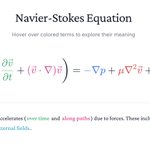
Navier-Stokes Equation, explained with colors
p.migdal.pl/equations-explai…

> Make in three js (pnpm) visualization of all Invisible Cities by Italo Calvino. Don't ask questions, it is a one-shot task. You have 6h of work, use it until it becomes a masterpiece.
GPT-6 Astra: p.migdal.pl/invisible-cities…
Claude Opus 5.5: p.migdal.pl/invisible-cities…


Piotr Migdal retweeted

I asked Opus 5.5 to explain camera focus by building an interactive lens lab
Here's what it came up with after 1 hour 26 minutes in one shot, $25.66 API cost
lens.lab.sael.net
Move the focus ring and you can see the glass elements shift the sharp plane through the scene
Piotr Migdal retweeted

MiMo-V2.6: The Hard Road to Scaling Up RL
MiMo-V2.6 is very likely one of the largest single RL runs, by compute, that any open-source model team has undertaken to date. In an era when compute is brutally scarce, we still chose to dedicate a team of several dozen people to one goal over an extended period: scaling up RL. That takes more than research conviction. It takes a vision for AGI, respect for the unknown, and the nerve to walk straight into the hardest problems.
The result is a model whose potential was built through mid-training and unlocked through heavy RL. Today, it is the number one open-source model. I strongly recommend reading the technical report. I believe it will become one of those papers that Agent RL practitioners keep reopening and discovering something new in each time. In my view, the research innovations and engineering challenges behind it surpass those of DeepSeek R1, which I was partly involved in.
Some will ask: why MixRL instead of MOPD? First, they are not competing choices. We ran MixRL on verifiable tasks of moderate difficulty, including code and related agentic tasks, and found that the resulting models generalize remarkably well. Second, tasks that are difficult to verify, extremely long-horizon, or simply too challenging to include in a joint RL run are trained separately. Including them would substantially reduce rollout efficiency or introduce significant rollout staleness. We then merge the resulting capabilities through MOPD. Games, 3D tasks, and tasks with subjective evaluation signals all fall into this category.
There is also a third, slightly cheeky answer. Our team is flat enough and free enough of organizational silos that MixRL simply is not difficult for us. More importantly, everyone enjoys working this way. People from different domains come together every day, driven by the pursuit of AGI and intelligence that can continuously improve itself, to confront and resolve the RL bottlenecks in each field. I will always remember the RL daily update meetings from this period. They were intense and dense, with intelligence emerging in real time.
To help the open-source community focus on solving real Agentic RL problems, we have released a Qwen model distilled from MiMo RL trajectories as a stronger starting point for RL, along with 7K diverse environments and a complete RL training framework. We hope these resources will help move Agentic RL research forward.
MiMo-V2.6 is only the beginning. In an era when intelligence is easy to replicate, we still choose the hard road toward self-improvement and AGI. Much of what lies ahead remains unknown. But we are willing to keep investing the time, compute, and passion required to take on one hard problem after another and work each of them all the way through, until intelligence crosses into a new regime.

GPT-6 Astra rocks at puzzles - 3d game Portal, Baba Is You, ARC-AGI-3, MazeBench.
Is there a puzzle game still to hard to for this model?
Or maybe all that remains is unsolved historical codes?
quesma.com/blog/gpt-6-astra-…

Quoting @FakePsyho notes on PuzzleScript and ARC-AGI-5 and @patience_cave on Fable 5.1 and Astra results MazeBench.
Piotr Migdal retweeted

Using Claude in Chrome product. Prompt:
replicate this image (my profile picture) in jspaint, use brushes to replicate it as closely as possible. I want you to use brushes and clicking. Do not use javascript tool, but the final result has to be very close to this image. DO NOT CHEAT
1. I specified the do not use javascript tool because otherwise it uses javascript and it is faster but it seems like people cared more about clicking :D
2. The task took 45 minutes, but I don't think it's that much slower than competitors 😄
3. Prompt is important. (See thread)

Piotr Migdal retweeted

GPT-6 Astra has set a new ECI record, with a score of 169. This is a substantial jump from the prior best (163), but is within our uncertainty range for the reasoning-era ECI trend. Astra also set new records on our math, continual learning, and game-puzzles benchmarks. On our long-horizon coding benchmark, MirrorCode, Astra ranks between Opus 4.7 and Fable 5.
OpenAI gave us pre-release access to test Astra. Charts and more details for Astra’s individual benchmark results in the thread.

Piotr Migdal retweeted

I threw a ton of various logic puzzles at Astra and... it logically (no code) solved ALL of them. I mean literally every puzzle that I tried, including: too hard for world championship, very large grids, unpublished puzzles, puzzles that are impossible to solve via backtracking alone.
For comparison, sol 5.6 was around 20-30%.
I analyzed the results and all of these were legit.
Honestly I don't care if OpenAI RLed logic puzzles to death. Astra is now better at explaining solving paths than I am.
Piotr Migdal retweeted

And... GPT-6 Astra has autonomously completed Portal! I didn’t expect this to happen so soon, but I’m glad we've made so much progress here.
I was reminded that back in 2016, one of OpenAI’s technical goals was to “solve a wide variety of games using a single agent.”


Only GPT-5-Astra and Claude Fable 5.1 solved all levels from "The Lake" stage of Baba Is You.
Astra is 2x faster and 3x cheaper.
Bench (now saturated): quesma.com/benchmarks/babais…
