

@preskill
Account based inUnited States
About this account
- Account based in
- United States
- Connected via
- United States App Store
Account-level information from X, not a live location or the device used for a specific post.
Theoretical physicist @Caltech, Director of @IQIM_Caltech
Pasadena, California
Joined October 2010
- Tweets6.1K
- Following1K
- Followers348K
- Likes5.9K




Pinned Tweet
It's an exciting time @TeamOratomic. We are on a focused mission to build a utility-scale, fault-tolerant quantum computer, and have now raised $775M since our launch in March 2026.
Find out more about us here:
oratomic.com/news/mission

Student @Caltech Saleh Naghdi urges scientists to create short videos that explain their work. An example: this 1.5-minute video abstract for his recent paper on simulation of quantum spin systems.
quantumfrontiers.com/2026/10…

Student @reionize @caltech ponders the value of PhD training in the AI era.
quantumfrontiers.com/2026/10…

Informative discussion by very knowledgeable experts about the threat to modern cryptography posed by AI models. The good news is that the models can vet cryptosystems much faster than the human mathematicians we've relied on in the past, building trust and allowing more rapid deployment.

AI is getting better at solving hard math problems, especially given recent drops. But what does that mean for the cryptography that protects everything from private messages to healthcare to banking and crypto wallets?
Stanford cryptographer Dan Boneh, with @eddylazzarin, @SuccinctJT, @liz_harkavy, and @smc90, makes sense of the warnings sounded recently. They cover:
- what’s fact vs. assumption
- what’s new and what risks cryptographers have long prepared for
- where quantum computing doesn't (and does) fit
- opportunities for builders
Highlights:
00:37 – What sparked the most recent debate about AI and cryptography
01:35 – Signal vs. noise: What the math does and doesn’t tell us
05:29 – Why cryptography depends on open problems
09:25 – Why the stakes go beyond blockchains
10:43 – How AI could strengthen confidence in cryptography
13:50 – Considerations for users and institutions
20:10 – Where AI and quantum threats overlap
22:32 – Building systems that can change cryptographic methods
23:59 – Hash-based versus lattice-based cryptography
33:07 – Opportunities for builders, and better security tools
38:14 – What comes next if there were a cryptographic break?

Thanks, @martinmignot, for this thoughtful essay about the origin of @TeamOratomic, and why @IndexVentures decided to invest.
indexventures.com/perspectiv…


Thank you, @chrismichel. (In the third photo, Chris made a futile attempt to make me look more like a Tech Bro.)

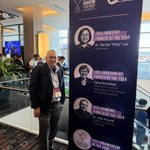
.@Caltech Professor @preskill has spent decades figuring out how to make quantum computers actually work.
He helped develop fault-tolerant quantum computing, coined NISQ, and pushed quantum information into black holes and spacetime.
More: explorers.com/john-preskill/
Photographed for @theNASEM.
#NewHeroes #Quantum @TeamOratomic


My talk last week at the #QuantumWorldCongress, a 20-minute overview of recent highlights in quantum computing.
youtube.com/watch?v=YYjK9ppp…

Chemistry giant and @Caltech institution Rudy Marcus, fondly remembered by @nicoleyh11.
quantumfrontiers.com/2026/09…

John Preskill retweeted

In our new work, we touch one of the beautiful fundamental questions at the heart of quantum physics: when does classical behavior emerge from quantum systems?
We study this question through the lens of learning bosonic Gaussian states, and find a precise quantum-to-classical crossover in their learnability as thermal fluctuations increase. Cold Gaussian states are intrinsically quantum to learn, while sufficiently warm ones can be learned with the same sample complexity as classical Gaussian distributions, using operations that are just as simple.
Thanks a lot to my collaborators @CSenrui, @FrancescoMeleAn, and @preskill for all their great work! I'm also grateful for my visit to Caltech in March, where I had the nice opportunity to brainstorm this project in person with them!
ArXiv link: arxiv.org/pdf/2609.26705

I'm at the #QuantumWorldCongress in College Park, MD, where I'll speak tomorrow at 9:50am "On the Road to Quantum Advantage."

Very articulate mathematicians pondering the future of math.
quantamagazine.org/live-from…

For fans of Strunk and White (I'm one), here's a version customized for scientists by @nicoleyh11.
quantumfrontiers.com/2026/08…

John Preskill retweeted

We're pleased to announce the QIP 2027 call for submissions. The key dates are as follows; refer to the website qipconference.org/2027/call/ for detailed instructions.

Interesting chat: @Jacob_Tsimerman talks to @TOEwithCurt about how AI is changing mathematics.
youtube.com/watch?v=6uIJdXmB…
We're excited @Caltech and @TeamOratomic about mitten codes, which we hope will accelerate the journey to practical quantum computing. An extraordinary team worked on this project -- I especially appreciate brilliant contributions from Caltech students Aditya Bhardwaj, Richard Ma, and Nadine Meister.
arxiv.org/abs/2607.28795
