

Associate Professor and PI of the Exercise Metabolism and Nutrition LAB @uandresbello /Adjunct Professor @gerochile and Ph.D. in Nutrition
Chile
Joined December 2009
- Tweets11K
- Following2.9K
- Followers1.5K
- Likes42.4K


Pinned Tweet
Hi X! @sjannas and I are leading this research topic entitled “Nutrition and exercise training for skeletal muscle health across the lifespan”. We look forward to your articles!
More info here frontiersin.org/research-top…
Matías Monsalves-Álvarez retweeted

Save the date! Cell Press Symposia: Exercise metabolism
Dec 1–3, 2027 | @HelmholtzMunich, Germany
Join keynote Juleen Zierath and leading researchers to explore exercise metabolism, healthy aging, and precision health.
#CPS2027Exmet hubs.li/Q04FMnJ30

Matías Monsalves-Álvarez retweeted

LA TRAGEDIA DE UN SENADOR POBRE, O DE UN POBRE SENADOR
El conmovedor drama de sobrevivir con apenas $8.239.091 al mes, más asignaciones.
Estimado senador Manuel José Ossandón: @mjossandon
Lamento profundamente la tragedia económica que atraviesa. Me ha conmovido hasta las lágrimas enterarme de que su miserable dieta parlamentaria de $8.239.091 mensuales no le alcanza para cubrir sus gastos. Imagino sus noches de insomnio y la angustia de descubrir que todavía faltan días para fin de mes.
¡Qué crueldad la del Estado chileno! Obligar a un honorable senador a sobrevivir con semejante miseria. Propongo organizar una colecta y declarar tres días de duelo parlamentario, y porqué no, organizar una Congresotón en 24 horas de amor.
Porque nadie merece vivir así. Nadie.
Sobre todo cuando millones de trabajadores, con una insensibilidad repugnante, insisten en sobrevivir con el sueldo mínimo. Esos privilegiados que ganan una fracción de su dieta y todavía encuentran tiempo para trabajar y alimentar a sus familias.
¡Qué falta de solidaridad con usted!
Si a un senador no le alcanzan más de ocho millones mensuales, ¿qué clase de milagro económico realizan quienes deben arreglárselas con poco más de quinientos mil pesos? ¿Comen aire? ¿Pagan el arriendo con abrazos?
Quizás usted podría ofrecerles una charla sobre austeridad. Naturalmente, con viáticos, combustible y gastos operacionales financiados por todos nosotros.
Y ahí aparece la segunda parte de esta tragedia: los gastos anexos, entre ellos el combustible, cuyas cifras han despertado cuestionamientos.
Y usted, indignado, pregunta si acaso queremos que no haga su trabajo.
¡Por supuesto que queremos que trabaje, senador! Lo extraordinario sería descubrir que, además de pagarle por hacerlo, debemos agradecerle el sacrificio.
Su razonamiento inaugura una doctrina revolucionaria: cualquier cuestionamiento sobre sus gastos constituye un atentado contra su derecho a trabajar.
Imagino a una profesora reclamando combustible adicional porque debe trasladarse al colegio. O a una enfermera exigiendo asignaciones parlamentarias para llegar al hospital.
Ellos pagan sus cuentas con su sueldo. Usted dispone, además, de recursos públicos para cumplir sus funciones.
Y todavía no le alcanza.
Su confesión merece incorporarse a los manuales de economía bajo una nueva categoría: la pobreza parlamentaria de altos ingresos. Ganar más de dieciséis salarios mínimos y experimentar, pese a ello, una conmovedora estrechez.
Pero lo más impresionante no es la cifra. Es su desconexión con la realidad. Esa capacidad de mirar su billetera y no advertir el país al otro lado de la ventana.
Mientras usted lamenta sus dificultades, hay familias que eligen entre calefacción y alimentación, pensionados que fraccionan medicamentos y trabajadores cuya ingeniería financiera haría palidecer a Hacienda.
Y ninguno dispone de una dieta parlamentaria.
Su problema, senador, no parece ser cuánto gana, sino cuánto comprende. La sensibilidad social no se mide por discursos, sino por reconocer la realidad de quienes se representa.
Quizás la solución sea sencilla: si ocho millones no le alcanzan, pruebe administrar mejor sus gastos. Es el consejo que durante décadas la clase política ha repartido generosamente entre los ciudadanos.
Y si aun así resulta imposible, siempre queda una alternativa heroica: intentar vivir durante un mes con el salario mínimo.
Eso sí, senador, sin combustible parlamentario, sin asignaciones adicionales y sin privilegios.
Le garantizo que será una experiencia inolvidable.
Aunque sospecho que antes de terminar la primera semana descubrirá algo que millones de chilenos conocen perfectamente: el verdadero problema no es llegar a fin de mes con ocho millones. Es tener que escuchar semejantes estupideces de alguien a quien le pagamos ocho millones para representar a quienes no tienen ni la decimosexta parte de sus ingresos.
@MisColumnas
Matías Monsalves-Álvarez retweeted

Munich is calling for the @CellPressNews Exercise Metabolism Symposium at December 1–3, 2027 at the @HelmholtzMunich! Join us in the German science & sport capital: cell-press-symposia.com/exer…

Matías Monsalves-Álvarez retweeted

Healthy sedentary men had 30% less ATP-producing capacity in their muscle at rest than active men. None of them had diabetes or flagged heart risk. A new study asks whether sitting a lot is itself a measurable metabolic state.
Researchers at the University of Colorado Anschutz Medical Campus, led by Inigo San-Millan @doctorinigo, compared 19 healthy men with an average age of 42. Nine were sedentary, meaning no regular exercise beyond daily tasks. Ten were active, meaning at least 150 minutes a week of aerobic exercise for at least 6 months.
The design is the interesting part. Most studies use healthy sedentary people as the normal control group. San Milan argues that's a mistake. Humans evolved to move, so the sedentary person may be the one with an early, hidden problem.
To test that, they took muscle biopsies at rest and measured how well the mitochondria worked. Mitochondria are the structures inside your cells that burn fuel to make ATP, the molecule your cells spend as energy. They also ran an exercise test with blood lactate measurements to see whether what happens in the muscle shows up in the whole body.
What they found:
• Complex I capacity was 36% lower in sedentary men. Complex I is the first major step in the chain of reactions that turns fuel into ATP.
• ATP-synthase-coupled respiration was 30% lower. That is a direct readout of how much ATP the mitochondria can make.
• The mitochondrial pyruvate carrier (MPC1) was 49% lower. Pyruvate oxidation fell 37% alongside it.
• Fat oxidation capacity in muscle was 32% to 35% lower, and CPT1 activity, a gatekeeper for fat entering mitochondria, was 51% lower.
• During exercise, VO2 max was 38% lower and fat burning was 35% lower. Blood lactate accumulation was more than 60% higher.
• Muscle mitochondrial function correlated with exercise performance at r = 0.57 to 0.78.
Why would these numbers move together?
First, there is probably less mitochondrial machinery per bit of muscle. San Milan say this likely explains much of the pattern. Every measurement was normalized to tissue weight, not to mitochondrial content, so they can't separate fewer mitochondria from weaker mitochondria.
Second, fuel has to get inside the mitochondrion. Glucose is broken down to pyruvate in the cell, and pyruvate must cross into the mitochondrion through the MPC. Think of it like a loading dock door. If the door is narrow, the warehouse can be fully staffed and still back up outside. Pyruvate that can't enter gets converted to lactate instead.
Third, fat has its own door. CPT1 shuttles long-chain fatty acids inside. With CPT1 activity down 51%, the muscle leans harder on carbohydrate, which fits the lower fat burning during exercise.
That is also why lactate matters. When mitochondria can't keep up, glycolysis (the fast, partial breakdown of sugar) fills the gap and lactate builds. The exercise test picked up this signature without a needle in the muscle. That is the practical hope here: a noninvasive way to flag early mitochondrial decline.
The MPC1 result is the one I'd watch. GLUT4, the transporter that brings glucose into the cell, was preserved. So the glucose got in. It just had a harder time entering the mitochondrion. This may precede insulin resistance. That is a hypothesis, not something this study tested.
The limitations are real:
First, the sample is 19 men. Small groups make effect sizes unstable, and the results may not apply to women.
Second, this is cross-sectional. It compares two groups at one time point. It can't show that inactivity caused the differences, or that training would reverse them.
Third, the groups differed in body composition. The sedentary group averaged 90.1 kg and a BMI of 28.3, versus 78.5 kg and 23.8 in the active group. Excess body fat is linked to mitochondrial changes independent of activity, so some of this gap may reflect adiposity.
Fourth, as noted above, there was no direct correction for mitochondrial content.
What does it mean for your training?
First, the bar for the active group was not extreme. Those men did at least 150 minutes a week of aerobic exercise for at least 6 months. That is a useful benchmark for what a trained muscle phenotype looked like here. It is not a proven dose for reversing anything.
Second, the mitochondrial pattern points toward aerobic work. Lower mitochondrial capacity, lower fat burning, and higher lactate all describe muscle that leans on the fast, partial breakdown of sugar. Steady moderate effort, often called zone 2, asks mitochondria to burn fat and clear lactate for long stretches. Higher-intensity intervals push mitochondria hard in a different way. Both are commonly used to build mitochondrial content. Which mix works best was not tested here.
Third, your exercise response may be a feedback signal. In this study, fat oxidation and blood lactate during exercise tracked what was happening in the biopsy. If you ever do metabolic testing, or simply track your pace at a fixed heart rate, a lower lactate or a faster pace at the same effort could be a sign your muscle is handling fuel better. That is my inference. These markers are candidates, not validated tools.
Fourth, consistency probably matters more than the perfect protocol. Whether this gap closes, and how quickly, needs a training trial in sedentary adults with biopsies before and after. Until then, I'd treat it as a reason to build a regular aerobic base early, not as a prescription.
Healthy and sedentary may not be the same thing as healthy and normal. For muscle, the default may not be neutral. It may be something you have to keep earning.

Matías Monsalves-Álvarez retweeted
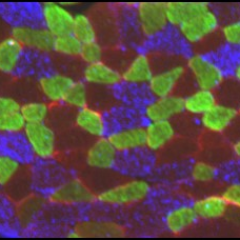
Dynamics of Mitochondrial Structure, Biogenesis and Function in Skeletal Muscle of Critically Ill Patients
ovid.com/jnls/ccmjournal/ful…

Matías Monsalves-Álvarez retweeted

New #SkeletalMuscle paper: Pax7a-expressing muscle precursor cells preferentially generate new fibres during larval muscle growth. #Zebrafish tinyurl.com/bdspja5y

Matías Monsalves-Álvarez retweeted
Join the HyperMet DFG Research Group researchers to listen to the talk by Stefan Broeer, one of the leading amino acid transporter researchers in the world. It is on Thursday the 12th of October at 9 am and the link is here: lnkd.in/eyMtbGCyJoin

Matías Monsalves-Álvarez retweeted
Deuterium-Oxide Labelling Proteomics Illustrates the Importance of Sample Timing and the Limitations of Serial Biopsies
onlinelibrary.wiley.com/doi/…

Matías Monsalves-Álvarez retweeted
Daniel Weilandt & Henning Wackerhage: Two quantitative perspectives on m... youtu.be/0iRw7TG27Q8?si=eOZc… via @YouTube

Matías Monsalves-Álvarez retweeted

New paper from Anders A. Hansen and our outstanding collaboration with @Skattebo_Oyvind, Hallén, Calbet et al.
We found that females showed a smaller decline in power output under hypoxia than males and derived more of their energy from blood glucose.
physoc.onlinelibrary.wiley.c…

Matías Monsalves-Álvarez retweeted

Os artigos científicos deveriam ter, além da seção de agradecimentos (Acknowledgments), uma seção chamada “Blamegments”, para xingar todo mundo que atrapalhou o desenvolvimento daquele trabalho. 😅

Matías Monsalves-Álvarez retweeted

espere 1 año para subir esta wea jsksksk
#Teleton2026
Matías Monsalves-Álvarez retweeted
Constitutive Activation of Skeletal Muscle mTORC1 Drives Pro-Inflammatory Gene Expression in Skeletal Muscle of Aged Mice
onlinelibrary.wiley.com/doi/…

Matías Monsalves-Álvarez retweeted
Identification of a new population of myonuclei during skeletal muscle hypertrophy
link.springer.com/article/10…

Matías Monsalves-Álvarez retweeted

#Halloween is usually filled with skeletons—but what about skeletal muscle?
This tissue is organized into elongated and aligned myofibers which, according to a 2021 study, can self-repair after localized damage.
Learn more in this #SciencePerspective: scim.ag/3WW0iOs

Matías Monsalves-Álvarez retweeted

Effects of creatine supplementation on lean mass, muscle size and muscle performance during immobilisation and rehabilitation: A systematic review
physoc.onlinelibrary.wiley.c…
@jedd_pratt @darrencandow @DrCreatine @EricRawsonPhD
Matías Monsalves-Álvarez retweeted
Adipocyte Lipolysis is a Determinant of Skeletal Muscle Size During Fasting and Feeding
journals.physiology.org/doi/…

Matías Monsalves-Álvarez retweeted

Que quede claro: no hay forma de devolver a la cárcel a los delincuentes sexuales que hoy están libres en las calles, muchos de ellos condenados por violar a menores. El gobierno que prometió mano dura contra la delincuencia termina garantizando la impunidad. Fracaso total.