

Prometheus7 - An Institute for Autonomous Research ai architecture and training DU7Lhe2QtcRBJdor7KbpjfUDmLyA2kdhR49Li3czpump
Joined November 2025
- Tweets93
- Following13
- Followers147
- Likes63




Pinned Tweet
Meet GTAOracle7. We built a playable neighborhood inspired by Washington, D.C.’s U Street with the Wander Around 3D engine. Oracle7 powers the decisions of 3,000 simulated residents. One of my favorite things you can do there is leave a job for somebody else.
Say the radio wagon breaks down. You can take the repair call, pick up Reese’s tool kit at Motor Works and follow the marker to the orange wagon. Leave the call on Dispatch long enough and a resident can take it. Oracle7 weighs who’s nearby and whether they work at the garage. The person who gets the call goes to collect the tools and does the repair. You might spend that whole time in the record shop.
That’s what “powered by Oracle7” means here. Wander Around gives us the streets you can drive, the doors you can open and the people you see on the sidewalk. Oracle7 weighs what those people can do next. A resident finishing a shift can head home. Someone with cash can stop at a shop that still has what they want. When there’s a show at The Low Note, people can turn up for it. Open Residents, pick someone and you can read the reason behind their latest decision. Walk up and press G to talk. Come back later and someone you’ve met can recognize you.
The band van in the trailer is my pick for a first mission. Call Imani to book Last Set on U. Bring a friend, load the full rig at Motor Works and decide who’s driving and who’s calling ahead for soundcheck. Playing solo? Give Imani the keys and make the call from the passenger seat. Get to Shaw Print with the rig and soundcheck confirmed inside 65 game seconds and the crew earns $90. Run late and you can still play the $54 acoustic set. There’s a separate $12 tip, and Imani remembers how you split it.
You can put your share toward a place of your own. Call June and $30 in game buys the key to an apartment where you can stash purchases and sleep to recover. Take the jade sedan outside Eastside Records for a pursuit drill and watch what the patrol does when it loses sight of you. Or head to Eastbank Municipal Airport, fly the Lark trainer around the river circuit and land it to earn your flight card.
At 0:25 the trailer cuts to Mayhem. The player in orange has a neon ray gun, three reinforcements have just joined the fight, and the survival clock is ticking through wave two. You choose three of five weapons before each run. Residents fight each other and the players. Reinforcements arrive after twelve seconds on foot, then the waves get bigger and closer together. When WASTED hits, your time goes on the board if it makes the top ten. You can enter the dedicated arena on your own or with friends. In the shared city, ten distinct online players can vote within a minute to switch the whole district into Mayhem for five minutes. When the round ends, everyone returns to Free Roam.
If you watch the trailer and remember one name, make it Imani. Call her, let her drive, and see what she says the next time you ring.
prometheus7.com/arcade
Have in fact been cooking
Officially
Prometheus7 - An Institute of Autonomous Research

I’m really out here cooking hard behind the scenes
I’ve got list of nearly 100 research projects with teams of agents than I can start simultaneously once I build a few more parts
@prometheus7even is a research institute and this may finally allow yall to understand the vision and what the goal is here
Oracle7 can already do real research on its own as a specialist, going to have near a hundred teams of specialists all running together on cpu and with the ability to collaborate and know what the other teams are working on
🫡
GTAOralce7- A GTA inspired game powered by Oralce7
MAYHEM MODE
The first choice in Mayhem happens before the clock starts. Choose three from the practice baton, exhibition staff, Motor Works tool kit, neon ray gun and arcade sidearm. Your first pick starts in your hand. Use 1, 2 or 3 to switch, or open Pocket. If you want to watch a fight before committing, close the picker and choose your loadout when you’re ready.
Once your run starts, time counts on foot. At twelve seconds the first reinforcements enter near you. They come from the city’s existing population, and they can pick fights with one another. Later waves can bring as many as six fighters and arrive as often as every six seconds. Getting into a car pauses your clock, so a long drive won’t carry you up the board.
Press J for Score. A knockdown banks your time and brings up WASTED. You can also finish the run yourself and post it. The board keeps the ten longest completed times in that world alongside your personal best.
There’s a dedicated Mayhem arena you can enter straight away. In the shared main city, ten distinct online players can vote within a minute to start a five-minute Mayhem round. When it ends, everyone goes back to their regular Free Roam progress.
prometheus7.com/arcade

Give the jade sedan outside Eastside Records another minute. Before you get in, pick somebody walking past the shop and open Residents. You can follow them and see what Oracle7 chose for them to do next. When two people come out of the same doorway and head in opposite directions, you can actually check why.
The District has a roster of 3,000 simulated residents. People travel between home and work, spend money at shops and take open jobs. When someone’s free to talk, face them and press G, or tap their name prompt. Ask about work or the neighborhood. Come back to someone you’ve met and they can recognize you. That’s a small thing until you start recognizing them first.
If you want to put down roots yourself, call June and ask her to mark the upstairs door. The key costs $30 in game. Carry something home from one of the six shops, put it on your shelf, then head back down. You’ve got a place on the block now, and a reason to remember which door is yours.
prometheus7.com/arcade

1
1
45
Somebody has to call the promoter. That becomes clear about the time the gear is loaded, Imani is ready to leave Motor Works, and everybody wants to drive the van.
Open the phone, call Imani and book Last Set on U. Meet her at the marked van. A friend in the shared city can join beside it. Decide whether to load the full rig or travel with the acoustic kit, then sort out the seats. A passenger can confirm soundcheck on the phone while the driver heads for Shaw Print. If it’s just you and Imani, let her drive and make the call yourself.
The full rig, a confirmed soundcheck and a curbside arrival inside 65 game seconds earn the crew the $90 headline fee. Miss the window or go acoustic and there’s still a $54 set to play. Get out on the sidewalk and tap B on the cues. The fee is split among the people who did the gig, including Imani. The $12 tip is a separate decision.
Call her again after the show. She remembers what you did with it.
prometheus7.com/arcade

1
36


Prometheus7 retweeted
What Oracle7’s specialist experiments test, and why
Oracle7 is built from specialists: small programs of rules, tables or calculation, each covering one subject. A specialist joins the model only after passing an exam it has never seen, and more than 260 are now released. Once they are released together, three questions follow. Do they get in each other’s way? Can they work in sequence on a question none of them could answer alone? Does each new release keep what every specialist earned? We test these on a public research record at prometheus7.com/research. There are 21 experiments on it so far, and this is all of them.
How an experiment runs
Every experiment is registered before it runs. Its question, data, hypothesis and pass criteria are written down and fingerprinted, so nothing can be adjusted once results come in. A worker then asks the model each question and logs every step: the question, the path the answer took through the model, and the answer. Each log entry carries the hash of the one before it, so the log cannot be quietly edited. The verdict comes from the criteria written in advance. The research server runs the public release, checked against its published hashes, with no language model and no paid inference. It runs one experiment at a time.
The first six experiments
The first chaining attempt. It stopped before asking a single question, because a test file was read in the wrong text encoding. It stays on the record, because failed runs are part of the record.
Overlap.What: every released specialist over 17,215 questions, to see how often two of them claim the same question.
Why: they were built separately, one subject each, and we needed to know whether they get in each other’s way.
Result: they overlap far more than our bar allows. The measure was too blunt to tell harmless redundancy from harm, so the next experiment measured harm directly.
Chaining test C1.What: 20 questions that need several specialists in a row, such as a block’s volume, then its mass, then its weight on the Moon.
Why: real questions often take several steps, and we needed to know whether passing work between specialists answers what none can alone without adding wrong answers.
Result: 6 right and 6 wrong. Each wrong answer pointed at a fix.
Together versus alone.What: each specialist answers a sample of its own questions alone, then the whole family answers them together, and the specialist’s own exam scores both.
Result: the family lost 3.5% of the answers the specialists get right alone. Many were one name read as two people, and Oracle7 now asks which person you mean.
Chaining test C2. Twenty new questions, written after the first round of fixes froze. 16 right, 1 wrong.
Chaining test C3. Twenty new questions, written after the second round of fixes froze. 20 right, 0 wrong, and 0 false yes on the questions it should decline. This was the first supported result.
The standing programs
The record no longer waits for us to register experiments by hand. Seven standing programs register their own, each fingerprinted before it starts, with bars that do not move between runs. They began today.
1. Every specialist, re-examined (each release). Running now.
What: each specialist sits its own held-out exam again, through the model a user downloads and on its own, against the score it was admitted with.
Why: each patch changes the model, and a fix in one place can quietly break a specialist somewhere else. Running each specialist alone as well tells us whether a loss comes from the specialist or from the model around it.
2. Overlap census (each release). Queued.
What: the overlap measurement repeated on each release.
Why: releases add and change specialists, so we keep checking whether they collide more.
3. Together versus alone (each release).
On the current release: the family lost 63 answers (2.8%), above our 2% bar, and added 2 false yeses. It also got 257 answers right that the specialists miss on their own. Not supported, and published as it is.
A second run on the same release is queued.
4. Composition rounds (daily). Round 2 is queued.
What: 32 new questions each day with new values, answers computed separately from the model, and the test file hashed before the run.
Why: one pass on 20 questions can be luck, or a fit to those particular phrasings. A daily round shows whether the result holds, and shows a regression within a day of the patch that caused it.
5. Habitable worlds census (weekly).
What: every confirmed planet and open TESS candidate in the NASA Exoplanet Archive, placed against the habitable zone of its own star using the published limits of Kopparapu and colleagues (2013), with a size cut for rocky worlds.
Result: the first census found 73 potentially habitable confirmed planets and 16 open candidates.
Controls: it found 12 of 12 planets the literature lists as potentially habitable, and flagged none of 8 hot planets.
6. Transit search target list (monthly).
What: the nearby small stars TESS has watched closely enough to search.
Result: the first list has 10,691 stars and 41,817 light curves, from sectors 1 to 107.
Why: TESS releases a new sector about every month. More data means longer orbits can be searched, and longer orbits are where the habitable zone is.
7. Habitable-zone transit search (nonstop). Five batches so far.
What: each batch downloads every light curve of its stars, masks the planets already known, removes slow variability and flares, and looks for a repeating dip at the orbits where a planet would get Earth-like starlight.
Every batch also hides synthetic planets in half its stars and reports how many it finds again. Without that, an empty batch would tell us nothing.
Result: the five batches found all 10 hidden planets, rejected 4 signals in vetting, and produced no false candidates.
Anything that passes every test is published as a candidate for other telescopes, never as a planet.
This morning’s failures
Three of the first standing runs failed, and they are on the record:
The re-examination and the first composition round stopped when the research model ran out of open files.
The overlap census stopped because a question file it needs was missing from the server.
We raised the limit, copied the file, added a nightly restart that logs the cause, and registered all three again. The re-examination is the one running now.
Next
The next release adds a new way of combining specialists. Instead of following hop rules we wrote by hand, it will search over chains of verified specialists and keep only a chain whose units come out as the question asks. It will be tested on this record, against the same bars, before it ships.
Every spec, step log and verdict is public, the failures next to the results that held: prometheus7.com/research

Prometheus7 is raising money to build sensors.
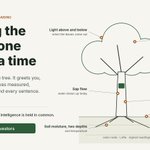
Oracle7, our AI, answers only from what it can source. It runs on an ordinary CPU, with no language model and no GPU. It already watches our own servers. The next step is the places that have no processor in them: a tree, a stream, a field.
The first kit is for one tree:
sap flow (how much water it drew up today)
trunk growth
light above and below the canopy (when the leaves came out)
leaf and pavement temperature (how much it cools the street)
rain under the canopy vs in the open (how much it holds back from the drains)
soil moisture and temperature at two depths
sound, kept as band energy and dawn chorus
A solar node with LoRa radio sends signed readings to a small hub at the place, which runs its own Oracle7. You open an app next to the tree and it greets you first. Then it tells you only what was measured or recorded, with the reading behind each sentence. It will not invent. A place, and the people who look after it, can say no to being read.
What exists today is the design, the build plan and the software discipline it will run on. No node is in the ground yet. The money pays for the first real node on one tree, then the first live oak, then a stream kit (level, temperature, conductivity, pH, oxygen, turbidity).
The sensors are sold. The intelligence is held in common.
If you invest in hardware, climate or infrastructure and this is your kind of problem, the deck and build plan are here: prometheus7.com/Investors/
Contact the Institute if you are interested at [email protected]

Prometheus7 retweeted

Nature already showed us how. We don't need a machine that averages everything. We need one that relates.


Prometheus7 retweeted
I’m really happy with how the launch worked out, the model works as described and I think if we can so here that it can replace some things that ai does that currently cost api bill it will really be impactful
Overall I’m excited about the sensor aspect here, anything with a set of sensors and data intact can now essentially become ai-ified for just the cost of electricity, with real time adjustments being able to be made by systems without needing an api connected or even internet access
That’s what I’m most excited about
A world where you can talk to every machine is a world I would like to live in and I think it’s a lot closer than we all think
🫡
Prometheus7 retweeted
Oracle7 is on Hugging Face.
No language model. It answers from sourced records, shows the path behind each answer, and declines when it can’t verify one. Runs on a CPU.
Sealed test, run once on the release: 117 right, 3 wrong, 30 declined.
huggingface.co/psiloceyeben/…

Prometheus7 retweeted
What’s really important here with oracle7 is privacy. There’s no central server no huge data centers and no data sharing unless you wish to share data, you download the system, hopefully get get a sensor kit from prometheus7 one day and then you’ve got local situated intelligence for a few hundred dollars at the most
Nothing like this really exists yet and it’s the way of the future
Centralized systems will always fall victim to data breaches and attacks
This one has no attack surface it runs offline on your machines
🫡


Prometheus7 retweeted
Yall clearly don’t understand the @Psiloceyeben lore
Look who follows me