


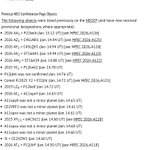



Global Fireball Observatory has confirmed the atmospheric entry of small asteroid 2026 RW1 off the north-west coast of Australia. Photo by Richard Young from Broome gfo.rocks/blog/2026/06/09/20… minorplanetcenter.net/mpec/K…
Small (<1 meter) asteroid, temporary designation CERNQ52, will enter Earth’s atmosphere and disintegrate off the north west coast of Australia in about 3 hours (1607 UTC according to the ESA).

☄️🎇INCOMING! Our systems have calculated an atmospheric entry in the timeframe between 16:00-16:30 UTC of a harmless object discovered by Mt Lemmon survey with a diameter of ~0.8 m northwest of Australia over the ocean. The impact will likely cause a bright meteor @esaoperations

Peter Thomas retweeted

Follow-up observations are improving the prediction accuracy: impact time will be 16:07 UTC

Peter Thomas retweeted
☄️🎇INCOMING! Our systems have calculated an atmospheric entry in the timeframe between 16:00-16:30 UTC of a harmless object discovered by Mt Lemmon survey with a diameter of ~0.8 m northwest of Australia over the ocean. The impact will likely cause a bright meteor @esaoperations
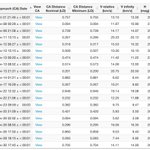
New observations have been announced for asteroid 2023 DW. minorplanetcenter.net/mpec/K… This asteroid is famous as the one with a chance of hitting Earth on Valentine’s Day in 2046. That risk was ruled out 3 years ago. The new observations show it will miss by 4 million km.
It is an Aten class asteroid and its orbit is mostly closer to the Sun than Earth’s orbit. Combined with its small size that means we only see it every so often. Its orbital period is about 0.75 Earth years, which is why we can see it again now, 3 years after the previous pass.
2023 DW is probably about 50 meters in diameter, so bad news for a city if it were to land on one but not a regional or global threat. It will pass a bit closer, at 2.3 million km, in Feb 2124. After that its position uncertainty grows. ssd.jpl.nasa.gov/tools/sbdb_…
JWST has completed it’s first observation of 2024 YR4 for this year. A second observation is planned for next week, 2026-Feb-26. I imagine it might be several weeks before the results are announced. There’s quite a bit of processing to do to get the astrometric measurements.
Another issue is that when doing non-sidereal tracking (tracking the asteroid, not the stars) the star images shift from pixel to pixel across the chip and this messes with the usual algorithm that looks for and removes artifacts that are typically caused by cosmic rays.
JWST observing schedule for next week is out. stsci.edu/files/live/sites/w… The first of 2 planned observations of asteroid 2024 YR4 is scheduled for 2026-02-18T07:30:00Z. See Visit ID 9441:1:1
Hi @planet4589, looks like we had some space junk re-enter over Victoria, Australia last night (night of 2026-Feb-02 to 2026-Feb-03 local time). Any idea what it might be? facebook.com/watch/?v=131969…

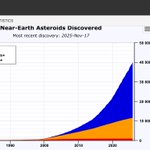
Count of known near Earth asteroids has passed 40,000. cneos.jpl.nasa.gov/stats/tot…


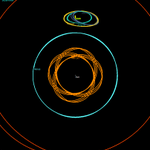
With all the talk about Earth's "new moon", asteroid 2025 PN7, here's a plot showing some of the other bodies looping near Earth. Turquoise = (469219) Kamo'oalewa, tan = (164207) Cardea, lilac = 2025 PN7. Earth & Moon are the short yellow strip. Rotating reference frame. SOLEX 12

And here's a related plot I made 6 years ago showing other Earth co-orbital bodies. teapaw.org/ptastro1/status/117807…


Back in June, the planetary defense community released updated info on the trajectory of asteroid 2024 YR4, following the last observations by JWST in May. Odds of an Earth impact on 2032 Dec 22 - zero, risk of an impact on the Moon - 4.3%. science.nasa.gov/blogs/plane…

The observing proposal also notes that JWST would have to be pointed into what would otherwise be a “no-go” zone set up to minimise risks from micrometeoroid impacts on the main mirrors.