

Investing and Trading. For information and education only, not investment advice.
Weekly Recap →
Joined July 2022
- Tweets744
- Following794
- Followers18.5K
- Likes998






Not All Quants Are Alike: Exploring Where Equity Alpha Comes From, from Goldman.
am.gs.com/en-no/institutions…

The “implied value premium,” measured as the difference in implied costs of capital between value and growth stocks, predicts the value premium.
It outperforms traditional valuation spreads.
Newly published paper by Li et al.: cambridge.org/core/journals/…

Interesting report on "Rethinking the 60/40 Portfolio" from @HedgeNordic
hedgenordic.com/2026/10/reth…

A great new survey paper covering fifty years of research on quantitative equity investing.
Paper by Feng et al.: onlinelibrary.wiley.com/doi/…

A new paper decomposes stock returns into systematic and residual components using industry exposures, 151 firm characteristics, and an adjustment for earnings announcements.
Systematic moves tend to continue, while residual moves reverse. Negative residual shocks reverse much faster than positive ones.
Paper by Baldi-Lanfranchi et al.: papers.ssrn.com/sol3/papers.…
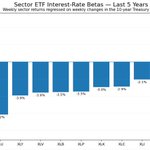
Over the past five years, the relationship between interest rates and equity returns has differed sharply across sectors.
Using weekly returns, real estate and utilities have had the most negative exposure to changes in the 10-year Treasury yield. Energy stands out at the other extreme: XLE is the only sector with a statistically significant positive interest-rate beta, consistent with energy’s role as an inflation hedge.

Stocks with a high frequency of down days over the previous month outperform those dominated by up days, and the effect is not explained by conventional short-term reversal.
New paper by Fattinger et al.: papers.ssrn.com/sol3/papers.…
New white paper from AQR on inflation protection. "...strategic allocations to inflation-linked bonds, commodities and trend following may help to improve portfolio resilience at a time of uncertain inflation outlook."
aqr.com/Insights/Research/Al…

"Japanese equities exhibit a large, robust drift in the days before scheduled Bank of Japan policy meetings."
New paper by Maeda: papers.ssrn.com/sol3/papers.…
New white paper from AQR:
aqr.com/Insights/Research/Wh…
"We find that all 30-minute options order imbalances positively predict next-day stock returns, with the strongest effects near the market close."
New paper by Lin et al.: papers.ssrn.com/sol3/papers.…
0DTE option returns largely reflect compensation for gamma and tail risk, not mispricing. Any remaining alpha vanishes after trading costs.
Recent paper by Dorion et al.: papers.ssrn.com/sol3/papers.…
Current gross profit minus its 8-quarter moving average is a strong cross-sectional return predictor. Especially among small and micro caps.
New paper by Yang et al.: papers.ssrn.com/sol3/papers.…
With the rise of 0DTE options, 3:45 PM implied vol predicts next-day realized variance far better than the 4:00 PM measure.
"The 3:45 PM snapshot offers a practical compromise: it is close enough to the end of the trading day to incorporate most information, but early enough to avoid much of the final expiration distortion."
New paper by Clark et al.: papers.ssrn.com/sol3/papers.…
Using 10-K risk disclosures to identify firms with similar risk exposures, this new paper finds that stocks with the best-performing “risk peers” outperform those with the worst-performing peers by 1.78% per month.
New paper by Chen and Yang: papers.ssrn.com/sol3/papers.…
Great episode with Peter Brandt.

NEW EPISODE 329📢 How a 50-Year Veteran Thinks About Risk Management | Peter Brandt
From 50+ years of classical charting to founding Factor LLC, @PeterLBrandt explains why indicators are just price derivatives, how he trades simple horizontal setups, and why pure risk control beats indicator optimization. 🎙️ @averydaytrading
chatwithtraders.com/episode/…

If you’re interested in FX anomalies and currency risk premia, the site Currency Factors is a great resource. It provides long time series for 11 currency factors across different currency universes.
currencyfactors.com/
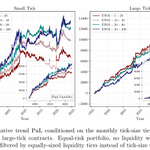
Why did short-term trend following stop working around 2009?
This new paper argues overcrowding wasn't the main reason. Fast trend largely disappeared in small-tick contracts, consistent with HFT-driven changes in liquidity provision.
Paper by Bouchaud et al.: arxiv.org/abs/2607.01550

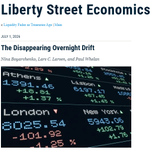
The Disappearing Overnight Drift
"Extreme closing-imbalance days, which the inventory-risk framework identifies as a source of overnight pricing pressure, have become markedly rarer."
libertystreeteconomics.newyo…

QuantSeeker retweeted

Never mind the reflecting pool, what about pooling statistical estimates for portfolio optimisation?
qoppac.blogspot.com/2026/06/…