

Infinite intelligence. Local. Any Hardware. Peer-to-Peer Hyper Swarm. No cloud. No compromise. QVAC is the decentralized AI platform for humans and machines.
Joined April 2025
- Tweets572
- Following2
- Followers12.6K
- Likes33



Why should AI be local first?
"Humanity should invest in AI that is local first, that is owned by the people, that is available and inclusive to everyone."
@paoloardoino, CEO of Tether
Half of Europe couldn't reach their bank app yesterday because one data center in London lost power.
Now imagine the same outage taking down the AI your business depends on.
Wild idea, but what if access to intelligence didn't need a data center?

Our PM can’t even take a flight without coming back with a QVAC prototype. This one turns any exam curriculum into practice tests, and it works without internet.
Want to give it a try or build on it?
It's accessible here: github.com/tetherto/qvac-exa…

It's fascinating how many real life use cases there are where local AI is so handy.
I was on a plane with my girlfriend and she was learning for a certification, while randomly complained that she couldn't practice on real tests (low cost life, no internet 😆)
Of course a @qvac prototype popped into my head -> you feed in some exam curriculum and you get tests based on it, works offline, and you can generate as many tests as you want, for free.
The power and beauty of local AI is amazing.


You can now run Laya with QVAC, an open source decision model from ConvAI Innovations.
Laya answers your questions about a piece of text.
In this first video, you can see it play a runner game: for each object coming its way, it decides whether to grab it or jump over it, based on a rule you pick, such as "This is an animal."
Laya takes three kinds of question: yes or no, one option from a list, or a place on a scale, from not urgent to blocking.
It comes in three versions: English (421M parameters), multilingual (322M), and typed decisions (421M), fine-tuned on business workflows such as invoice processing and customer service.
Load Laya with loadModel, then pass your text and questions to decide().
Docs: docs.qvac.tether.io/sdk/refe…

QVAC SDK 0.22 is out, and it adds Laya, a model that makes decisions instead of writing text.
We added:
- Laya support: answers the questions you define, each with a probability
- CUDA support: for LLM, embedding and VLA models.
- MiniMax-H3 image to video: start a clip from your own picture
- MOSS-SoundEffect v2: create sound effects on device
- Model fit checks: broader model coverage, improved estimates for model combinations, and opt-in load refusal before model loading begins
- Parallel tool calls: agents run several tools in one turn
Learn more in the thread below.
Complete release doc here: github.com/tetherto/qvac/rel…
Star ⭐️ for updates.

Other items:
- The KV cache now lives inside the addons: apps can send the whole conversation each turn, as with any OpenAI-style API, and the addon reuses the part it already processed
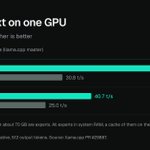
- MiniMax Music 3 speed improvement on an RTX 5090: up to 28% faster on CUDA and 20% faster on Vulkan (f16).
- Optimizations to Audio8, Parler and CosyVoice speech that now run faster on Apple silicon
Fabric moves to llama.cpp b11018 (@qvac/fabric 0.20.0). The shared runtime is rebased onto upstream llama.cpp b11018, and the addons built on it are re-released to match.
QVAC will be at Lugano's Plan ₿ Forum (@LuganoPlanB) on 23 and 24 October.
Come and see private and sovereign AI running locally, so access to intelligence always stays in your hands.
Not your AI, not your intelligence.

AI adoption grew more than twice as fast in the Global North as in the Global South.
We wrote in Computerworld about how local AI, running on the phones people already own, can narrow that gap.
computerworld.com/article/42…

Building with QVAC? Tell us what’s working and what isn’t.
A short, anonymous feedback form. We want to know what you’re building, where the SDK gets in the way, and what you need next. Every answer feeds directly into what we fix and ship.
forms.gle/2JStBzTAopLhJYrs6

ALT Building with QVAC? Tell us how it's going.