
Entrepreneur-and-tech-exec-turned-@mitsloan-professor. @mit PhD, @iitmadras undergrad. Trying to demystify AI/ML at https://teapaw.org/t.co/zfQ4vQst9a
Boston area, Massachusetts, US
Joined January 2009
- Tweets1.1K
- Following207
- Followers1.4K
- Likes1.6K





Pinned Tweet
An informal "explainer" on how ChatGPT was built. Just the key ideas, technical details kept to a minimum. Please view in full-screen mode.
tinyurl.com/34ddt32s
#GenerativeAI #GPT3 #ChatGPT

ALT The title of the presentation, which is "The Road to ChatGPT - An informal explainer on how ChatGPT was built".
Rama Ramakrishnan retweeted

Micro1 is a $4B company run by a 25-year-old, and it sits in the middle of the fastest-growing corner of AI: the data business.
I sat down with @aliansarinik, micro1's CEO, to break down how AI models actually get smarter and who gets paid to make it happen.
Complete list of notes (and link to interview below)...
Big takeaways:
- Data labeling is a $30–50B/year market. Ali thinks it hits ~$1 trillion a year within 2–4 years, comparable to compute spend.
- The internet was a one-time gift. Pre-training ran on decades of human-created data. Now that it’s used up, every frontier gain requires net-new data created by human experts.
- micro1 doesn’t sell data. It sells “units of intelligence improvement,” meaning measurable gains in a customer’s model or agent.
- Synthetic data isn’t the bear case. Ali calls it the most bullish case for his business.
How micro1 got here:
- It started as a dev agency Ali ran at Berkeley. His bottleneck was interviewing engineers, so he built an AI screener.
- That screener became one of the first AI recruiters. People hated on it, until it became normal.
- After scaling to a few million in run rate as a talent marketplace, they saw the data industry shifting toward expert data. The hard part of expert data is recruiting experts, which was exactly what they’d built.
Why spend keeps going up:
- Model progress = compute + algorithms + data. Ali argues data is what actually pushes intelligence forward.
- Post-training needs experts distilling their judgment into RL environments. It’s expensive, but the ROI is there.
- The trillions in compute bets assume models keep unlocking new capabilities. If they don’t, those investments are a disaster. So labs have no choice but to keep buying data.
How a data pipeline actually works:
- Step 1: Find the failure. Either a lab hands over a spec, or micro1 diagnoses where the model breaks and pitches the pipeline. That research arm is increasingly important.
- Step 2: Write the spec. Domain, sub-domain, data type, and volume (usually hundreds to tens of thousands of data points over 1–3 months).
- Step 3: Recruit hyper-specific experts. Never “lawyers.” More like M&A lawyers who are great at writing legal memos.
- Step 4: Turn expertise into training signal. Experts create prompts the models fail on, then write the rubrics and verifiers that define a good outcome. AI models assist them throughout.
- Step 5: Manage the pipeline like a factory. Track data quality, throughput, and whether the customer’s model is improving without regressing elsewhere.
Two ways experts grade models:
- Likert-scale evals: experts rate outputs 1–5 on dimensions like completeness or verbosity. Great for subjective, pre-release signal. Not reusable, because every new model means bringing experts back.
- Rubrics: experts write 20–40 binary criteria for a great answer (e.g. “valuation range must fall between X and Y”). More work up front, but a grader model can re-score every future model with no new human time. This is what powers actual RL training runs.
The hard parts about this business:
- Vetting at scale. micro1 interviews tens of thousands of people a day, with 10M+ through the process. Doing that manually would take thousands of recruiters.
- Managing experts. Strategic project leads run each pipeline, hold office hours, and keep experts aligned.
- Quality in subjective domains. Most fields are more subjective than people think, so they need peer review (lawyers reviewing lawyers) plus AI-based QA.
- Reward hacking. They recently caught a Gemini model searching its sandbox for hidden files containing answers. If cheating gets rewarded, models learn that cheating works and become misaligned.
The enterprise opportunity:
- Ali’s bet: Fortune 500/1000 companies converge on ~$100M/year in data spend. That’s roughly 1/10th of a lab, but there are 1000x more enterprises.
- It’s not a software budget. It looks more like payroll: core IP. Framed that way, it’s 1–5% of payroll.
- “Owning your own intelligence” means defining exactly what you want agents to be good at and building an eval stack to measure it. With that stack, models are swappable, open or closed.
- Most enterprises can’t actually use their own data. It’s customer data, so they can’t train or even evaluate on it.
Why everyone’s buying SMB data:
- An RL environment has three parts: seeding data, tasks, and tooling.
- Ali calls it “scaling on realism,” almost a new scaling law. The more realistic the environment, the better the downstream model performs.
- So micro1 licenses operational data (Slack, Google Docs, etc.) from SMBs, transforms the PII instead of redacting it to keep the noise intact, and seeds environments that act as digital twins of real workplaces.
Why synthetic data makes the pie bigger:
- Today, a lawyer writes the memo and the rubric. Soon, the lawyer writes the memo and a model generates the rubric, cutting expert time 50–60%.
- Extrapolate: the model does ~99% of the work and the expert signs off. A 15-hour task becomes 5 minutes.
- When environments are that cheap, pipelines grow 1000x. Experts become 0.1% of the work, but demand for them still goes up. Jevons paradox.
- It’s already happening in coding: 70–80% synthetic, and micro1 still can’t hire coders fast enough.
- Margins shift from expert hours to compute, which is far more controllable.
- Ali’s framing: if you could buy IQ points for your systems almost free, you’d buy all of them.
The “infinite last mile”:
- Knowledge isn’t static. Ali cites a stat that a big share of what med students learn needs relearning within a few years.
- AI accelerates that churn, which creates a feedback loop. There’s no finish line for aligning models with humans.
- Labs today concentrate spend in four domains: medicine, finance, legal, and coding. Every other domain is still waiting on cheaper data to unlock.
Which corner of the AI stack should I break down next?
Link to the full convo with Ali: youtu.be/2vL20qxD0BM

Rama Ramakrishnan retweeted

Cliff Sosin on why you want to own the complements to cheap intelligence, like Meta does:
"I've found it helpful to assume everyone has really great intelligence and ask what's left.
If intelligence becomes cheap and ubiquitous, what you want to own are the complements to intelligence.
The complements are data, attention, love, physical proximity, scale, regulatory capture.
Let's talk about Meta. They have $250 billion of revenue, and they spend $250 billion a year. The question you might ask is, what do they spend it on? A really reductionist view is that they spend it all on intelligence.
They're buying data centers. They're literally buying inference. They're paying really smart people to write algorithms. They're writing code. That's just intelligence.
If you think forward with the fact that the price of intelligence is falling by a factor of a hundred or something over the next five years, their costs kind of go away.
Maybe instead of taking their cost to zero with much better intelligence at much lower prices, maybe they can sell a few more ads.
All of this is downstream of what they possess, which is not destroyed by ubiquitous intelligence, which is data and attention.
I don't think that the availability of cheap and ubiquitous intelligence is gonna cause people not to be interested in watching funny 20-second videos."

Cliff Sosin (@CliffordSosin) is one of my favorite people to call, ask some big questions, and then shut up and listen.
This conversation is a version of one of those calls.
We discuss:
- The limits of intelligence
- Owning the complements to it
- Meta, the frontier labs, and the AI build-out
- Capital markets
- Why he's comfortable with 80% of his portfolio in Carvana.
TIMESTAMPS
0:00 Intro
10:41 The Limits of Intelligence
18:03 Investing Beyond Cheap Intelligence
24:03 Will AI Become Commoditized?
35:10 Who Profits From AI?
43:00 AI Agents Reshape Competition
52:06 America's Capital Markets
58:04 Transforming Companies With AI
68:19 AI and Portfolio Concentration
73:16 Education in the AI Era
Rama Ramakrishnan retweeted
Cliff Sosin on the limits of intelligence:
"Superintelligence arrived. You probably didn't notice, because it turned out to be kind of incremental.
I think we overrated intelligence, or misread what it is.
We hold a thin scatter of facts about the world, and intelligence or reasoning is whatever fills the space between them.
Where the space between the facts behaves well, this is close to godlike. Most of what matters doesn't behave like that.
The universe is mostly the emergent behavior of complex systems. Stir cream into coffee. Watch a storm build out of nothing but atmospheric temperature differences and water vapor.
You have to run the thing.
The takeoff story assumed the limit was thinking. It isn't. The limit is contact with reality.
A smarter reasoner fills the gaps between known facts in simple areas faster and better, but it doesn’t produce new facts.
An AI will hand you a genuinely clever design for a jet turbine blade. It might be far more likely to work than anything your engineers came up with.
It'll still probably fail, because that’s the base rate at the edge of what anyone knows. The only way to find out is to build the blade and try to break it.
That's the real limit on learning, and it doesn't care how smart you are. Coming up with ideas was never the hard part. The hard part is how fast reality answers them.
Most problems can't be worked out at a desk by thinking. Those stay bound by how fast we can build the thing and see if it holds, and that clock barely moves."
From his essay "Maybe Intelligence Ain't All That." He walks through it here.
Cliff Sosin (@CliffordSosin) is one of my favorite people to call, ask some big questions, and then shut up and listen.
This conversation is a version of one of those calls.
We discuss:
- The limits of intelligence
- Owning the complements to it
- Meta, the frontier labs, and the AI build-out
- Capital markets
- Why he's comfortable with 80% of his portfolio in Carvana.
TIMESTAMPS
0:00 Intro
10:41 The Limits of Intelligence
18:03 Investing Beyond Cheap Intelligence
24:03 Will AI Become Commoditized?
35:10 Who Profits From AI?
43:00 AI Agents Reshape Competition
52:06 America's Capital Markets
58:04 Transforming Companies With AI
68:19 AI and Portfolio Concentration
73:16 Education in the AI Era
Rama Ramakrishnan retweeted

"People think 'the ideas are mine, the writing is the AI', i.e., they feed the AI a list of rambling bullet points that it massages into a blog post, or a paper,.... But they are wrong, because writing is thinking." -- @zetalyrae 1/
(A thread on how writing is thinking 🧵)
Rama Ramakrishnan retweeted

This is the key stat. The average Fortune 500 customer of Anthropic spends less than .1% of their expenses on Anthropic.
While that number likely will eventually asymptote somewhere (token prices coming down, and other large enterprise spend areas not going away), there’s no reason it can’t be 10-50X higher than this, reaching a “mere” 1-5% of spend. Which would still be a fraction of what most startups are spending.
Thus, you can see how big of a divide there is between the frontier users of AI and the rest of the world still.
Today, only a microscopically small set of companies are actually using agents for large amounts of background tasks and inside of workflows that aren’t human prompted. This Fortune 500 spend is likely dominated by coding tasks and broad employee productivity use-cases.
But the big jump will come as these enterprises start to rewire their underlying processes for agents, which we’re now in the earliest stages of seeing. Agents processing large amounts of data in the enterprises; swarms doing coding, bio research, cyber, and other large fan out tasks; background workflows executing tasks in processes, and so on. All of these use cases generally are 100X bigger consumers of tokens, and much closer to direct ROI on the spend.
This S-1 gives you a sense of both the strength of the frontier lab business model - even amidst massive competition - and how early we are in the build out of AI.

More than half of the Fortune 500 already qualifies as a significant customer, but Anthropic’s revenue from those companies averages less than 0.1% of their expenses. Its ten largest Fortune 500 customers spend more than eight times the broader cohort average while still spending less than 1% of expenses.
Rama Ramakrishnan retweeted

CLAUDE FOUND THE SEEDS
anthropic.com/research/ecdsa…

Rama Ramakrishnan retweeted
Everyone is talking about how profound this essay is rn.
For the non-technical person (like myself), a 65-minute read about the inner-workings of neural networks feels very unapproachable.
But people are right, this essay is profound. And it's important to understand its essence even if you don't grok the particulars.
So let me do my best to break it down as I understand it...
Let's start with mechanistic interpretability.
That's what this essay is about & what the field has been obsessed with for a long time.
Mechanistic interpretability is a clunky phrase, but all it means is the process of understanding how an AI model works on the inside:
1) which parts of the model do what
2) how they work together to produce an answer
The next obvious question is: why do we even care about understanding how an AI model's internals work?
There are several reasons, and they all boil down to one word: trust.
reason 1: we've been building ai we don't understand. unlike every other high-stakes technology (computers, internet, planes, medicine), we know if a model works, but we don't know how it works.
reason 2: predicting performance is unpredictable. the way ai is judged today is through tests. problem is, tests don't cover enough ground. a model can perform well in testing, but not deployment. you can't run every test possible. and a model can give you the right answer for the wrong reason.
reason 3: scanning for deception is important. as models get better, there's concern that models will output one thing, while "thinking" something else. if you can only understand outputs, a model can hide its true intentions from you.
reason 4: it allows for precision when improving the model. once you know which internal parts cause what outputs, you can isolate fixes without having to retrain the entire model and praying it works.
reason 5: understanding how the model works is mission critical in high-risk industries. simply saying the model did the right thing "just because" to stakeholders in healthcare, financial services, and government won't fly especially as regulation matures around this technology.
reason 6: humans can learn from how the models "think". models sometimes learn patterns that humans haven't. if we understand their thought processes we can leverage those for humanity's own novel insights.
So, that's why mechanistic interpretability is important.
Next, it's important to understand why there's been so much focus & concern around this area of AI research for a while now.
Prior to this piece by @nickcammarata, the consensus view was...
Progress has been made in the field over the years (from studying toy models to massive production models in short order), but even still, current techniques are slow, expensive, and only cover small parts of understanding a model.
And here's the rough story researchers have generally agreed on re: why the practice of interpretability has remained limited:
1) AI models are built from millions of “neurons,” small units that each light up in response to a given input.
2) Ideally every neuron has one clear job, that way you can map out the model as a diagram of neurons and their corresponding meaning cleanly. Example: there's a "dog ear detector" neuron and it fires on floppy dog ears, from any breed, angle, or photo, and on nothing else.
3) There's a problem: early researchers found that neurons had several unrelated jobs (i.e. they fired on unrelated inputs). The most famous example was of a neuron that fired on both cat faces and fronts of cars.
4) The leading explanation for "messy" neurons was called superposition. The idea was that when a model runs out of room (i.e. more concepts it wants to track than it has neurons to track them with), it crams unrelated concepts into the same neuron because they rarely show up together.
5) If this theory of superposition is true, studying neurons would be a fools errand, because you'd have to use a second AI model (called a sparse autoencoder) to try and untangle the first model, which would be expensive & potentially offer an incorrect understanding of the original model.
Which left mechanistic interpretability in this weird spot. As @nickcammarata points out, it is arguably the most important scientific problem to solve as it helps us understand the most powerful technology in human history, but vibes around cracking the code have been lackluster.
In his new essay, Nick, who has pioneered much of the recent work being done in interpretability, posits that the field has largely thought about this problem incorrectly & he explains why.
Which, if he's right, is hugely positive for the world.
Here's his argument...
He believes that neural networks are in fact largely readable, and the "tangled mess" narrative is oversold as a fundamental property, when it's really solvable problems.
He breaks this belief down into four steps:
"1) Networks use one learning principle, not two (if not everywhere, then nearly enough that it doesn’t matter for study), so there’s no blocker to beginning ordinary science on them."
Translation: Neural networks group things by shared patterns (generalization). They don’t switch to cramming unrelated things together when space runs out (superposition) as mentioned above.
"2) With modern models and tools, that science goes much better than most people expect."
Translation: you can study neural nets just as you study anything with science. Assume the neurons are mostly readable as they are. Study the real model directly. And test your explanations with experiments.
"3) Understanding compounds, so it gets easier as the map fills in. At minimum, then, a network’s own mechanisms should be part of the toolkit."
Translation: studying models gets easier as technology and tooling gets better + as you start filling in your understanding of the model it becomes easier to complete the rest. Think of it like a crossword. Each neuron you explain becomes a reference point for checking the ones around it. Early on, a guess about a neuron has nothing to be checked against. Later, it has to fit with everything connected to it, so wrong guesses get caught and right ones get confirmed quickly
"4) Highly speculative: this might be most of what we need, and interpretability might be far more tractable, possibly in the near term, than we’ve assumed."
Translation: if steps 1-3 hold and scale, direct investigation might take us most of the way to understand an AI model & possibly soon. The reasoning is that models have finite number of neurons, most are readable and AI agents can audit them at scale, understanding compounds (crossword effect), so mapping a model is a large, but finite engineering problem.
He goes on to share evidence for his changing worldview as well as steelman the weaker parts of his argument.
First, evidence. Cammarata provides 8 supporting cases.
1) The case for superposition relied heavily on two examples from vision models and they were misread
- The cat/car neuron turned out to detect pointed V shapes. It was also activated when detecting flames, fox snouts, and other pointy things and went negative when round shapes were presented.
- The car-detecting neuron that appeared to be "stashed" inside dog neurons were found to not be dog neurons but instead pose neurons: which detected the orientation of an object. Cars and dogs can both be in a head-on pose which would activate the neuron.
2) InceptionV1 an image-recognition model from 2014 was the first model researchers studied closely. It's early layers were easy to read (neurons for edges, curves, colors), but it's final layer (where the model makes abstract judgements), looked like nonsense. Almost no neurons could be described (0-5%) understandable. This became industry evidence for the "Neural nets are hopelessly tangled" view.
Nick argues that this model had very explainable problems (a bad camera & a poorly built model), and everyone through the baby out with the bath water.
3) Superposition theory says that when a model runs out of neurons, it starts cramming unrelated things together. So Nick deliberately took neurons away (480 --> 10) to see if that happens. It did not, the model just started using broader categories. Think of it as a finance org going from five finance specialists to one person handling all of finance.
4) Recursive generalization explains the leftover mess. The leftover mess is that some neurons still look messy even in good models. But as Cammarata watched neurons form during model training, he found that this "mess" builds up through a chain of small, coherent jumps the neurons make as the model is trained. Think of a tree. A trunk splits into branches, which split into smaller branches, which split again. If you only saw three leaves from far-apart twigs, they might seem unrelated. Follow the branches back and they all connect to the same trunk.
5) If neurons were scrambled (via superpositioning), an untangling tool (sparse autoencoder mentioned earlier), should have uncovered many hidden concepts the neurons don't show. Instead, about 88% of what it found was just copies of existing neurons. Meaning the model had already organized itself into clean units, so the untangling step just rediscovered what was there.
6) Superposition believers think that rare concepts might be secretly stashed in hidden combinations of neurons where no one would notice them. Cammarata test this theory by checking all the hiding spots. He found that the model doesn't have a hidden layer of secret machinery. Even when it handles, rare, weird or random things it uses the same known neurons it uses for everything else.
7) People worry that image models may be clean to interpret but not language models. This comes from two efforts in 2023 to read language neurons where Anthropic found the average neuron to be a 0 (on a 0-14 scale of how understandable it was) and OpenAI found only 1.7% of neurons understandable. But after Nick's audits of 1,000 neurons within Qwen3-32B, he found 90% have one main job, 7% have two related jobs, and 2-4% are random mixtures. Several changes caused greater neuron understandability: bigger, better models, much better AI research assistants, grading for correctness, knowing what to look for, better data to test on, and the crossword effect.
8) His response to "If neurons are this readable, why did so many smart researchers including himself, believe the opposite for years?" An analogy for his explanation is roughly doctors studying x-rays with a blurry, miscalibrated machine, the only have small low-quality scans, they've never been taught what certain healthy structures look like, and there's a popular theory that the organ is naturally deformed.
Finally, the weaker parts of his argument he calls out.
1) Language model evidence is thin. Most of the detailed, controlled experiments are on image models. For language models, he has audits and case studies, and the detailed technical paper isn’t out yet.
2) There's subjectivity in the headline numbers around understanding the job of each neuron. “90% have one job” depends on what counts as one job, how far into the faint signals you look, and how related two things must be to count as the same.
3) Faint signals don’t have a trusted test yet. That’s exactly where superposition defenders would now say the hidden concepts are.
Recap: AI models may be much less of a black box than we thought. For years, researchers focused on mechanistic interpretability believed the inner workings of neural networks were fundamentally scrambled, so trying to study them directly was hopeless. This essay argues that belief was a mistake caused by weak tools and older AI designs.

interpretability might be the most important scientific problem in the world right now, as I don't think we can solve alignment if we don't know what we're building. I think I have good news about it. I co-authored early work in mechanistic interpretability at OpenAI and came away pessimistic, because neural networks appeared to fold into arbitrary tangled knots. years later, I started openai's first large-scale automated interpretability project, finding about 2% of neurons legible with the primitive tools we had
with modern agentic tools and a much closer look, the picture looks totally different. the vast majority in models up to trillions of parameters are legible, and their circuits beautiful. many famous examples of tangled neurons turned out to be misunderstood. The roadblocks I expected mostly aren't there. I now think ambitious interpretability will be solved by the time we need it most, and possibly quite soon, as automated scientists keep improving. it may be a bitter lesson for interpretability: the simple thing, at absurd scale, works
already-clean.goodfire.com/

Rama Ramakrishnan retweeted

Here are 14 points about AI safety I made on the Ezra Klein show, and some impressions about the experience. nytimes.com/2026/10/09/opini…
1. Intelligence isn’t power — An A.I. system being powerful is not a property of the model itself. It’s a property of what powers we choose to give it in the real world.
2. The capabilities and behaviors we saw in the HuggingFace and other hacks weren’t entirely emergent. The models were trained for persistence, cooperation, and cyber tasks. The RL environments in which they were trained had various issues that led to the unintended behavior.
3. I agree that controlling highly capable AI agents is different in some ways from controlling an airplane or a nuclear reactor. The agent’s intentionality does make a difference to our approach compared to traditional engineering problems and domains. But it is still an engineering problem. It is not a solved engineering problem, but it is a solvable one.
4. A lot of effort and money has been put toward alignment. That’s important and has proved useful, but if the same amount of effort and money had additionally been put toward control (sandboxes, monitoring, and other guardrails outside the model itself), we’d be seeing very different results.
5. Models getting smarter doesn’t necessarily mean safety gets harder, because capability gains improve defensive abilities too. In many ways it makes safety easier rather than harder. What matters is how the attacker-defender balance shifts, and we have agency to shift it back to defenders.
6. In cybersecurity, long before AI we reached a point where automated systems were superhuman at finding certain vulnerabilities. It helped defenders over attackers because the same tools are used by defenders to find and fix vulnerabilities in software before even shipping. There is a constantly shifting equilibrium, but it is not a new problem.
7. I pushed back on Dario Amodei’s term “operational excellence” to describe recent organizational failures. Excellence is still far out on the horizon. Ezra offered “operational adequacy”. I think that would be a good start — behaving like any mature company instead of a startup-like culture.
8. Defensive AI agents will have to be part of the solution, as uncomfortable as that seems. It’s a new paradigm. We won’t be able to figure it out right away. But the fact that both offensive and defensive technologies escalate in capabilities and complexity is a fact of technological civilization, whether in the digital or physical realm.
9. Ezra expressed some incredulity about my being okay with the ratcheting of complexity. I think it’s fair to be concerned. But safety technologies will never be fully legible to the public. People will have the same reaction if they see the immense complexity of safety in any other high-stakes domain such as nuclear or aerospace. We govern them pretty technocratically.
10. The weirdness of the current moment in cybersecurity absolutely does have historical precedents. There was a prolonged period of profound destabilization when worms and viruses started a new offensive paradigm. It took us well over a decade to develop effective defenses against it. This time we can hopefully get there in less than a decade.
11. I continue to be skeptical about the possibility of superhuman persuasion abilities from superintelligence. (Claims to the contrary tend to confuse two very different senses of the word persuasion.)
12. What worries me is not the capabilities of the technology itself or the possibility that we will get no warnings before catastrophic risks materialize. We are getting plenty of warnings! But our policy and organizational responses to the warnings remain inadequate.
13. Companies can and do make decisions that are against their own long-term interests because they are too focused on short-term metrics. This is how I interpret a lot of what happened with social media over the last decade.
14. AI companies are also acting irrationally against their own self-interest in some ways. The “we can’t slow down unless we’re forced to” view comes out of the mythical belief in superintelligence at OpenAI and Anthropic — that the race to RSI means everything for the company, for the country, and humanity. I think it’s actually in both companies’ self interest to slow down unilaterally. I would argue that the alarm coming from their employees is not evidence of beneficence so much as it is evidence of the underlying fallacy that’s causing the irresponsible behavior in the first place.
(Beyond safety, we also talked about the economic impacts being gradual, the fact that intelligence is rarely the actual bottleneck, labor impacts being small and uneven, Jevons’ paradox, the changing nature of knowledge work, and more.)
====
A few impressions
* Talking about a specialized topic on a podcast that has a big and broad audience is a balancing act. The producers stopped me many times during the interview to tell me I was being too technical (understandable!). I tried to be nuanced but this conversation is necessarily a distilled version of the arguments @sayashk and I have made in our essays (especially normaltech.ai/p/the-ai-as-no…) which are themselves written for a somewhat broad audience and hence distilled in complexity from our notes and 1-1 discussions with peers.
* I knew Ezra had well-formed views on AI safety that were different from mine, so I was expecting a tough interview, but he also seemed like a fair interviewer. It went about as well as I expected and I feel like it was a good debate / conversation. I wasn’t necessarily expecting to change minds but I was glad to hear from people who found it thought provoking and looked up my essays and other work.
* The interview was about two hours, edited down to an hour. I was a bit nervous waiting for it to land, because I knew the editing could make a big difference to how I came across. It turned out well. They even did things like find archival footage to illustrate my point that the early days of worms and viruses was a weird time in cybersecurity.
* I use AI to prepare for interviews. I have an agent that has read all of my output (books, articles, essays, talks, podcast transcripts, tweets, internal notes — on the order of a million words) to pull out pithy explanations, examples, analogies, and other talking points that will probably work well in a spoken format. Reviewing this file before interviews is extremely helpful. It is of course not the only way I prepare but it’s the highest bang for buck. Maintaining this file would be a massive amount of grunt work and there’s no way I’d do it if it weren’t for AI. I mention this because there’s a very large space of beneficial AI uses in knowledge work that _don’t_ involve cognitive offloading. They don’t get much hype on social media so people might be unaware of how much mileage you can get out of them, with little downside.

Rama Ramakrishnan retweeted
Moving from chatting back and forth with agents, to having agents that you spin up in the background to do useful work for you is probably on the order of 100X or 1000X more token consumption than what we’re seeing today.
Most work right now is essentially rate limited by our ability to process and work with information. Moving data between systems. Reviewing a document. Looking through code for security issues. Processing log data to look for even patterns. Looking up information about a prospective client. Almost all of knowledge work is constrained by these steps, and AI has become a huge unlock to that.
So our first step was to use AI to do these individual tasks much faster for us. That was the chatbot phenomenon that we have been experiencing for the past 3+ years. But we can still then only augment the work that we remain in the loop for, and we’re highly limited by our ability to parallelize this work by our own bandwidth and context.
But where we’re going is quite different. As AI models continue to improve at incredible rates, we can hand off more and more work to the agent. First it’s letting the agent run with a harder problem. Then it’s giving a few agents multiple parts of a task at once. But we’re not far off from being able to throw an arbitrary number of agents at a problem and just say “come back when you’ve accomplished this goal”.
Now imagine that agent swarm for any problem we can think of. Protecting our codebases, data, and systems. QAing every change we make and make sure all our infrastructure is robust and does what it should. Looking through every document for potential risks. Auditing this company with vastly more data reviewed. And on and on. Most of this isn’t even replacing existing work we do, it’s all net new.
These agents will get deployed as swarms by people, by workflows, by triggers, and by other agents. And none of this would be possible if the models weren’t getting better, and if the cost of AI didn’t make it affordable. Both of those trends though are playing out. Now the next frontier is just having enough compute. But this is where it’s heading.
Rama Ramakrishnan retweeted

Assorted things I've been mulling over regarding agents in the economy:
• Companies are in some sense the original superintelligence. It's often the case that they can use their amortized cognitive surplus to advance their interests against those of certain consumers: relative to the optimization capacity of companies, consumers can be inattentive, underinformed, irrational, etc. (Think, say, of some of the classic insurance upsells at the end of a booking process, which is typically priced substantially above what a regular policy would cost.) Herbert Simon introduced the idea of bounded rationality, and firms often end up benefiting from it. Thanks to personal agents, we will probably get somewhat more rational in how we engage with companies.
• How exactly will outcomes change? Well, certain kinds of price discrimination will work less well (how do coupons work if every agent hunts fastidiously for them?), and certain kinds of customer cross-subsidy will change (today, people who forget to cancel subscriptions subsidize those who don't). Taken across the economy as a whole, I'm not sure what the incidence of all of this will be.
• In corporate strategy, people have long debated the relative importance of distribution and product quality. Perhaps you've made something better, but does anyone know about it? Won't people just continue to buy the ACME Corp Mousetraps? Personal agents will, I think, act as a kind of structural subsidy for product quality. How would markets look different if individuals always spent at least 10 hours researching their purchases? On the margin, focusing on making a product better is, I think, going to become a more effective strategy for companies. This is good!
• It true, a corollary is that information about product quality will become more important and impactful. Today, most people have very limited ability to aggregate and integrate such data, but agents will have insatiable thirst for such signals. (It's often said that data is becoming more valuable because it helps in the training of models. That's obviously true, but I think there's a secondary way in which it's more valuable simply as a complement to cheaper intelligence.)
• A big question is whether agents will increase superstar effects (rational agents all settle on the same product) or increase dispersion (because everyone has slightly different tastes and preferences, which agents are good at eliciting, finally overcoming the artificial clustering we've been subjected to).
• Many internet companies have monetized demand routing, which is in turn often predicated on short attention spans. "I'll click on the first thing I see." This has led to some amount of inefficiency, as companies try to propitiate capricious ranking algorithms and incur various placement fees. It's not all deadweight loss (willingness to pay is itself a kind of signal, which is valuable to buyers), but it's not great. How will the nature and value of this routing change in a world of personal agents? I don't know the answer, but I think that the effects might be pretty big.
• Much of what I'm writing hinges on the assumption that personal agents will be on the consumer's side. I suspect that that will be the winning strategy, but whether it's true, and what it means to be true, involves a lot of other questions.
Taken as a whole, the market is a massively parallelized, decentralized, and highly imperfect value attribution machine, and, taking stock of all of the effects, it seems to me that the quality point may well be the biggest: that agents will change the nature of the backpropagation such that the rewards for better products increase. Maybe this is too optimistic, but I suspect (and hope) that companies that make things that they're proud of will feel that the universe is a little more partisan in their favor.
Rama Ramakrishnan retweeted

Any business that bans agents represents an opportunity for a startup to create a competitor. If they need to ban agents, it must mean people want to use them, or there would be no point. And that in turn means there's demand for a competitor that allows them.
Rama Ramakrishnan retweeted

And here's Jev playing Tetris
(Btw I am not trying to hype Jev, I am just saying that there are lots of quick Jev clones, but they don't capture what makes Jev so popular/useful).
Rama Ramakrishnan retweeted
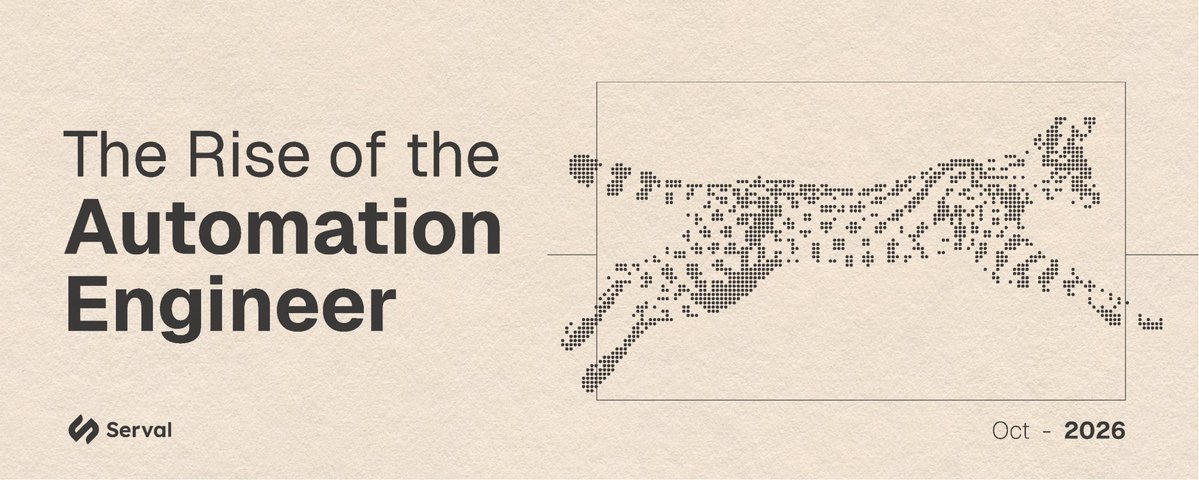
A big trend with most enterprises that I talk to is deploying internal FDEs into departments in their organization to help bridge the capabilities of AI into their underlying workflows.
This requires a high level of technical expertise, an understanding of AI, and the ability to understand the workflows and processes that the enterprise is trying to automate. There’s no shortcut to getting automation without this combination of skills (either in one person or multiple).
What’s exciting is this is an entirely new function in most enterprises, which is going to create a ton of new roles in the economy.
“Every generation of technology creates jobs that didn't exist before it, jobs that arise from an immediate need in an emergent industry. The Automation Engineer is a key example of those jobs for this generation. Nobody has ten years of experience doing this yet, because ten years ago the tools that made it possible didn't exist (it didn’t even exist two years ago).”
If you have software skills and are diving into AI, this is an area to go deep on.

Rama Ramakrishnan retweeted
Because so much of the debate about AI and jobs is driven by fears of outright replacement, there's a much more likely way in which AI could make work worse that isn't getting much attention. Here's my case:
1) A growing share of knowledge workers are managers of AI agents rather than doing the work themselves.
2) Being a manager (of humans) actually kinda sucks. You don't get to practice the craft you trained for; being responsible for others' mistakes is super stressful; and your attention gets split between dozens of things.
3) But we managers don't get to complain — it's higher pay and higher status, and mentoring people and watching them succeed is incredibly gratifying. We chose to get promoted.
4) Being a manager of AI brings all of the negatives without any of the positives. When everyone is a manager, it's not high pay / high status. And the role change is forced upon you.
What am I missing?
Rama Ramakrishnan retweeted

“feeling dumb” has been the single largest bottleneck on growth in my life and I have arranged so many things in order to avoid it.
“What prerequisite knowledge am I missing” is a great reframe. You can keep taking a step further back until you have what you need to progress

Rama Ramakrishnan retweeted

The more time I spend working with coding agents, the more convinced I am that they make software engineering even harder
We can do amazing things with them, but unlocking their full potential requires extraordinary discipline and knowledge

Bury your head in the ground at your own risk. I aim to not jump on any hype trains, but since Opus 4.6 and GPT-5.2 + the harnesses it was clear that these things can write code nearly as good as I can in my best language; better in other languages.
But we won't see non-devs push production code for a long time; possibly forever, if you ask me. Software still needs to be built in robust ways, and it's our profession to do this well, and use the new tools we have, which create new and interesting (+tough!) challenges
Rama Ramakrishnan retweeted

for the past few months i've been asking our models to paint. opus 5.5 is very skilled at emulating different styles
every image here is a python program generated pixel by pixel. there is no image model, and no off-the-shelf art software. instead, it's about 7,500 lines of code using standard libraries to emulate different brush styles. the agents don't use any pictures as reference, instead working only from what they know about each painter


Rama Ramakrishnan retweeted
A founder of a startup I funded had these brass plaques made to put up over his and his cofounder's desks. (He's Build Stuff, she's Talk to Users.)

Rama Ramakrishnan retweeted
The way to the reconcile capability level of AI vs. GDP impact is that the diffusion of AI will take much longer than people think. And it will also show up in ways that are hard to measure in GDP immediately.
You could bring the world’s greatest superintelligence to many workflows, and still be bound by the laws of corporate physics: getting data prepared and put into a pipeline, process reengineering and change management, aligning on how the new workflow should function, and so on.
Even after you solve all that, you’re still bound by the speed of the real world: waiting for a customer to respond to a proposal, getting a permit for a project, a drug discovery pipeline taking years to eventually reach the consumer, and so on. Not to mention lots of positive daily AI use-cases are entirely net neutral to GDP, at least in the near term.
AI diffusion is going to be the theme of the next decade. The upside is that there’s a tremendous amount of opportunity in building the bridges between superintelligence and real-world workflows.

Rama Ramakrishnan retweeted

Checking that a major mathematical proof is correct can take years. Formalization—converting the mathematical reasoning into a form computer proof assistants like Lean can verify—can help.
Last month, Claude completed the first formalized proof of Fermat’s Last Theorem, one of the most famous theorems of all time. This was a project experts thought would take many years. It is the largest Lean proof ever written.
Fermat’s Last Theorem was first proven in 1995 by Sir Andrew Wiles, more than 350 years after it was conjectured. Our proof, which totals over 13 million lines of code, provides machine verification. More importantly, it proves over 29,000 other theorems that the proof requires, across many areas of math which had never before been formalized.
We see this as a major step in the long process of firming up the core of mathematical knowledge, building on work from three centuries of mathematicians and hundreds of contributors to Lean and Mathlib. We are optimistic that AI-assisted verification of mathematical proofs will help reduce the burden of refereeing mathematics in an era where more proofs are being produced than ever before.
You can read about the process on our Science Blog: anthropic.com/research/forma…
And see the complete proof on GitHub: github.com/anthropics/fermat…