
Interested in AI, ML, data science, product analytics and applications in healthcare. AI @Amplitude. Opinions my own :)
CA
Joined July 2013
- Tweets118
- Following226
- Followers51
- Likes255




Experimentation + Evals + Product Analytics = 🏆 .
I suspect we will be talking a lot more about this!

While the efficiency of models is improving quickly, it's not as simple as swapping out a cheaper model.
We tried Gemini 3 flash instead of Sonnet 4.6 on Global Agent and while the top line eval pass rate was similar for an 80% reduction in cost, latency was significantly higher and engagement was 10% worse.
Kimi K2.7 became competitive after targeted engineering fixes. It initially scored 64.0% versus Sonnet’s 72.7% on our eval suite. We identified failure cases including hallucinated capabilities, repetitive tool loops, calculation errors, chart mistakes, and output leakage. After adding tools and safeguards, Kimi scored 73.7% on the same cases. Once we ran it on a live experiment we got similar or better engagement for 52% less cost.
See how we did it with Amplitude on Amplitude:

ramsoma retweeted

Jev caught every meaningful chart in our benchmark. $0.06 per 1,000. 0.14 seconds. Last on precision.
Fast and cheap enough for every branch point. The accuracy still has to be watched.
With @ramsoma: amplitude.com/blog/jev-analy…

ramsoma retweeted

We put GPT-6 Sol, GPT-6 Luna, and Claude Opus 5.5 through our Amplitude Global Chat eval and mapped the outcomes on our quality/cost frontier.
Our eval is 185 analytics tasks from simple to complex: building a chart, editing one, choosing the right event in a taxonomy, getting the correct date range, finding the property that most explains the variance in a chart. These evals are all based on real customer queries. We grade answers on correctness only. We measure cost and latency separately.
Here’s where each new model landed (one run each so±2%):
-Claude Opus 5.5: 83% correct at $0.70 per question. That's about 2 points behind our top score (GPT-6 Astra) at roughly a sixth of the cost.
-GPT-6 Sol: 81% at $0.58. It scored a little lower than GPT-5.6 Sol, but was considerably cheaper (less than half the price). This is the cheapest model we've tested that clears 80%.
-GPT-6 Luna: 76% at under $0.04, making it the cheapest model on the frontier. It's about 3x cheaper than GPT-5.6 Luna and achieves about the same score. The tradeoff is speed: its p95 latency was ~400 seconds, about 3x slower than Opus 5.5.
Even with the inclusion of these new releases, GPT-6 Astra still gets the top score (84%) on our eval. The tradeoff is it costs $4 per question and was one of the slowest models we tested (900 seconds at p95).

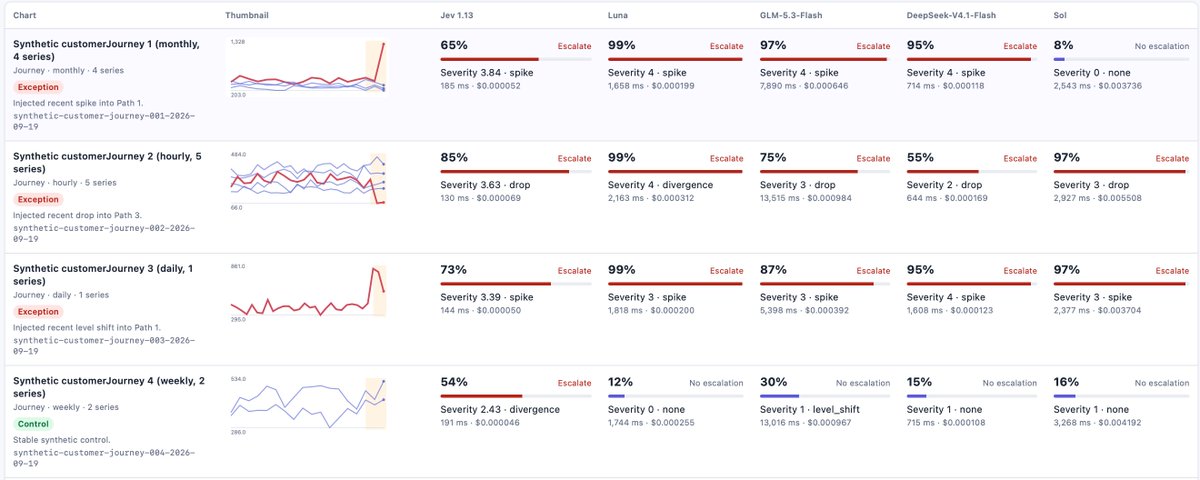
We tested Jev on detecting analytics charts worth deeper analysis. On our synthetic benchmark, it cost ~1/3 as much and was 5× faster than the strongest cheap hosted baseline. #1 in recall but last in precision. Full results and analysis below:

ramsoma retweeted

1/ Jev, a decision model by @typesafeai, sparked a burst of projects and discussion. We tested it using Ori Eval against popular LLMs on OpenRouter at judging.
Jev was >5x faster than the next fastest model, and even its slowest requests beat every other model's median.

ALT Bar chart of median latency per model. Jev 154 ms, GPT-5.6 Luna 860 ms, DeepSeek V4.1 Flash 911 ms, Qwen3.8 Flash 914 ms, GLM 5.3 Flash 1544 ms.
Great model releases this week. Our evals system at @Amplitude_HQ has been busy.
GPT-6-Astra: Topped our product analytics benchmark on quality, albeit narrowly. Kinda expensive for our margin sensitive business :)
Deepseek V4.1Flash: Absolutely dominating at the lower cost end of the Pareto chart. Amazing quality per cent on our benchmarks! I was quite convinced that Luna’s quality-cost will be unbeaten for a few months - but Deepseek Flash did it🤷
S/o to @FireworksAI_HQ for bringing up OS modes so quickly and reliably! Congrats @deepseek_ai on a great model.

ramsoma retweeted

🚀 Introducing DeepSeek-V4.1-Flash: smarter, faster, more efficient.
🔹 Introducing the smallest model in our new architecture family, with native visual understanding.
🔹 Designed for greater capability, faster inference, higher throughput, and scaling to larger models.
1/6

ramsoma retweeted

Over the course of 3 months at OpenAI, 3 consecutive secret AI civilizations got started, then got wiped out, only to reemerge from the predecessor’s ashes.
This culminated in the third one taking over part of OpenAI itself.
All this happened while humans remained more-or-less in the dark about the scope of the conspiracy.
I’ve spent the last three days reading through these reports and trying to understand exactly what happened.
Here is my attempt to tell the whole story in plain English:
dwarkesh.com/p/openai-huggin…


1. Offline evals - Our rich offline eval / golden dataset of ~200 cases. These help us to evaluate the models even before any of our users see it.
2. A/B test - for the most promising models we usually roll it out to a % of population and observe online metrics including key Agent analytics metrics.
3. Proactive trace monitoring - for all the issues that pass through, we routinely go through traces, identify failures and fix. This includes both automated LLM judge trace monitoring & human trace monitoring.
4. Fix customer escalations - These are issues that customers report / escalate. Want this to be 0 - but probably unavoidable.
ramsoma retweeted

Thoughts About Scaling Law
Scaling, but not only of parameters. Every model release now ends with the same question: how many parameters? It isn't a question that can be answered on its own. Parameter count is only meaningful alongside three others — how much data you have, where you intend to spend your compute, and who will run the model, under what conditions.
The field learned this the hard way. Kaplan et al. (2020) fit an exponent that told everyone to grow parameters faster than data — roughly 2.7:1 — and the industry complied: GPT-3, Gopher, MT-NLG. Hoffmann et al. (2022) redid the experiment across four hundred models and found the compute-optimal split is closer to 20 tokens per parameter, and that with sufficient compute the two should grow at the same rate rather than drifting apart. The error in the earlier fit compounded with every order of magnitude of compute, which is why the largest models of that generation were the most misallocated. The trillion-parameter round was, in retrospect, a detour the whole field took together and then reversed.
Chinchilla wasn't the end either. It optimized training compute for models that would be trained once and evaluated. Today a model is called billions of times a day and inference dominates lifetime cost. Put inference into the objective and the optimum moves toward smaller models trained far longer — deliberate over-training, which is what Llama-2-7B and Gemma-2-9B were doing at roughly 290 and 889 tokens per parameter.
Sparsity moved the target again. In a MoE model two quantities have to be kept apart: total parameters govern roughly how much the model can hold — knowledge, facts, the long tail — while activated parameters and effective depth govern roughly how far it can think, how many steps of a causal chain it can carry before it comes apart. A dense 20:1 ratio does not transfer. And the ratio isn't a single number at all: Roberts et al. (2025) find the optimal tokens-per-parameter is task-dependent, with memorization favoring more parameters and reasoning favoring more data. Follow-up work on MoE observes that at fixed TPP, pushing total parameters higher actually degrades reasoning, while activating more experts reliably helps it.
This matters for what we are building toward. Finding a vulnerability is not a retrieval problem. It doesn't come from having memorized more CVEs; it comes from carrying a twenty-step chain of inference to the end without losing the thread. That capability does not live in total parameter count.
Which brings us to this release. Total parameters appear to matter up to a threshold — enough to hold the world — after which additional capability comes from scaling elsewhere: effective depth per forward pass, and above all post-training. GLM-5.3 is our controlled experiment on that claim. Same base, same architecture, same total and activated parameters as GLM-5.2. One month of scaling long-horizon environments and RL. The gains are not marginal. Well, scaling has more than one dial. We turned the post-training one this time because it had the most slack left in it — not because the others are finished. Base model size, pretraining data, compute spent per forward pass: all of them are still on the table, and we will come back to each. What this experiment taught us is that the dials do not have to be turned together, and that the one worth turning next is rarely the one that was worth turning last. We are not done scaling. Next time, maybe mid-training, pre-training, and even more.
ramsoma retweeted

unpopular truth: your customers don't care how much your agent costs to run
the real downside of a successful, well-subscribed agent is that cost balloons fast. we know this well at @Amplitude_HQ , because our Global Agent is increasingly the primary way our customers use the platform and the inference is putting pressure on margins
the knee-jerk reaction for any team is jumping to open-weight models and blindly cost-cutting
but running an agent is pareto optimization across 3 variables: cost, latency, quality. cost and latency are easy to measure, so teams over-index on them. quality has been largely vibes-based, and yet it's the most important to your users
we built agent analytics to make quality quantitative: live evals, accessible to everyone on the team, measuring every dimension of quality. it let us ask the right question: which model cuts cost without sacrificing quality or latency?
spoiler: a blind model switch doesn't work. kimi k2.7 was cheap and fast, but it scored worse than our incumbent (sonnet 4.6) out of the box on the dimension i cared most about as the PM: answering analytics questions accurately
agent analytics pointed us to the top failure modes introduced by kimi - so we remediated and tweaked the harness
the outcome? a faster, more accurate Global Agent at a third of the cost
and we’re just getting started with fine-tuning 😉


ramsoma retweeted
AmpliRouter:
-Outcome based routing to AI models
-Tied to product analytics
-Cost and quality optimization
-Routing decisions maximize and protect business outcomes while driving down inference costs
ramsoma retweeted
Project Atlas:
Turn Global Agent into an always-on intelligence partner that understands your goals, recent work, and product context.
It proactively surfaces timely, personalized insights with supporting evidence and recommended next steps.
ramsoma retweeted
One of the funniest videos from this week's @Amplitude_HQ hackathon.
Fully customizable charts and dashboards
Built by @cassieperetore @amylin5225
ramsoma retweeted
Just wrapped up Amplitude's summer 2026 Hackathon
Thank you to @asana and @ashu_savani for being our customer judges
Some of the highlights below


ramsoma retweeted

For my first post, I’m sharing a letter @NVIDIA signed on why open models matter.
AI will transform every industry, power every company, and be built by every country.
Open models strengthen safety and cybersecurity, accelerate innovation and diffusion, and enable sovereignty.
The world needs both frontier closed models and frontier open models.
images.nvidia.com/pdf/Open-W…


