





Dallas-houston at sunset with the windows down and a custom playlist for 3 hours on cruise control

31
If @keranews radio continues to ask for donations, i might actually give them my money
34
Ramzy El-Amine retweeted

Life if Jensen Huang returns as CEO of NVIDIA #standwithjensen
Your favorite podcaster has less ball knowledge than you.
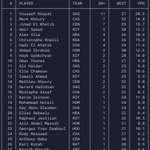
I asked Claude to extract the over/under predictions from last season's episodes of the Bill Simmons podcast, and compare them to the actual win totals from 2025-26.
Here's how each of the hosts performed:
1
1
43
If Bill and Zach had wagered $100 a pick, they would've netted -$600 each. House would've netted -$1,000.
While they may be good at spotting talent, they understand just as much about team performance as the average fan.
They all would've likely been beaten by a coin toss.
1
16
Here's a breakdown of the picks, and the episodes are here:
part 1 - youtube.com/watch?v=kO4n1GBo…
part 2 - open.spotify.com/episode/63y…


12
“You can see everything” could’ve been 6 hours long and i would’ve enjoyed it all the same. Much respect, Nathan Fielder. Incredible movie
2
42

Ramzy El-Amine retweeted
This man is so wonderful! Amazing moral clarity

I've been in politics for a quarter century. It's hard to express how staggering it is to see a conversation like this on corporate US media. The Morning Joe panel gobsmacked by the directness of @AbdulElSayed's points.
(clip via @DropSiteNews)
Ramzy El-Amine retweeted

We introduced Steve Kerr to his viral doppelgänger, Steve.
The Steves hit it off. And now they're making plans.
"You are a stunningly handsome man."
Ramzy El-Amine retweeted

It's a week into the season and the NBA is averaging the most possessions per game, shortest average possession length, highest average pickup distance, and most possessions with at least three offensive players crashing in the tracking era. Playing very hard for 82 games!

Not all successful challenges are equal. Some win you the ball back, others win you points, free throws, and change the course of the game.
I’ve quantified the return value of all 1,195 successful challenges during the 2025-26 NBA season from the details of the overturned calls
1
1
98

the real risk is all the companies and government entities that are leaking sensitive information to open ai and anthropic without realizing it because the haven’t put necessary guardrails around employee usage and haven’t invested in gpus for local inference
48
In dragon ball z, goku goes to train in a hyperbolic time chamber, where time is diluted. Several months pass as one day in the “real” world. That’s how it feels coming back to Beirut from the US each summer. Time passes, but so little changes.
2
61

Ramzy El-Amine retweeted

The Alcaraz-Shelton highlights are outrageous
youtube.com/watch?v=wYd7I5_t…

Important implications for scientific research beyond the field of computer vision

What is the role of academic computer vision research in the age of increasingly powerful large models? Is GPT-6 Astra a step change? How can a researcher have an impact today in academia?
These are the questions I ask myself as I head off to ECCV 2026, a conference I’ve attended since 1992. One of my papers this year is VIGA, a method that takes an image as input and outputs a 3D Blender scene that represents that image. This is a classical inverse-graphics task and VIGA was the first method to solve it using an agentic approach.
The idea is now several years old and the first version of the paper was rejected. This delayed publication significantly. After it was accepted at ECCV, it was quickly surpassed by people using Claude Code for the same purpose. Today GPT-6 Astra blows away all previous results. But we still head off to ECCV to tell the community about our invention that is now fully out of date.
The way academic work often progresses is that one reads recent papers, notices that they have limitations, comes up with a new idea, explores this, publishes it, etc. Any published paper I read today is based on ideas that are at least a year old. And those ideas were based on the literature of the time, which was also a year old. That means that any paper I see at ECCV is likely two years out of date. In AI today, two years means your work is likely irrelevant.
At CVPR this summer I noticed that many authors have not gotten the message. They continue to work on “old” problems that have a long history. This history is based on assumptions about how the “vision problem” will be “solved”. The truth is that it is being solved in a very different way and many of these problems are no longer relevant. Another group of papers focuses on very niche problems where large models likely fail because of insufficient data or lack of business interest. The impactful papers were largely from industry and had long author lists and massive data+compute behind them. These papers were also out of data, describing systems that had been released months before, but at least they served to provide the community with more complete documentation and analysis of commercial systems.
So what should academics do? First, we need to put aside the tools we’ve used for years and start from scratch. Every project should start by trying really hard to solve the problem with existing tools. I would like to see every paper begin with a detailed experimental analysis of how existing models perform and why they fail (if they do). This gives the kind of insight we need today. Then, assuming current models fail, the solution should provide some fundamental insight that will outlive the next release of such models.
Reviewers today still focus on technical novelty. This pushes people to focus on tweaking architectures rather than clearly moving the field forward. Papers need to be judged based on their novel insight and not their novel technical contribution. This is a real shift in thinking but it focuses us on what matters - progress of the field.
If we want there to be a “field” of computer vision, then it can’t become a marginal backwater, focusing on esoteric problems. If you haven’t tried using Astra (or whatever comes next) to solve your problem, then you have not done your homework. This omission should be seen as negatively as not having a previous work section.
Concretely, I think papers should include a new section analogous to “Related Work” where that related work is current models and how they perform on the task. Reviewers should start asking for this and expecting authors to be able to articulate their insights about the limitations of existing large models.
I'm interested in your thoughts.
3
78