
Co-founder, Samasthiti Advisors. #40under40 Alternative Investment Professional. Member, PL Committee, CFA Society India. Views personal.
Chennai, India
Joined April 2009
- Tweets3.2K
- Following564
- Followers3.7K
- Likes2.3K




Pinned Tweet
*IMPORTANT NOTICE*
It has been brought to my attention that unknown individual(s) have used my identity to provide stock tips and lure investors to trade/speculate in stocks. It is hereby clarified that *I do not provide any stock tips and do not reach out to investors...
In 1994, two people retired with almost the same amount of money. One ran out. The other still has 96% of it left.
One used the classic "4% rule", while the other used the "forego inflation" method.
We back-tested both these strategies, and the result:

- The classic 4% rule ran out in December 2022, a year short of the finish line
- The forego inflation rule, which started with ₹20 lakh smaller corpus, finished 30 years of retirement with ₹76.7 lakh still intact.
Full case study (with the data and charts) here: samasthiti.in/a-30-year-reti…
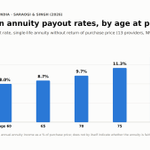
1/ Should you convert part of your retirement savings into an annuity? We studied this for Indian retirees. Short answer: it depends almost entirely on the payout rate you lock in. Here's what we found 🧵@team_samasthiti

7/ The exception: "with ROP" annuities (your money returned to your family on death) are priced fairly — MWR of 0.92-0.98. You trade a bit of income for that guarantee.
8/ Bottom line: annuitizing isn't automatically good or bad. Check the payout rate you're offered, the product type, and how much you actually need to withdraw before deciding. Full paper with all the data: papers.ssrn.com/sol3/papers.…
If a retiree chooses to partially annuitize their corpus, how does it impact their retirement? My recent co-authored study examines this.

- Single life, without ROP: loading rises from 18.5% at age 60 to 22.5% at age 80. Joint life, without ROP: loading rises from 17.1% at age 60 to 25.0% at age 80
- For every ₹100 paid in, ₹18–25 is absorbed by the insurer before a rupee reaches the retiree as expected income
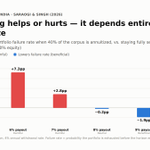
The implication is that partial annuitization is not uniformly good or bad. At annuity payout rates of 6–7%, annuitizing raises the risk of running out of money, while an ~8% or above annuity payout rate, it can improves outcomes.
Full study - papers.ssrn.com/sol3/papers.…
In May 2026, @PFRDAOfficial launched the Retirement Income Scheme (RIS), which is India's first regulated NPS decumulation product, sitting between rigid annuities and do-it-yourself (DIY) withdrawals. My latest paper decodes this landmark scheme:
- The two RIS styles serve different retirees. The Systematic Payout Rate (SPR) offers higher expected and upside income but a bumpier ride, with late-life income that can fall in poor markets. The Systematic Unit Redemption (SUR) trades some of that upside for a smoother ride.
You can read the full paper here: papers.ssrn.com/sol3/papers.…
@team_samasthiti