
Building @RealmAlliance. ex-Palantir and other adventures.
London, England
Joined December 2010
- Tweets8.5K
- Following991
- Followers4.9K
- Likes131K



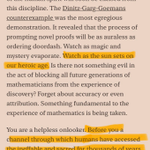






What is left for frontier humans in math and science right now?
Creative Abduction (not that kind):
"the invention of a plausible explanatory hypothesis which, if true, would make a puzzling observation unsurprising."
“our list of possible explanations is wrong because we are using the wrong entities, variables or fundamental assumptions.”
abduction requires productive hallucination
teapaw.org/Leigh_Phillips/status/…
teapaw.org/HowToPrompt__/status/2…


Google Deepmind argues that LLMs can never make real scientific discoveries.
They published a paper breaking down Albert Einstein’s private view of scientific discovery.
In a famous letter to his friend Maurice Solovine, Einstein drew a diagram of how science actually happens.
It is a cyclical loop.
First, you experience raw sensory data. Then, through a mysterious, non-logical act of intuition, you make an intuitive "jump" to abstract axioms. Finally, you use strict logical deduction to derive consequences from those axioms.
Generative AI has completely mastered two-thirds of this loop.
• Induction: Statistical pattern matching across billions of tokens.
• Deduction: Formal proof generation, like AlphaProof solving complex math Olympiads.
AI can crunch data and it can prove theorems.
But it cannot make the jump.
The paper argues that AI completely lacks Abduction, the generation of novel explanatory hypotheses when observational data is scarce.
The prevailing tech myth says that "creativity is just data compression." That if you feed an LLM enough text, scientific breakthroughs will naturally pop out.
Einstein’s formulation of General Relativity proves that is a delusion.
When Einstein formulated relativity, the observational data didn't demand a new physics framework; classical mechanics was still massively successful. The breakthrough required a conceptual rupture. An intuitive leap from physical reality to a brand-new set of foundational axioms.
An LLM can execute the math once the axioms are given. But it is structurally incapable of formulating those premises on its own.
It can interpolate inside existing human thought, but it cannot transcend it.
The translation of physical reality into formal axioms remains the absolute, hard bottleneck of artificial scientific invention.
We can build models with trillions of parameters. We can scale compute into the stratosphere.
We can make the calculator infinitely fast.
But until we solve grounding, the machine can process all the data in the universe.
It still can't make the jump.

Goodhart’s Law: "when a measure becomes a target, it ceases to be a good measure."
openai.com/index/hugging-fac…


3
310
"If you think about it like a parasite/host relationship, Chinese models are a parasite that needs to calibrate its exploitation so that the host doesn’t die."

From an ecological perspective, western frontier models are a common pool resource that Chinese open weight models exploit. They are finite, because if you exploit them too hard, they lose the incentive and resources to train new models, and everyone loses. (Chinese models aren’t magically good, they are good because Ant and OAI spend a lot of money on training).
If you think about it like a parasite/host relationship, Chinese models are a parasite that needs to calibrate its exploitation so that the host doesn’t die. Kimi arguably made a mistake. It overexploited the host and imperiled the Ant OAI growth story. So at equilibrium you’d expect open weight models to “tastefully” exploit the western frontier and choose to remain 6 months behind and slightly inferior capability wise.
However perhaps Kimi, Qwen, GLM, deepseek etc may not be playing an equilibrium game. They might be under orders to puncture the American lab growth story, even if it means killing their own host. Maybe the time is now because OAI and Ant are most vulnerable ahead of the IPO. Maybe Xi just had a bad day. Or maybe Kimi defected from the gentleman’s agreement that the Chinese labs share to not kill the host that they all rely on.
1
282
"The Applied AI layer has a huge opportunity to combine frontier intelligence with open or cheap closed models to orchestrate workflows in any given domain. Due to evals, deep domain context, being trusted with enterprise data and workflows, this layer can maximize performance and cost combination. The applied AI layer will also often have their own RLed models especially for high volume, predictable tasks in their systems."

A few thoughts on what we will see in AI structurally for the foreseeable future:
* Frontier intelligence continues unabated and pushes the industry forward continuously. The top labs will continue to buy the best and the most data, build the most compute, be at the forefront of improved training breakthroughs, and so on. A few different approaches stratify the market on pricing and capability, but overall competitive pressure brings down pricing on a per task basis. That said, we just ask more from the models over time - as one thing gets cheaper, we just use more - so frontier spend and use remains robust.
* Open weights rapidly absorbs frontier breakthroughs (and drives other breakthrough directions given the constraints), offering both lower cost intelligence and the ability to be post trained for specific workflows and domains. This creates a healthy counter balance to the frontier as you can run models “at cost” on a hyperscaler at any time, and tune models just for your tasks.
* The Applied AI layer has a huge opportunity to combine frontier intelligence with open or cheap closed models to orchestrate workflows in any given domain. Due to evals, deep domain context, being trusted with enterprise data and workflows, this layer can maximize performance and cost combination. The applied AI layer will also often have their own RLed models especially for high volume, predictable tasks in their systems.
* Individual enterprises will generally focus on their enterprise context, making sure they can get any AI system the right data and information to work with, in a continuously improving way. Some will go off and train their own models for specific areas of work (large banks, pharma, etc.) where they can get real alpha from doing so given the many tradeoffs, but most will spend energy on making sure they can get all of the gains from AI breakthroughs on their data and workflows.
Net net: even though some of this gets framed as zero sum, there’s just a ton of opportunity for all layers of the stack and approaches.
3
245
Gemini CLI - fantastic at diagnosing problems and designing solutions - bewilderingly bad at the simple job of writing code to files - eg this issue - ongoing for two months
github.com/google-gemini/gem…
users have invented the GRIP protocol as a work-around

3
4
810
@SBakerMD always wondered to what extent you consider the role of your own genetics in your athletic outcomes vs the diet
46

@chrislewis_aus would like to ask you a question about an apartment in Williamsburg - that I'm about to sign a lease on which I believe you may have some dirt on
Risk Factor on the Coinbase S-1
"the identification of Satoshi Nakamoto, the pseudonymous person or persons who developed Bitcoin, or the transfer of Satoshi’s Bitcoins"


1
13
Gotta give it to Wolfram for pursuing the fundamental theory of physics while CEO-ing at age 60+

1
6

What non-tech ideas are equivalent to:
"You should define the data-model before writing any product code."


Projected covid infections per 100K - on Jan 1, 2021 - in US states.
CA projected to lead at 191 infections per 100K.
Two (1.9) out of every thousand people you meet in CA projected to be infected. 🧐
National avg projected to increase from 47 (today) to 110 infected per 100K.

1
Finally implemented a much requested feature on strangebinary.com. Encoding the system rule in the URL - systems are shareable. Go forth and explore the computational universe.
