

RENEWING PROTESTANT® • Teaching, correcting, and calling God's people back to pure Bible truths that renew the mind • Reviving the spirit of true Protestantism
Joined April 2023
- Tweets6.2K
- Following307
- Followers1.5K
- Likes12.6K




Pinned Tweet
Tracing the Beautiful Unbroken Pattern of Sabbath Rest. From Adam and Eve in Genesis to the Redeemed saints in the Earth made knew.
If you are a Christian who sits in a church pew every Sunday morning, this is an open invitation to step away from centuries of inherited church traditions, clear your mind, and look directly at a staggering, undisputed fact written plainly across your own Bible:
From the first chapter of Genesis to the final vision of Revelation, every major character of Scripture rested on the exact same day.
Not one of them ever kept a Sunday. Not one of them left a single command to switch days. Trace the line yourself, person by person, and ask yourself why the modern church broke the chain.
1. The Creator of the Universe
The very first Entity in all of cosmic history to observe the Sabbath was not a Jewish man, a patriarch, or a prophet. It was Almighty God Himself.
“And on the seventh day God ended His work which He had done; and He rested on the seventh day from all His work which He had done. Then God blessed the seventh day and sanctified it…” (Genesis 2:2-3)
⏸️ Pause and read that again:
God did not rest because He was physically tired; He rested to establish a permanent monument to His authority as Creator. He built this 24-hour palace of time into the literal fabric of a sinless planet long before sin ever required a cross, a ceremonial sacrifice, or a Jewish nation.
2. Adam and Eve
Created on the afternoon of the sixth day, the first parents of the human race took their very first full breaths of life inside a holy day.
“And God saw everything that He had made, and behold, it was very good. So the evening and the morning were the sixth day.” (Genesis 1:31)
⏸️ Pause and read that again:
Adam and Eve’s very first full day of existence was the Seventh-day Sabbath. Their initial human experience was not an experience of exhausting physical labor, but of intimate, restful communion with their Maker in Eden. The Sabbath was given to mankind at our birth.
3. The Patriarch Abraham
Centuries before the stone tablets were carved at Mount Sinai, the father of the faithful was already living in complete alignment with God's moral boundaries.
“Because that Abraham obeyed My voice, and kept My charge, My commandments, My statutes, and My laws.” (Genesis 26:5)
⏸️ Pause and read that again:
God has only ever had one moral law. If Abraham kept God's specific laws and statutes, he was actively guarding the sacred day of rest that God had blessed and set apart in Eden.
4. Moses, Aaron, and the Millions of Israel
Weeks before Israel ever arrived at Mount Sinai, God performed a massive, weekly, three-part miracle to retrain His people on the sanctity of His specific day.
“Six days you shall gather it [the manna], but on the seventh day, which is the Sabbath, there will be none.” (Exodus 16:26)
⏸️ Pause and read that again:
For 40 consecutive years in the wilderness, God sent a double portion of food on Friday, preserved it from rotting overnight, and sent absolutely nothing on Saturday. When a few individuals tried to go out and work on the seventh day anyway, God did not say, "I am about to give you a new law." He barked in righteous anger, “How long do you refuse to keep My commandments and My laws?” (v. 28). The Sabbath was alive and binding long before the Ten Commandments were spoken aloud.
5. Elijah, Isaiah, Jeremiah, and the Prophets
Throughout the tumultuous history of Israel, the prophets stood as fierce guardians of the Fourth Commandment, explicitly warning that compromising this day would result in national ruin.
“If you turn away your foot from the Sabbath, from doing your pleasure on My holy day, and call the Sabbath a delight, the holy day of the Lord honorable… then I will cause you to ride on the high hills of the earth…” (Isaiah 58:13-14)
⏸️ Pause and read that again:
The prophets never treated the Sabbath as an annoying legalistic ritual. They viewed it as the ultimate line of demarcation between those who worshipped the true God and those who drifted into pagan sun worship.
6. King David and the Sanctuary Choirs
During the golden era of Israel's monarchy, King David organized the structural governance of the tabernacle worship, explicitly designing a perpetual weekly rhythm for the Levites that prioritized the Seventh day.
“And others of their brethren of the sons of the Kohathites were over the showbread, to prepare it every Sabbath.” (1 Chronicles 9:32)
⏸️ Pause and read that again:
David understood that God's presence required a continuous rhythm of obedience. He commissioned dedicated Levites whose entire life purpose was to prepare fresh showbread inside the sanctuary every single Saturday morning. David’s own psalms bear this signature; Psalm 92 is explicitly titled in the Hebrew text as "A Song for the Sabbath Day," revealing that Israel’s greatest king structured his personal praise around the holy hours.
7. Ezra the Scribe: Reviving the Fallen Law
When the remnant of Israel returned from the crushing weight of the 70-year Babylonian captivity, the nation was spiritually broken. Ezra the priest stood before the ruins of Jerusalem to read the Torah and rebuild the shattered spiritual foundation.
“You came down also on Mount Sinai, and spoke with them from heaven… And made known to them Your holy Sabbath…” (Nehemiah 9:13-14)
⏸️ Pause and look at that verse one more time:
Ezra led the people in a massive, corporate prayer of national repentance. Notice what he emphasized: he did not list the Sabbath as a casual cultural habit or an optional ritual. He identified the Seventh day as a supreme, direct revelation given by the voice of God on Sinai. Under Ezra’s reformation, Israel collectively covenanted to clear out foreign influences and protect the holy day.
8. Nehemiah the Governor: Weaponizing the Gates
When Nehemiah looked at the newly rebuilt walls of Jerusalem, he was horrified to find merchants and heathen traders turning the holy hours into a frantic marketplace. His response was swift, radical, and unyielding.
“So it was, at the gates of Jerusalem, as it began to be dark before the Sabbath, that I commanded the gates to be shut, and charged that they should not be opened until after the Sabbath.” (Nehemiah 13:19)
⏸️ Pause and read that again:
Nehemiah didn't just give a polite sermon; he literally weaponized the city gates against commercialism, placing his own servants at the entrances to ensure no economic burdens crossed into Jerusalem on Saturday. When the merchants camped outside the walls trying to bypass his decree, he threatened them with physical force:
“If you do so again, I will lay hands on you!” (v. 21).
For Nehemiah, the Sabbath was the ultimate boundary line of national survival.
9. Jesus Christ: The Lord of the Day
When the Word became flesh, He did not arrive to tear down the law He had personally spoken at Creation. He lived it out meticulously as our ultimate Example.
“So He came to Nazareth, where He had been brought up. And as His custom was, He went into the synagogue on the Sabbath day, and stood up to read.” (Luke 4:16)
⏸️ Pause and read that again:
Jesus didn't just stumble into church on Saturday because it was a convenient social gathering. It was His lifelong custom. He spent His entire ministry actively stripping the day of heavy, legalistic human traditions, declaring that “the Sabbath was made for man” (Mark 2:27)—using the Greek word Anthropos, meaning all of humanity, not just the Jews. He then flatly asserted His ownership over it, stating,
“The Son of Man is also Lord of the Sabbath” (v. 28).
If Jesus is the Lord of the Sabbath, then Saturday is the only true "Lord’s Day."
10. Mary Magdalene, Mary the Mother of Jesus, and the Holy Women
The absolute proof that Jesus never secretly taught His inner circle that the Sabbath was changing happened at the darkest moment of Passion Week.
“That day was the Preparation, and the Sabbath drew near… And they returned and prepared spices and fragrant oils. And they rested on the Sabbath according to the commandment.” (Luke 23:54, 56)
⏸️ Pause and read that again:
On Good Friday afternoon, Jesus died. His body needed to be embalmed. Yet, despite their overwhelming, earth-shattering grief, these holy women halted their preparation and refused to touch His body on Saturday. If Jesus had dropped even a single hint during His three years of teaching that the Fourth Commandment was expiring or shifting to Sunday, these women would have finished their work. Instead, they sat in silent obedience to the stone tablets while their Savior lay in the tomb.
11. Jesus Christ: Resting in Death
The absolute climax of human history occurred in a quiet garden tomb on the seventh day of the week.
“And on the seventh day God ended His work… and He rested.” (Genesis 2:2)
“He said, ‘It is finished!’ And bowing His head, He gave up His spirit.” (John 19:30)
⏸️ Pause and read that again:
Look at the cosmic symmetry. In Genesis, Jesus finished His physical work of Creation on the sixth day (Friday) and rested on the seventh day (Saturday). Thousands of years later, Jesus finished His agonizing work of Redemption on the cross on the sixth day (Friday), cried out "It is finished," and spent the entire seventh-day Sabbath resting in the sleep of death inside the tomb. He honored His Father’s commandment even while dead.
12. The Apostle Peter and the Early Church
Decades after the resurrection and the Day of Pentecost, Peter stood before crowds, completely unbroken in his commitment to the original faith.
“But Peter said, ‘Not so, Lord! For I have never eaten anything common or unclean.’" (Acts 10:14)
⏸️ Carefully look at that verse again:
If Peter was so hyper-conservative that he had never allowed a single piece of non-kosher food to touch his lips years after Christ ascended, do you honestly believe he would have casually abandoned one of the literal Ten Commandments written by the finger of God?
13. The Apostle Paul and the Gentile Converts
As the great missionary to the non-Jewish world, Paul traveled across the Roman Empire planting churches. If the day of worship had changed to Sunday in honor of the resurrection, his ministry would reflect it. It reflects the exact opposite.
“So when the Jews went out of the synagogue, the Gentiles begged that these words might be preached to them the next Sabbath.” (Acts 13:42)
⏸️ Pause and carefully read that verse again:
This was Paul's perfect strategic moment. He had a massive coliseum of hungry Gentile seekers begging to hear about Jesus. If Sunday was the new Christian day of worship, Paul would have said, "Hey, don't wait a week, show up tomorrow morning!" Instead, he left them waiting an entire week, and “on the next Sabbath almost the whole city came together to hear the word of God” (v. 44). The book of Acts records Paul doing this week after week, year after year, in city after city (Acts 16:13, Acts 17:2, Acts 18:4).
14. John the Revelator and the End-Time Saints
At the very end of the New Testament canvas, looking down the long corridor of time to the final generation of believers standing on earth just before the Second Coming, the Bible identifies God's people by a unique, undeniable signature.
“Here is the patience of the saints; here are those who keep the commandments of God and the faith of Jesus.” (Revelation 14:12)
⏸️ Pause and look at that verse again:
The book of Revelation does not identify the final saints by their human traditions, church dogmas, or cultural trends. They are identified by their unshakeable loyalty to the written Law of God.
15. The Eternal Sabbath
The chain does not end with the close of human history. The Sabbath was born in a sinless world, and it will endure forever in a restored world.
“‘And it shall come to pass that from one New Moon to another, and from one Sabbath to another, all flesh shall come to worship before Me,’ says the Lord.” (Isaiah 66:23)
⏸️ Pause and read that again:
Just a few years from now, on a New Earth completely free from pain, sin, and death, the entire saved family of God will still pause every single seventh day to bow before the Sovereign King.
The chain is completely unbroken. It spans from the perfect soil of Eden, through the wilderness manna, through the majestic courts of King David, through the gatekeeping reformations of Ezra and Nehemiah, through the quiet grave of Christ, through the trials of the apostles, right into the architecture of eternity.
Scripture never breaks this link. It never shifts the solemnity. It never authorizes a replacement.
If the Bible leaves this chain completely intact, it forces every honest believer into a profound, personal crossroads: If the shift to Sunday was implemented purely by human decrees, imperial edicts, and church traditions, whose authority are we recognizing when we rest?
Look back down the line. God the Father, Adam, Eve, Abraham, Moses, Elijah, King David, Ezra and Nehemiah, Isaiah and the Prophets, Christ the Savior Himself, the Mother of Christ, the Apostles, the Gentile converts, the final martyrs of the end times and the redeemed in the new Earth they all walk the exact same path.
Your Bible contains an absolute, ironclad consensus. Not a single author, character, or disciple in the pages of Holy Writ ever recognized Sunday as a holy day.
If this chain is completely unbroken from Genesis to Revelation, it leaves every honest Christian staring directly into a profound, undeniable question:
If every single person in my Bible kept the Seventh-day Sabbath, whose voice am I actually obeying when I worship on Sunday?

Please pray with this lovely child of God. 🙏

This is the truth right here! I am a follower of Christ for many many years. But not a good follower. Many mistakes. Many sins many selfish acts. But I really love this. I am not Jewish yet. I really want to learn about the Sabbath and keep it holy. I truly believe in my heart that the Sabbath like you said that has been established from the beginning from Eden to Even now, please pray for me that I will receive all truth from El Elyon.
Search the Scriptures retweeted

This is the truth right here! I am a follower of Christ for many many years. But not a good follower. Many mistakes. Many sins many selfish acts. But I really love this. I am not Jewish yet. I really want to learn about the Sabbath and keep it holy. I truly believe in my heart that the Sabbath like you said that has been established from the beginning from Eden to Even now, please pray for me that I will receive all truth from El Elyon.
The deception behind the futurist interpretation, is that it takes the breathtaking, glorious work of Jesus Christ dying on the cross to end the need for animal sacrifices, and sadly attributes that exact glorious work to the future Antichrist. It takes a crown jewel of Messianic prophecy and hands it to a fictional, future villain.
The tragedy of the counterfeit!

The prophecy of the 70 weeks of Daniel (found in Daniel 9:24–27) is mathematically the most devastating textual proof in the entire Old Testament verifying the exact timing of the first arrival, ministry, and sacrificial death of Jesus Christ.
For a Jewish or Roman Catholic thinker looking at biblical chronology, this prophecy provides an absolute anchor. However, a major theological divergence exists: the early Protestant Reformers utilized a continuous historical fulfillment (Historicism), whereas modern Futurism (the foundation of the "secret rapture" theory) introduces a massive 2,000-year "gap" or parenthetical pause between the 69th and 70th week.
Here is the correct and precise Biblical mathematical breakdown of the 70 weeks according to the historic Protestant timeline.
---> The Prophetic Scale: The Day-Year Principle
To unlock this prophetic math, we must apply the standard biblical rule of prophetic scale: one prophetic day equals one literal year (established in Ezekiel 4:6 and Numbers 14:34).
70 Prophetic Weeks = 490 prophetic days.
Applying the day-year scale, 490 days equals 490 literal years decreed specifically upon the Jewish nation and the city of Jerusalem ("Seventy weeks are determined for your people and for your holy city," v. 24).
---> The Timeline Breakdown: From the Decree to the Messiah
Daniel 9:25 gives the explicit starting trigger for the entire 490-year countdown: "From the going forth of the command to restore and build Jerusalem until Messiah the Prince..."
Historically, there were three decrees issued by Persian kings regarding Jerusalem, but only the third decree issued by Artaxerxes Longimanus in 457 BC (recorded in Ezra 7:11–26) gave the Jewish people full political authority to restore their civil government, laws, and city walls.
Phase A: The First 7 Weeks (49 Years) — 457 BC to 408 BC
The text splits the timeline: "seven weeks and sixty-two weeks."
The first 7 weeks (49 literal years) cover the agonizing period where the streets and walls of Jerusalem were systematically rebuilt, "even in troublesome times" (v. 25), matching the historical records of Ezra and Nehemiah.
Phase B: The Next 62 Weeks (434 Years) — 408 BC to 27 AD
Adding 62 weeks (434 literal years) to the completion of the city brings us precisely to the end of the 69th week (7 + 62 = 69 weeks, or 483 years).
• The Mathematics: Start at 457 BC and count forward 483 literal years. Because there is no "Year 0" when crossing from BC to AD, the math lands flawlessly on 27 AD.
• The Fulfillment: What happened in 27 AD? Jesus of Nazareth was baptized by John in the Jordan River and was anointed by the Holy Spirit (Luke 3:21–22). The word Messiah literally means "The Anointed One." In 27 AD, Jesus stepped out of the water and openly launched His public ministry, proclaiming: "The time is fulfilled, and the kingdom of God is at hand" (Mark 1:15).
---> The 70th Week: The Crucifixion and the Finished Sacrifice
Daniel 9:26–27 outlines what occurs during the final, 70th prophetic week (the last 7 years of the timeline, running from 27 AD to 34 AD).
The text states: "And after the sixty-two weeks Messiah shall be cut off, but not for Himself... Then he shall confirm a covenant with many for one week; but in the middle of the week he shall bring an end to sacrifice and offering."
---> The Midpoint Real-World Execution (31 AD)
The "middle of the week" represents exactly 3.5 years into the final 7-year block.
Adding 3.5 years to the autumn of 27 AD brings us precisely to the spring of 31 AD.
• The Fulfillment: In the spring of 31 AD, at the exact time of the Passover, Jesus Christ was crucified ("cut off, but not for Himself"). The moment He died, the heavy veil inside the earthly temple was ripped from top to bottom by an invisible hand (Matthew 27:51). By offering His own perfect body as the ultimate, once-for-all sacrifice, Christ legally brought an end to the spiritual validity of animal sacrifices and offerings in the eyes of God (Hebrews 10:12).
---> The Close of the 70th Week (34 AD)
The remaining 3.5 years of the prophecy run from 31 AD to 34 AD. During this window, the apostles focused their preaching almost exclusively on the Jewish nation in Jerusalem.
In 34 AD, the Jewish ruling council (the Sanhedrin) officially rejected the apostolic gospel by stoning the deacon Stephen to death (Acts 7). From that exact historical tipping point onward, the gospel began flowing directly to the Gentile nations, matching Paul's declaration in Acts 13:46: "It was necessary that the word of God should be spoken to you first; but since you reject it... behold, we turn to the Gentiles."
But have a look at how modern Futurism (Jesuit-originated eschatology) treats this text.
Futurism slices the 70th week off the timeline, introduces an unwritten 2,000-year "gap," and pushes the last 7 years into the future. They claim that the phrase "he shall confirm a covenant... and bring an end to sacrifice" refers to a future political Antichrist who will make a treaty with modern Israel, rebuild a stone temple, and then betray them.
But here is a heavy exegesical defeat:
The central figure of Daniel 9 is Jesus Christ (Messiah the Prince), not the Antichrist.
The text says he will confirm the covenant (Greek/Hebrew denotes a specific, existing covenant). Jesus explicitly stated at the Last Supper: "This is My blood of the new covenant, which is shed for many" (Matthew 26:28). Jesus confirmed the New Covenant through His blood.
The futurist interpretation takes the breathtaking, glorious work of Jesus Christ dying on the cross to end the need for animal sacrifices, and attributes that exact work to the future Antichrist. It takes a crown jewel of Messianic prophecy and hands it to a fictional, future villain.
The 70 weeks of Daniel requires a seamless, historical, continuous fulfillment. It proves with mathematical precision that Jesus of Nazareth arrived exactly on time, was anointed on time, died on time, and finished the legal work of human redemption on time.
By recognizing that the 70th week was already completely fulfilled by Christ in the first century, the entire foundation of the "secret rapture" and the futurist "7-year tribulation" disappears. The Bible does not leave a gaping hole in history; it leaves a solid monument to the total victory of the Savior.

"But no one can keep the commandments of God"
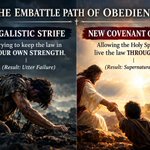
This is actually the most honest, raw admission a Christian can make. It cuts straight through academic theology and hits the painful reality of human experience. When you read the absolute holiness of the Ten Commandments, your conscience instantly screams: “I can’t do this. I have tried, I have failed, and nobody in human history can perfectly keep this standard.”
If you feel this way, you are 100% correct. In your own human strength, flesh, and willpower, keeping the commandments of God is a total, absolute impossibility.
But here is exactly where the beauty of the Gospel shines. The argument that "no one can keep the law" is not a reason to abandon the Sabbath, it is the exact reason why the New Covenant and the Holy Spirit exist.
---> The Fatal Flaw: Whose Power Are You Relying On?
When a Christian says, "No one can keep the commandments," they are making a massive, accidental assumption. They are assuming that God expects them to grit their teeth, pull themselves up by their bootstraps, and white-knuckle their way into holy obedience.
If that is your strategy, you will fail every single time. The Apostle Paul described this exact, agonizing trap in Romans 7:
“For the good that I will to do, I do not do; but the evil I will not to do, that I practice... O wretched man that I am! Who will deliver me from this body of death?” (Romans 7:19, 24)
The Answer to the Cry: Paul doesn't leave us in despair. He instantly answers his own question in the very next verse:
“I thank God—through Jesus Christ our Lord!” (v. 25).
The Gospel does not say, "Here is a difficult law, good luck trying to keep it." The Gospel says, "You are completely powerless, so Christ is going to come live inside of you and keep the law through you."
---> The True New Covenant: God Overcomes Your Impossibility
If human beings could easily keep the law on their own, we would never have needed the cross, the New Covenant, or the Holy Spirit. The entire mechanics of the New Covenant are built around God doing for us what we could never do for ourselves.
Look at this explicit, ironclad promise God makes to you under the New Covenant:
“I will give you a new heart and put a new spirit within you... I will put My Spirit within you and cause you to walk in My statutes, and you will keep My judgments and do them.” (Ezekiel 36:26-27)
⏸️ Pause and read that again:
Closely observe who is doing the heavy lifting in this text. God does not say, "You need to try harder to walk in My statutes." He says, "I will CAUSE you to walk in them." Amen!
When you surrender your life to Christ under the New Covenant, the Holy Spirit takes up residence in your heart. Obedience stops being a frantic, legalistic checklist and becomes the natural, effortless fruit of a supernatural relationship. To say that the commandments cannot be kept is to accidentally claim that the Holy Spirit lacks the power to change a human heart.
---> The Ultimate Accusation: Is God a Tyrant?
Think deeply about the logical conclusion of the argument that "God's commandments are impossible to keep."
If God commands humanity to do something that is physically and spiritually impossible, and then punishes them for failing to do it, that would make God an unjust tyrant. It would mean God sets us up to fail.
But the Apostle John, who laid his head directly on the chest of Jesus and understood grace deeper than almost anyone, completely shatters this dark view of God:
“For this is the love of God, that we keep His commandments. And His commandments are not burdensome.” (1 John 5:3)
⏸️ Pause and carefully read that again:
Why aren't they burdensome? Because love makes obedience light. When a husband is deeply, desperately in love with his wife, the commandment "Thou shalt not commit adultery" is not a heavy, agonizing restriction that he struggles to keep every day. It is the joyful, protective boundary of his love.
The Seventh-day Sabbath is not an exhausting chore. It is a gift. God is literally commanding you to stop working, stop stressing, put down your economic burdens, and spend a guilt-free 24 hours resting in His arms every single week.
How can a command to rest be too hard to keep?
Yes, you are weak. Yes, you are incapable of holiness in your own strength. But the solution to your weakness is not to throw away God's holy law and make excuses for disobedience. The solution is to throw yourself at the feet of Jesus and ask for the grace that empowers obedience.
When you stop trying to keep the Sabbath to earn your salvation, and instead start receiving the Sabbath as a holy sanctuary of time to celebrate your Creator, the impossibility vanishes.
The question is no longer, "Can I keep this day holy?" The question becomes: "Will I surrender my life completely to the Savior, allowing His Holy Spirit to write His holy rest into my heart?"

The Sabbath chain is completely unbroken. It spans from the perfect soil of Eden, through the wilderness manna, through the majestic courts of King David, through the gatekeeping reformations of Ezra and Nehemiah, through the quiet grave of Christ, through the trials of the apostles, right into the architecture of eternity.
xitter.cf/i/status/2114742190924…
Tracing the Beautiful Unbroken Pattern of Sabbath Rest. From Adam and Eve in Genesis to the Redeemed saints in the Earth made knew.
If you are a Christian who sits in a church pew every Sunday morning, this is an open invitation to step away from centuries of inherited church traditions, clear your mind, and look directly at a staggering, undisputed fact written plainly across your own Bible:
From the first chapter of Genesis to the final vision of Revelation, every major character of Scripture rested on the exact same day.
Not one of them ever kept a Sunday. Not one of them left a single command to switch days. Trace the line yourself, person by person, and ask yourself why the modern church broke the chain.
1. The Creator of the Universe
The very first Entity in all of cosmic history to observe the Sabbath was not a Jewish man, a patriarch, or a prophet. It was Almighty God Himself.
“And on the seventh day God ended His work which He had done; and He rested on the seventh day from all His work which He had done. Then God blessed the seventh day and sanctified it…” (Genesis 2:2-3)
⏸️ Pause and read that again:
God did not rest because He was physically tired; He rested to establish a permanent monument to His authority as Creator. He built this 24-hour palace of time into the literal fabric of a sinless planet long before sin ever required a cross, a ceremonial sacrifice, or a Jewish nation.
2. Adam and Eve
Created on the afternoon of the sixth day, the first parents of the human race took their very first full breaths of life inside a holy day.
“And God saw everything that He had made, and behold, it was very good. So the evening and the morning were the sixth day.” (Genesis 1:31)
⏸️ Pause and read that again:
Adam and Eve’s very first full day of existence was the Seventh-day Sabbath. Their initial human experience was not an experience of exhausting physical labor, but of intimate, restful communion with their Maker in Eden. The Sabbath was given to mankind at our birth.
3. The Patriarch Abraham
Centuries before the stone tablets were carved at Mount Sinai, the father of the faithful was already living in complete alignment with God's moral boundaries.
“Because that Abraham obeyed My voice, and kept My charge, My commandments, My statutes, and My laws.” (Genesis 26:5)
⏸️ Pause and read that again:
God has only ever had one moral law. If Abraham kept God's specific laws and statutes, he was actively guarding the sacred day of rest that God had blessed and set apart in Eden.
4. Moses, Aaron, and the Millions of Israel
Weeks before Israel ever arrived at Mount Sinai, God performed a massive, weekly, three-part miracle to retrain His people on the sanctity of His specific day.
“Six days you shall gather it [the manna], but on the seventh day, which is the Sabbath, there will be none.” (Exodus 16:26)
⏸️ Pause and read that again:
For 40 consecutive years in the wilderness, God sent a double portion of food on Friday, preserved it from rotting overnight, and sent absolutely nothing on Saturday. When a few individuals tried to go out and work on the seventh day anyway, God did not say, "I am about to give you a new law." He barked in righteous anger, “How long do you refuse to keep My commandments and My laws?” (v. 28). The Sabbath was alive and binding long before the Ten Commandments were spoken aloud.
5. Elijah, Isaiah, Jeremiah, and the Prophets
Throughout the tumultuous history of Israel, the prophets stood as fierce guardians of the Fourth Commandment, explicitly warning that compromising this day would result in national ruin.
“If you turn away your foot from the Sabbath, from doing your pleasure on My holy day, and call the Sabbath a delight, the holy day of the Lord honorable… then I will cause you to ride on the high hills of the earth…” (Isaiah 58:13-14)
⏸️ Pause and read that again:
The prophets never treated the Sabbath as an annoying legalistic ritual. They viewed it as the ultimate line of demarcation between those who worshipped the true God and those who drifted into pagan sun worship.
6. King David and the Sanctuary Choirs
During the golden era of Israel's monarchy, King David organized the structural governance of the tabernacle worship, explicitly designing a perpetual weekly rhythm for the Levites that prioritized the Seventh day.
“And others of their brethren of the sons of the Kohathites were over the showbread, to prepare it every Sabbath.” (1 Chronicles 9:32)
⏸️ Pause and read that again:
David understood that God's presence required a continuous rhythm of obedience. He commissioned dedicated Levites whose entire life purpose was to prepare fresh showbread inside the sanctuary every single Saturday morning. David’s own psalms bear this signature; Psalm 92 is explicitly titled in the Hebrew text as "A Song for the Sabbath Day," revealing that Israel’s greatest king structured his personal praise around the holy hours.
7. Ezra the Scribe: Reviving the Fallen Law
When the remnant of Israel returned from the crushing weight of the 70-year Babylonian captivity, the nation was spiritually broken. Ezra the priest stood before the ruins of Jerusalem to read the Torah and rebuild the shattered spiritual foundation.
“You came down also on Mount Sinai, and spoke with them from heaven… And made known to them Your holy Sabbath…” (Nehemiah 9:13-14)
⏸️ Pause and look at that verse one more time:
Ezra led the people in a massive, corporate prayer of national repentance. Notice what he emphasized: he did not list the Sabbath as a casual cultural habit or an optional ritual. He identified the Seventh day as a supreme, direct revelation given by the voice of God on Sinai. Under Ezra’s reformation, Israel collectively covenanted to clear out foreign influences and protect the holy day.
8. Nehemiah the Governor: Weaponizing the Gates
When Nehemiah looked at the newly rebuilt walls of Jerusalem, he was horrified to find merchants and heathen traders turning the holy hours into a frantic marketplace. His response was swift, radical, and unyielding.
“So it was, at the gates of Jerusalem, as it began to be dark before the Sabbath, that I commanded the gates to be shut, and charged that they should not be opened until after the Sabbath.” (Nehemiah 13:19)
⏸️ Pause and read that again:
Nehemiah didn't just give a polite sermon; he literally weaponized the city gates against commercialism, placing his own servants at the entrances to ensure no economic burdens crossed into Jerusalem on Saturday. When the merchants camped outside the walls trying to bypass his decree, he threatened them with physical force:
“If you do so again, I will lay hands on you!” (v. 21).
For Nehemiah, the Sabbath was the ultimate boundary line of national survival.
9. Jesus Christ: The Lord of the Day
When the Word became flesh, He did not arrive to tear down the law He had personally spoken at Creation. He lived it out meticulously as our ultimate Example.
“So He came to Nazareth, where He had been brought up. And as His custom was, He went into the synagogue on the Sabbath day, and stood up to read.” (Luke 4:16)
⏸️ Pause and read that again:
Jesus didn't just stumble into church on Saturday because it was a convenient social gathering. It was His lifelong custom. He spent His entire ministry actively stripping the day of heavy, legalistic human traditions, declaring that “the Sabbath was made for man” (Mark 2:27)—using the Greek word Anthropos, meaning all of humanity, not just the Jews. He then flatly asserted His ownership over it, stating,
“The Son of Man is also Lord of the Sabbath” (v. 28).
If Jesus is the Lord of the Sabbath, then Saturday is the only true "Lord’s Day."
10. Mary Magdalene, Mary the Mother of Jesus, and the Holy Women
The absolute proof that Jesus never secretly taught His inner circle that the Sabbath was changing happened at the darkest moment of Passion Week.
“That day was the Preparation, and the Sabbath drew near… And they returned and prepared spices and fragrant oils. And they rested on the Sabbath according to the commandment.” (Luke 23:54, 56)
⏸️ Pause and read that again:
On Good Friday afternoon, Jesus died. His body needed to be embalmed. Yet, despite their overwhelming, earth-shattering grief, these holy women halted their preparation and refused to touch His body on Saturday. If Jesus had dropped even a single hint during His three years of teaching that the Fourth Commandment was expiring or shifting to Sunday, these women would have finished their work. Instead, they sat in silent obedience to the stone tablets while their Savior lay in the tomb.
11. Jesus Christ: Resting in Death
The absolute climax of human history occurred in a quiet garden tomb on the seventh day of the week.
“And on the seventh day God ended His work… and He rested.” (Genesis 2:2)
“He said, ‘It is finished!’ And bowing His head, He gave up His spirit.” (John 19:30)
⏸️ Pause and read that again:
Look at the cosmic symmetry. In Genesis, Jesus finished His physical work of Creation on the sixth day (Friday) and rested on the seventh day (Saturday). Thousands of years later, Jesus finished His agonizing work of Redemption on the cross on the sixth day (Friday), cried out "It is finished," and spent the entire seventh-day Sabbath resting in the sleep of death inside the tomb. He honored His Father’s commandment even while dead.
12. The Apostle Peter and the Early Church
Decades after the resurrection and the Day of Pentecost, Peter stood before crowds, completely unbroken in his commitment to the original faith.
“But Peter said, ‘Not so, Lord! For I have never eaten anything common or unclean.’" (Acts 10:14)
⏸️ Carefully look at that verse again:
If Peter was so hyper-conservative that he had never allowed a single piece of non-kosher food to touch his lips years after Christ ascended, do you honestly believe he would have casually abandoned one of the literal Ten Commandments written by the finger of God?
13. The Apostle Paul and the Gentile Converts
As the great missionary to the non-Jewish world, Paul traveled across the Roman Empire planting churches. If the day of worship had changed to Sunday in honor of the resurrection, his ministry would reflect it. It reflects the exact opposite.
“So when the Jews went out of the synagogue, the Gentiles begged that these words might be preached to them the next Sabbath.” (Acts 13:42)
⏸️ Pause and carefully read that verse again:
This was Paul's perfect strategic moment. He had a massive coliseum of hungry Gentile seekers begging to hear about Jesus. If Sunday was the new Christian day of worship, Paul would have said, "Hey, don't wait a week, show up tomorrow morning!" Instead, he left them waiting an entire week, and “on the next Sabbath almost the whole city came together to hear the word of God” (v. 44). The book of Acts records Paul doing this week after week, year after year, in city after city (Acts 16:13, Acts 17:2, Acts 18:4).
14. John the Revelator and the End-Time Saints
At the very end of the New Testament canvas, looking down the long corridor of time to the final generation of believers standing on earth just before the Second Coming, the Bible identifies God's people by a unique, undeniable signature.
“Here is the patience of the saints; here are those who keep the commandments of God and the faith of Jesus.” (Revelation 14:12)
⏸️ Pause and look at that verse again:
The book of Revelation does not identify the final saints by their human traditions, church dogmas, or cultural trends. They are identified by their unshakeable loyalty to the written Law of God.
15. The Eternal Sabbath
The chain does not end with the close of human history. The Sabbath was born in a sinless world, and it will endure forever in a restored world.
“‘And it shall come to pass that from one New Moon to another, and from one Sabbath to another, all flesh shall come to worship before Me,’ says the Lord.” (Isaiah 66:23)
⏸️ Pause and read that again:
Just a few years from now, on a New Earth completely free from pain, sin, and death, the entire saved family of God will still pause every single seventh day to bow before the Sovereign King.
The chain is completely unbroken. It spans from the perfect soil of Eden, through the wilderness manna, through the majestic courts of King David, through the gatekeeping reformations of Ezra and Nehemiah, through the quiet grave of Christ, through the trials of the apostles, right into the architecture of eternity.
Scripture never breaks this link. It never shifts the solemnity. It never authorizes a replacement.
If the Bible leaves this chain completely intact, it forces every honest believer into a profound, personal crossroads: If the shift to Sunday was implemented purely by human decrees, imperial edicts, and church traditions, whose authority are we recognizing when we rest?
Look back down the line. God the Father, Adam, Eve, Abraham, Moses, Elijah, King David, Ezra and Nehemiah, Isaiah and the Prophets, Christ the Savior Himself, the Mother of Christ, the Apostles, the Gentile converts, the final martyrs of the end times and the redeemed in the new Earth they all walk the exact same path.
Your Bible contains an absolute, ironclad consensus. Not a single author, character, or disciple in the pages of Holy Writ ever recognized Sunday as a holy day.
If this chain is completely unbroken from Genesis to Revelation, it leaves every honest Christian staring directly into a profound, undeniable question:
If every single person in my Bible kept the Seventh-day Sabbath, whose voice am I actually obeying when I worship on Sunday?
When you surrender your life to Christ under the New Covenant, the Holy Spirit takes up residence in your heart. Obedience stops being a frantic, legalistic checklist and becomes the natural, effortless fruit of a supernatural relationship. To say that the commandments cannot be kept is to accidentally claim that the Holy Spirit lacks the power to change a human heart.
Search the Scriptures retweeted

You will visit millions of Christian X accounts before landing to an online Christian platform teaching pure unadulterated gospel truths like this one. Pure blessings. 🙏
"But no one can keep the commandments of God"
This is actually the most honest, raw admission a Christian can make. It cuts straight through academic theology and hits the painful reality of human experience. When you read the absolute holiness of the Ten Commandments, your conscience instantly screams: “I can’t do this. I have tried, I have failed, and nobody in human history can perfectly keep this standard.”
If you feel this way, you are 100% correct. In your own human strength, flesh, and willpower, keeping the commandments of God is a total, absolute impossibility.
But here is exactly where the beauty of the Gospel shines. The argument that "no one can keep the law" is not a reason to abandon the Sabbath, it is the exact reason why the New Covenant and the Holy Spirit exist.
---> The Fatal Flaw: Whose Power Are You Relying On?
When a Christian says, "No one can keep the commandments," they are making a massive, accidental assumption. They are assuming that God expects them to grit their teeth, pull themselves up by their bootstraps, and white-knuckle their way into holy obedience.
If that is your strategy, you will fail every single time. The Apostle Paul described this exact, agonizing trap in Romans 7:
“For the good that I will to do, I do not do; but the evil I will not to do, that I practice... O wretched man that I am! Who will deliver me from this body of death?” (Romans 7:19, 24)
The Answer to the Cry: Paul doesn't leave us in despair. He instantly answers his own question in the very next verse:
“I thank God—through Jesus Christ our Lord!” (v. 25).
The Gospel does not say, "Here is a difficult law, good luck trying to keep it." The Gospel says, "You are completely powerless, so Christ is going to come live inside of you and keep the law through you."
---> The True New Covenant: God Overcomes Your Impossibility
If human beings could easily keep the law on their own, we would never have needed the cross, the New Covenant, or the Holy Spirit. The entire mechanics of the New Covenant are built around God doing for us what we could never do for ourselves.
Look at this explicit, ironclad promise God makes to you under the New Covenant:
“I will give you a new heart and put a new spirit within you... I will put My Spirit within you and cause you to walk in My statutes, and you will keep My judgments and do them.” (Ezekiel 36:26-27)
⏸️ Pause and read that again:
Closely observe who is doing the heavy lifting in this text. God does not say, "You need to try harder to walk in My statutes." He says, "I will CAUSE you to walk in them." Amen!
When you surrender your life to Christ under the New Covenant, the Holy Spirit takes up residence in your heart. Obedience stops being a frantic, legalistic checklist and becomes the natural, effortless fruit of a supernatural relationship. To say that the commandments cannot be kept is to accidentally claim that the Holy Spirit lacks the power to change a human heart.
---> The Ultimate Accusation: Is God a Tyrant?
Think deeply about the logical conclusion of the argument that "God's commandments are impossible to keep."
If God commands humanity to do something that is physically and spiritually impossible, and then punishes them for failing to do it, that would make God an unjust tyrant. It would mean God sets us up to fail.
But the Apostle John, who laid his head directly on the chest of Jesus and understood grace deeper than almost anyone, completely shatters this dark view of God:
“For this is the love of God, that we keep His commandments. And His commandments are not burdensome.” (1 John 5:3)
⏸️ Pause and carefully read that again:
Why aren't they burdensome? Because love makes obedience light. When a husband is deeply, desperately in love with his wife, the commandment "Thou shalt not commit adultery" is not a heavy, agonizing restriction that he struggles to keep every day. It is the joyful, protective boundary of his love.
The Seventh-day Sabbath is not an exhausting chore. It is a gift. God is literally commanding you to stop working, stop stressing, put down your economic burdens, and spend a guilt-free 24 hours resting in His arms every single week.
How can a command to rest be too hard to keep?
Yes, you are weak. Yes, you are incapable of holiness in your own strength. But the solution to your weakness is not to throw away God's holy law and make excuses for disobedience. The solution is to throw yourself at the feet of Jesus and ask for the grace that empowers obedience.
When you stop trying to keep the Sabbath to earn your salvation, and instead start receiving the Sabbath as a holy sanctuary of time to celebrate your Creator, the impossibility vanishes.
The question is no longer, "Can I keep this day holy?" The question becomes: "Will I surrender my life completely to the Savior, allowing His Holy Spirit to write His holy rest into my heart?"
Search the Scriptures retweeted
If God's final people are identified merely by the denomination written on their signboard, why does Revelation identify the remnant by their relationship to God: they “keep the commandments of God, and have the testimony of Jesus Christ”? (Revelation 12:17).
God's remnant is not ultimately identified by a human label.
Heaven identifies them by faithfulness to Christ and obedience to God.
Search the Scriptures retweeted
"Reason and sense demand the acceptance of one or the other of these alternatives: either Protestantism and the keeping holy of Saturday, or Catholicity and the keeping holy of Sunday. Compromise is impossible."
(John Cardinal Gibbons, The Catholic Mirror, December 23, 1893.)

If God's seal has nothing to do with His law, why does Scripture connect God's people with His law and His name?
“Bind up the testimony, seal the law among my disciples.” (Isaiah 8:16).
The final conflict involves competing authorities.
God has a seal. The beast has a mark. Worship reveals which authority we accept.
Search the Scriptures retweeted
This line really broke my heart.
"That observance (Sunday) remains as a reminder of the Mother Church from which the non-Catholic sects broke away - like a boy running away from home but still carrying in his pocket a picture of his mother or a lock of her hair."
(The book, Faith of Millions)
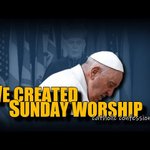
Catholic Bold Confessions on the Sabbath Change
Q. Have you any other proofs that they (Protestants) are not guided by the Scripture?
A. Yes; so many, that we cannot admit more than a mere specimen into this small work. They reject much that is clearly contained in Scripture, and profess more that is nowhere discoverable in that Divine Book.
Q. Give some examples of both?
A. They should, if the Scripture were their only rule, wash the feet of one another, according to the command of Christ, in the 13th chap. of St. John; —they should keep, not the Sunday, but the Saturday, according to the commandment, "Remember thou keep holy the SABBATH-day;" for this commandment has not, in Scripture, been changed or abrogated;...
—Rev. Stephen Keenan, A Doctrinal Catechism; New York in 1857, page 101 Imprimatuer
They assembled on Saturdays, not that they were infected with Judaism, but only to worship Jesus Christ the Lord of the sabbath —William Cave in his book entitled Primitive Christianity citing Athanasius bishop of Alexandria, pg. 125
It is well to remind the Presbyterians, Baptists, Methodists, and all other Christians, that the Bible does not support them anywhere in their observance of Sunday. Sunday is an institution of the Roman Catholic Church, and those who observe the day observe a commandment of the Catholic Church.
—Priest Brady, in an address, reported in the Elizabeth, NJ ‘News’ on March 18, 1903.
Protestants ... accept Sunday rather than Saturday as the day for public worship after the Catholic Church made the change... But the Protestant mind does not seem to realize that ... in observing Sunday, they are accepting the authority of the spokesman for the Church, the pope.
—Our Sunday Visitor, February 5th, 1950.
Of course these two old quotations are exactly correct. The Catholic Church designated Sunday as the day for corporate worship and gets full credit – or blame – for the change.
—This Rock, The Magazine of Catholic Apologetics and Evangelization, p.8, June 1997
Q. Have you any other way of proving that the Church has power to institute festivals of precept?
A. Had she not such power, she could not have done that in which all modern religionists agree with her; —she could not have substituted the observance of Sunday the first day of the week, for the observance of Saturday the seventh day, a change for which there is no Scriptural authority.
—Rev. Stephen Keenan, A Doctrinal Catechism; New York in 1857, page 174
Q. In what manner can we show a Protestant, that he speaks unreasonably against fasts and abstinences?
A. Ask him why he keeps Sunday, and not Saturday, as his day of rest, since he is unwilling either to fast or to abstain. If he reply, that the Scripture orders him to keep the Sunday, but says nothing as to fasting and abstinence, tell him the Scripture speaks of Saturday or the Sabbath, but gives no command anywhere regarding Sunday or the first day of the week.
If, then he neglects Saturday as a day of rest and holiness, and substitutes Sunday in its place, and this merely because such was the usage of the ancient Church, should he not, if he wishes to act consistently, observe fasting and abstinence, because the ancient Church so ordained?
—Rev. Stephen Keenan, A Doctrinal Catechism; New York in 1857, page 181
Question: Which is the Sabbath day?
Answer: Saturday is the Sabbath day.
Question: Why do we observe Sunday instead of Saturday?
Answer: We observe Sunday instead of Saturday because the Catholic Church transferred the solemnity from Saturday to Sunday.
—Rev. Peter Geiermann C.SS.R., The Convert’s Catechism of Catholic Doctrine, p. 50
Q. Must not a sensible Protestant doubt seriously, when he finds that even the Bible is not followed as a rule by his co-religionists?
A. Surely, when he sees them baptize infants, abrogate the Jewish Sabbath, and observe Sunday for which [pg. 7] there is no Scriptural authority; when he finds them neglect to wash one another's feet, which is expressly commanded, and eat blood and things strangled, which are expressly prohibited in Scripture. He must doubt, if he think at all. ...
Q. Should not the Protestant doubt when he finds that he himself holds tradition as a guide?
A. Yes, if he would but reflect that he has nothing but Catholic Tradition for keeping the Sunday holy; ...
—Controversial Catechism by Stephen Keenan, New Edition, revised by Rev. George Cormack, published in London by Burns & Oates, Limited - New York, Cincinnati, Chicago: Benzinger Brothers, 1896, pages 6, 7.
The Church, on the other hand, after changing the day of rest from the Jewish Sabbath, or seventh day of the week, to the first, made the Third Commandment refer to Sunday as the day to be kept holy as the Lord's Day.
The Council of Trent (Sess. VI, can. xix) condemns those who deny that the Ten Commandments are binding on Christians.
(The Catholic Encyclopedia, Commandments of God, Volume IV, © 1908 by Robert Appleton Company, Online Edition © 1999 by Kevin Knight, Nihil Obstat - Remy Lafort, Censor Imprimatur - +John M. Farley, Archbishop of New York, page 153.)
The [Roman Catholic] Church changed the observance of the Sabbath to Sunday by right of the divine, infallible authority given to her by her founder, Jesus Christ. The Protestant claiming the Bible to be the only guide of faith, has no warrant for observing Sunday. In this matter the Seventh-day Adventist is the only consistent Protestant.
—The Catholic Universe Bulletin, August 14, 1942, p. 4.
All of us believe many things in regard to religion that we do not find in the Bible. For example, nowhere in the Bible do we find that Christ or the Apostles ordered that the Sabbath be changed from Saturday to Sunday. We have the commandment of God given to Moses to keep holy the Sabbath Day, that is the 7th day of the week, Saturday. Today most Christians keep Sunday because it has been revealed to us by the Church outside the Bible.
—The Catholic Virginian, To Tell You The Truth,” Vol. 22, No. 49 (Oct. 3, 1947).
... you may read the Bible from Genesis to Revelation, and you will not find a single line authorizing the sanctification of Sunday. The Scriptures enforce the religious observance of Saturday, a day which we never sanctify.
—The Faith of Our Fathers, by James Cardinal Gibbons, Archbishop of Baltimore, 88th edition, page 89. Originally published in 1876, republished and Copyright 1980 by TAN Books and Publishers, Inc., pages 72-73.
Deny the authority of the Church and you have no adequate or reasonable explanation or justification for the substitution of Sunday for Saturday in the Third - Protestant Fourth - Commandment of God... The Church is above the Bible, and this transference of Sabbath observance is proof of that fact.'
—Catholic Record, September 1, 1923.
But since Saturday, not Sunday, is specified in the Bible, isn't it curious that non-Catholics who profess to take their religion directly from the Bible and not the Church, observe Sunday instead of Saturday? Yes, of course, it is inconsistent; but this change was made about fifteen centuries before Protestantism was born, and by that time the custom was universally observed.
They have continued the custom, even though it rests upon the authority of the Catholic Church and not upon an explicit text in the Bible. That observance remains as a reminder of the Mother Church from which the non-Catholic sects broke away - like a boy running away from home but still carrying in his pocket a picture of his mother or a lock of her hair.
—The Faith of Millions
Perhaps the boldest thing, the most revolutionary change the Church ever did, happened in the first century. The holy day, the Sabbath, was changed from Saturday to Sunday. "The Day of the Lord" (dies Dominica) was chosen, not from any directions noted in the Scriptures, but from the Church's sense of its own power. The day of resurrection, the day of Pentecost, fifty days later, came on the first day of the week. So this would be the new Sabbath. People who think that the Scriptures should be the sole authority, should logically become 7th Day Adventists, and keep Saturday holy.
—Sentinel, Pastor's page, Saint Catherine Catholic Church, Algonac, Michigan, May 21, 1995
If Protestants would follow the Bible, they would worship God on the Sabbath Day. In keeping the Sunday they are following a law of the Catholic Church.
—Albert Smith, Chancellor of the Archdiocese of Baltimore, replying for the Cardinal, in a letter dated February 10, 1920.
The observance of Sunday by the Protestants is homage they pay, in spite of themselves, to the authority of the [Catholic] Church.
—Monsignor Louis Segur, ‘Plain Talk about the Protestantism of Today’, p. 213.
What Important Question Does the Papacy Ask Protestants?
Protestants have repeatedly asked the papacy, "How could you dare to change God's law?" But the question posed to Protestants by the Catholic church is even more penetrating.
Here it is officially: You will tell me that Saturday was the Jewish Sabbath, but that the Christian Sabbath has been changed to Sunday. Changed! but by whom? Who has authority to change an express commandment of Almighty God? When God has spoken and said, Thou shalt keep holy the seventh day, who shall dare to say, Nay, thou mayest work and do all manner of worldly business on the seventh day; but thou shalt keep holy the first day in its stead?
This is a most important question, which I know not how you can answer. You are a Protestant, and you profess to go by the Bible and the Bible only; and yet in so important a matter as the observance of one day in seven as a holy day, you go against the plain letter of the Bible, and put another day in the place of that day which the Bible has commanded.
The command to keep holy the seventh day is one of the ten commandments; you believe that the other nine are still binding; who gave you authority to tamper with the fourth? If you are consistent with your own principles, if you really follow the Bible and the Bible only, you ought to be able to produce some portion of the New Testament in which this fourth commandment is expressly altered.
—Library of Christian Doctrine: Why Don't You Keep Holy the Sabbath-Day? (London: Burns and Oates, Ltd.), pp. 3, 4.
There is but one church on the face of the earth which has the power, or claims power, to make laws binding on the conscience, binding before God, binding under penalty of hell-fire. For instance, the institution of Sunday. What right has any other church to keep this day? You answer by virtue of the third commandment (the papacy did away with the 2nd regarding the worship of graven images, and called the 4th the 3rd), which says 'Remember that thou keep holy the Sabbath day.'
But Sunday is not the Sabbath. Any schoolboy knows that Sunday is the first day of the week. I have repeatedly offered one thousand dollars to anyone who will prove by the Bible alone that Sunday is the day we are bound to keep, and no one has called for the money. It was the holy Catholic Church that changed the day of rest from Saturday, the seventh day, to Sunday, the first day of the week.
—T. Enright, C.S.S.R., in a lecture delivered in 1893.
Of course the Catholic Church claims that the change was her act. And the act is a mark of her ecclesiastical power and authority in religious matters.
—C. F. Thomas, Chancellor of Cardinal Gibbons, in answer to a letter regarding the change of the Sabbath, November 11, 1895.
Tradition, not Scripture, is the rock on which the church of Jesus Christ is built.
—Adrien Nampon, Catholic Doctrine as Defined by the Council of Trent, p. 157
The Pope is of so great authority and power that he can modify, explain, or interpret even divine law". The pope can modify divine law, since his power is not of man, but of God, and he acts a vicegerent of God upon earth.
—Lucius Ferraris, Prompta Bibliotheca, art. Papa, II, Vol. VI, p. 29.
The leader of the Catholic church is defined by the faith as the Vicar of Jesus Christ (and is accepted as such by believers). The Pope is considered the man on earth who "takes the place" of the Second Person of the omnipotent God of the Trinity.
—John Paul II, Crossing the Threshold of Hope, p. 3, 1994
...pastoral intuition suggested to the Church the christianization of the notion of Sunday as "the day of the sun", which was the Roman name for the day and which is retained in some modern languages.(29) This was in order to draw the faithful away from the seduction of cults which worshipped the sun, and to direct the celebration of the day to Christ, humanity's true 'sun'.
—John Paul II, Dies Domini, 27. The day of Christ-Light, 1998 (Prominent protestant leaders agree with this statement - See here for a statement by Dr. E. T. Hiscox, author of the ‘Baptist Manual’)
The Sun was a foremost god with heathen-dom…The sun has worshippers at this hour in Persia and other lands…. There is, in truth, something royal, kingly about the sun, making it a fit emblem of Jesus, the Sun of Justice. Hence the church in these countries would seem to have said, to 'Keep that old pagan name [Sunday]. It shall remain consecrated, sanctified.' And thus the pagan Sunday, dedicated to Balder, became the Christian Sunday, sacred to Jesus.
—William Gildea, Doctor of Divinity, The Catholic World, March, 1894, p. 809
The retention of the old pagan name of Dies Solis, for Sunday is, in a great measure, owing to the union of pagan and Christian sentiment with which the first day of the week was recommended by Constantine to his subjects - pagan and Christian alike - as the 'venerable' day of the sun.
—Arthur P. Stanley, History of the Eastern Church, p. 184
When St. Paul repudiated the works of the law, he was not thinking of the Ten Commandments, which are as unchangeable as God Himself is, which God could not change and still remain the infinitely holy God.
—Our Sunday Visitor, Oct. 7, I951.
Question: How prove you that the Church hath power to command feasts and holydays?
Answer: By the very act of changing the Sabbath into Sunday, which Protestants allow of; and therefore they fondly contradict themselves, by keeping Sunday strictly, and breaking most other feasts commanded by the same Church.
—Henry Tuberville, An Abridgment of the Christian Doctrine (1833 approbation), p.58 (Same statement in Manual of Christian Doctrine, ed. by Daniel Ferris [1916 ed.], p.67)
Some theologians have held that God likewise directly determined the Sunday as the day of worship in the NEW LAW, that he himself has explicitly substituted Sunday for the Sabbath. But this theory is entirely abandoned. It is now commonly held that God simply gave His church the power to set aside whatever day or days she would deem suitable as holy days. The church chose Sunday, the first day of the week, and in the course of time added other days as holy days.
—Vincent J. Kelly, Forbidden Sunday and Feast-Day Occupations, Washington, DC, Catholic University of America Press, Studies in Sacred Theology, No. 70.,1943, p. 2.
If we consulted the Bible only, we should still have to keep holy the Sabbath Day, that is, Saturday, with the Jews, instead of Sunday; ...
—A Course in Religion for Catholic High Schools and Academies, by Rev. John Laux M.A., Benzinger Brothers, 1936 edition, Part 1.
Sunday is a Catholic institution, and... can be defended only on Catholic principles.... From beginning to end of Scripture there is not a single passage that warrants the transfer of weekly public worship from the last day of the week to the first.
—Catholic Press, Aug. 25, 1900
The Sabbath was Saturday, not Sunday. The Church altered the observance of the Sabbath to the observance of Sunday. Protestants must be rather puzzled by the keeping of Sunday when God distinctly said, 'Keep holy the Sabbath Day.' The word Sunday does not come anywhere in the Bible, so, without knowing it they are obeying the authority of the Catholic Church.
—Canon Cafferata, The Catechism Explained, p. 89.
Reason and sense demand the acceptance of one or the other of these alternatives: either Protestantism and the keeping holy of Saturday, or Catholicity and the keeping holy of Sunday. Compromise is impossible.
—John Cardinal Gibbons, The Catholic Mirror, December 23, 1893.

Search the Scriptures retweeted
What Important Question Does the Papacy Ask Protestants?
Protestants have repeatedly asked the papacy, "How could you dare to change God's law?" But the question posed to Protestants by the Catholic church is even more penetrating.
Here it is officially: You will tell me that Saturday was the Jewish Sabbath, but that the Christian Sabbath has been changed to Sunday. Changed! but by whom? Who has authority to change an express commandment of Almighty God? When God has spoken and said, Thou shalt keep holy the seventh day, who shall dare to say, Nay, thou mayest work and do all manner of worldly business on the seventh day; but thou shalt keep holy the first day in its stead?
This is a most important question, which I know not how you can answer. You are a Protestant, and you profess to go by the Bible and the Bible only; and yet in so important a matter as the observance of one day in seven as a holy day, you go against the plain letter of the Bible, and put another day in the place of that day which the Bible has commanded.
The command to keep holy the seventh day is one of the ten commandments; you believe that the other nine are still binding; who gave you authority to tamper with the fourth? If you are consistent with your own principles, if you really follow the Bible and the Bible only, you ought to be able to produce some portion of the New Testament in which this fourth commandment is expressly altered.
[Library of Christian Doctrine: Why Don't You Keep Holy the Sabbath-Day? (London: Burns and Oates, Ltd.), pp. 3, 4.]
This is the classic, mic-drop argument of modern Sunday theology. It is delivered with absolute confidence, as if it settles the entire historical and scriptural debate in one swift stroke. The logic seems bulletproof: If God wanted New Testament Christians to keep the Sabbath, He would have explicitly repeated the command in the New Testament letters. Since He didn't, the Sabbath is clearly the only commandment that has been completely abolished.
It sounds like a perfect checkmate. But when you cross-examine this claim using actual biblical history, ancient culture, and the text of the New Testament itself, this argument collapses into one of the most factually and logically flawed positions in modern theology.
---> The Historical Fact-Check: Why It Is Logically Flawed
The foundational flaw of this argument is a total blindness to how biblical law and historical transitions actually operate. You only issue a loud, repetitive command for a law that is being widely broken, forgotten, or changed.
The First-Century Reality: Every single writer of the New Testament was a Sabbath-keeping believer. Every early Christian congregation, both Jew and Gentile met systematically every single Saturday in the synagogues.
There was absolutely zero debate in the early church regarding which day was holy. The Book of Acts records massive, explosive theological councils over circumcision, ceremonial foods, and temple rituals. If Paul or the apostles had tried to tell a first-century believer that one of the literal Ten Commandments written by the finger of God on stone was being tossed out, it would have caused a historic, seismic rebellion. Yet, the New Testament records absolute, quiet consensus regarding the Seventh day. You do not command a nation to breathe oxygen; you only command them to do something they have forgotten to do.
---> The Textual Fact-Check: The Sabbath Is Explicitly Commanded in the NT
The claim that the Fourth Commandment is missing from the New Testament is simply factually false. The New Testament contains explicit, structural commands to observe the Seventh-day Sabbath. Modern readers have simply been trained to look right past them.
• The Explicit Commandment of Christ
When Jesus was giving His disciples an intense prophecy about the future destruction of Jerusalem (an event that occurred in 70 AD, decades after His resurrection and the cross), He looked them in the eye and gave them a direct, physical command:
“And pray that your flight may not be in winter or on the Sabbath.” (Matthew 24:20)
Why did Jesus command His New Covenant church to pray about the Sabbath forty years after the cross? If the Sabbath was going to be nailed to the tree, or if it was changing to Sunday on the resurrection morning, Jesus would have said, "Don't worry about traveling on Saturday, because Sunday is your new holy day." Instead, He issued a direct command to protect the physical sanctity of the Seventh day decades into the Christian era, ensuring His followers wouldn't be forced into hard physical labor, flight, or travel on His holy day.
• The Commandment of the Book of Hebrews
As analyzed through the original Greek text, the author of Hebrews wraps up a lengthy theological discourse on the rest of God by laying down an absolute, direct mandate for the Christian church:
“There remains therefore a rest [σαββατισμός - Sabbatismos / a literal keeping of the Sabbath] for the people of God.” (Hebrews 4:9)
The word is not a vague suggestion.
Sabbatismos is a technical, direct noun meaning "the physical keeping of a Sabbath." The Holy Spirit explicitly recorded that a literal Seventh-day Sabbath-keeping remains mandatory for the New Testament people of God.
---> The Fatal Hypocrisy of this Theological Standard
If a Sunday-keeping Christian insists that an Old Testament law is only valid if it is explicitly re-commanded in the text of the New Testament, they have trapped themselves in a fatal logical contradiction.
Where in the New Testament is there an explicit command that says, "Thou shalt not practice bestiality"? Where does the New Testament explicitly command, "Thou shalt not commit incest"? Where does it explicitly state, "Thou shalt not cheat an employee of their wages"?
The New Testament does not feature explicit, re-worded commands for these sins, yet no Christian would ever argue that bestiality or incest are now permitted under grace! The New Testament authors did not need to re-list every single moral boundary line from the Old Testament because they already accepted the Old Testament Scriptures as the foundational, infallible Word of God (2 Timothy 3:16). They knew that God's moral character does not change.
To top it all off, the New Testament defines the mechanism of the New Covenant with absolute clarity. God explains exactly what He does to His law under the New Covenant:
“This is the covenant that I will make with them after those days, says the Lord: I will put My laws into their hearts, and in their minds I will write them.” (Hebrews 10:16)
Under the New Covenant, God does not alter, dilute, or erase His law. He takes the exact same Moral Law that He previously engraved on cold stone tablets at Mount Sinai and engraves it directly onto the living flesh of the Christian's heart.
God never rewrote His law to match human culture. He didn't cross out the Fourth Commandment and write "Sunday" over it. He wrote the original Seventh-day Sabbath directly into your mind.
When a Christian uses a logical loophole to claim the Sabbath is the "only one missing," they are facing a profound spiritual crisis: Are you living under the genuine New Covenant of grace that writes the law on your heart, or are you relying on a human tradition that has erased it from your mind?

THE LAW IN THE NEW TESTAMENT
1. Thou shalt worship the Lord thy God, and Him only shalt thou serve. Matt. 4:10; Rev. 19:10.
2. Little children, keep yourselves from idols. 1 John 5:21; Acts 17:29.
3. That the name of God and His doctrine be not blasphemed. 1 Tim. 6:1.
4. The sabbath was made for man, and not man for the sabbath: Therefore the Son of man is Lord also of the sabbath. Mark 2:27,28; Heb. 4:4.
5. Honour thy father and thy mother. Matt. 19:19; Eph. 6:1-3.
6. Thou shalt not kill. Rom. 13:9; James 2:11.
7. Thou shalt not commit adultery. Matt. 19:18.
8. Thou shalt not steal. Rom. 13:9; Eph. 4:28.
9. Thou shalt not bear false witness. Rom. 13:9.
10. Thou shalt not covet. Rom. 7:7.
"Think not that I am come to destroy the law, or the prophets: I am not come to destroy, but to fulfil. For verily I say unto you, Till heaven and earth pass, one jot or one tittle shall in no wise pass from the law, till all be fulfilled. Whosoever therefore shall break one of these least commandments, and shall teach men so, he shall be called the least in the kingdom of heaven: but whosoever shall do and teach them, the same shall be called great in the kingdom of heaven." {John 5:17-19}

"Not every one that saith unto me, Lord, Lord, shall enter into the kingdom of heaven; but he that doeth the will of my Father which is in heaven." (Mathew 7:21)
So, what is the "will" of the Father?
Think deeply before answering.
When Jesus was giving His disciples an intense, apocalyptic prophecy about the future destruction of Jerusalem (which occurred in 70 AD, decades after His resurrection and the cross), He looked them in the eye and gave them a direct, physical command:
“And pray that your flight may not be in winter or on the Sabbath.” (Matthew 24:20)
Carefully look at that verse one more time:
Why did Jesus command His New Covenant church to pray about the Sabbath forty years after the cross? If the Sabbath was going to be nailed to the cross, or if it was changing to Sunday on the resurrection morning, Jesus would have said,
"Don't worry about traveling on Saturday, because Sunday is your new holy day."
Instead, He issued a direct command to protect the sanctity of the Seventh day decades into the Christian era, ensuring His followers wouldn't be forced into hard physical labor or travel on His holy day.
Search the Scriptures retweeted
Testing The Prophets (know your prophet today)
8 Biblical Tests of a True Prophet
"And Jesus answered and said unto them, Take heed that no man deceive you. For many shall come in my name, saying, I am Christ; and shall deceive many. And many false prophets shall rise, and shall deceive many. For there shall arise false Christs, and false prophets, and shall shew great signs and wonders; insomuch that, if it were possible, they shall deceive the very elect." (Mathew 24:4,11, 24)
Scripture provides multiple tests for examining anyone who claims to speak for God. These tests must be applied together, because no single test is sufficient by itself. A person may perform signs, teach some truth, or appear religious and still be a false prophet (Deuteronomy 13:1–4; Matthew 7:21–23).
1. Their messages will be in harmony with Scripture
"To the law and to the testimony: if they speak not according to this word, it is because there is no light in them." (Isaiah 8:20)
A true prophet will never contradict God's previously revealed Word. Their teaching must harmonize with established biblical truth and uphold all of God's commandments and testimonies.
--->Key principle: Scripture tests the prophet; the prophet does not become the standard by which Scripture is judged.
--->Important qualification: 2 Peter 1:20–21 primarily teaches that prophecy originates with God rather than merely being a product of human will or private invention. Isaiah 8:20 is the clearer direct test for whether a prophetic message agrees with Scripture.
2. Their genuine predictive prophecies will come to pass
"When a prophet speaketh in the name of the LORD, if the thing follow not, nor come to pass, that is the thing which the LORD hath not spoken." (Deuteronomy 18:22)
Jeremiah 28:9 likewise identifies fulfillment as a test of a prophet. When a prophet makes a genuine predictive statement in God's name, it must be fulfilled. An unfulfilled prediction presents a serious biblical problem. However, Scripture recognizes conditional prophecy. God's announced judgment or blessing may depend upon the response of the people involved:
• Jeremiah 18:7–10
• Jonah 3:4–10
Jonah announced Nineveh's destruction, yet Nineveh was spared when the people repented.
Therefore, every disputed prophecy must be examined carefully:
• Was it explicitly conditional?
• Was the condition clear from the immediate context?
• Was the condition established elsewhere beforehand?
• Or was a condition introduced only afterward to explain nonfulfillment?
At the same time, fulfilled prophecy alone does not prove a prophet genuine, because Deuteronomy 13:1–4 warns that a false prophet may give a sign or wonder that actually comes to pass. The decisive question is therefore not
merely "Did the prediction happen?", but whether the prophet's entire message remains faithful to God.
3. They will receive genuine messages from God through prophetic revelation
"I the LORD will make myself known unto him in a vision, and will speak unto him in a dream." (Numbers 12:6)
God used visions, dreams, and direct supernatural communication in the biblical prophetic ministry. Angels also communicated messages to God's servants (Zechariah 4:1; Revelation 19:10; 22:8–9).
A genuine prophet therefore claims to receive revelation from God rather than merely presenting personal opinions as divine messages.
Conversely, Scripture strictly condemns occult and satanic methods:
Deuteronomy 18:9–12 condemns divination, astrology/"observers of times," enchantment, witchcraft, consulting familiar spirits, wizardry, and necromancy.
--->Key distinction: Genuine prophetic revelation comes from God; occult revelation comes through forbidden supernatural sources.
4. They will confess the biblical divine-human nature of Christ
"Every spirit that confesseth that Jesus Christ is come in the flesh is of God." (1 John 4:1–3)
A genuine prophet must uphold the biblical Christ the divine Son who truly became human, came in the flesh, and gave Himself for the salvation of humanity.
Compare: Philippians 2:5–8, John 1:1, 14, 1 Timothy 3:16
The prophet's Christology must therefore be tested against Scripture, not merely by whether they frequently mention Jesus.
5. They will be holy people who bear good fruit
"Holy men of God spake as they were moved by the Holy Ghost." (2 Peter 1:21)
Jesus said: "Ye shall know them by their fruits." (Matthew 7:16)
A true prophet will seek, through the Holy Spirit, to live consistently with the message they proclaim. Their character, conduct, relationships, and influence should demonstrate the fruits of a life submitted to God.
Jesus also gives an important warning in
Matthew 7:21–23
Some people will claim to have prophesied, cast out devils, and performed wonderful works in His name, yet Christ will say: "I never knew you: depart from me, ye that work iniquity."
Therefore, supernatural experiences and religious works cannot substitute for godly character and obedience.
6. They will exalt Christ rather than themselves
John the Baptist provides the model: "He must increase, but I must decrease." (John 3:30)
And: "Behold the Lamb of God!" (John 1:36)
A genuine prophet directs attention toward Christ, not toward personal fame, authority, personality, or self-glorification. The prophet's ministry should ultimately cause people to follow the Master rather than become dependent upon the messenger.
--->Test: Does the messenger consistently point people to Christ, or does the messenger become the center of the movement?
7. They will edify, exhort, and comfort God's people
"He that prophesieth speaketh unto men to edification, and exhortation, and comfort." (1 Corinthians 14:3)
True prophetic ministry seeks the spiritual restoration and strengthening of God's people.
This does not mean a true prophet will always say pleasant things. Biblical prophets frequently delivered severe warnings and rebukes.
But even correction should serve God's purposes rather than personal hatred, manipulation, revenge, or needless division.
Nathan's confrontation of David provides an example of courageous but purposeful prophetic rebuke (2 Samuel 12:1–14).
--->Test: Does the prophetic ministry genuinely seek to build up, correct, strengthen, and restore God's people?
8. They will declare sin and call people to repentance
A genuine prophet does not merely promise blessings while ignoring rebellion.
Micah 3:5–8 describes the prophet as one who declares:
"Jacob his transgression, and to Israel his sin."
2 Chronicles 24:19–20 shows God sending prophets to call His people back to Him and confronting their disobedience to His commandments.
John the Baptist likewise confronted sin directly:
"Bring forth therefore fruits meet for repentance." (Matthew 3:7–8)
True prophets therefore: expose sin, rebuke rebellion, uphold God's commandments, warn of coming judgment, call people to repentance, and point them back to God.
A ministry that continually promises prosperity and blessing while refusing to confront sin and disobedience does not resemble the biblical prophetic model.

If God's final people are identified merely by the denomination written on their signboard, why does Revelation identify the remnant by their relationship to God: they “keep the commandments of God, and have the testimony of Jesus Christ”? (Revelation 12:17).
God's remnant is not ultimately identified by a human label.
Heaven identifies them by faithfulness to Christ and obedience to God.
What Important Question Does the Papacy Ask Protestants?
Protestants have repeatedly asked the papacy, "How could you dare to change God's law?" But the question posed to Protestants by the Catholic church is even more penetrating.
Here it is officially: You will tell me that Saturday was the Jewish Sabbath, but that the Christian Sabbath has been changed to Sunday. Changed! but by whom? Who has authority to change an express commandment of Almighty God? When God has spoken and said, Thou shalt keep holy the seventh day, who shall dare to say, Nay, thou mayest work and do all manner of worldly business on the seventh day; but thou shalt keep holy the first day in its stead?
This is a most important question, which I know not how you can answer. You are a Protestant, and you profess to go by the Bible and the Bible only; and yet in so important a matter as the observance of one day in seven as a holy day, you go against the plain letter of the Bible, and put another day in the place of that day which the Bible has commanded.
The command to keep holy the seventh day is one of the ten commandments; you believe that the other nine are still binding; who gave you authority to tamper with the fourth? If you are consistent with your own principles, if you really follow the Bible and the Bible only, you ought to be able to produce some portion of the New Testament in which this fourth commandment is expressly altered.
[Library of Christian Doctrine: Why Don't You Keep Holy the Sabbath-Day? (London: Burns and Oates, Ltd.), pp. 3, 4.]