

@retttx
Account based inUnited States
About this account
- Account based in
- United States
- Connected via
- United States App Store
Account-level information from X, not a live location or the device used for a specific post.
GTM Engineering
New York, NY
Joined May 2012
- Tweets11.4K
- Following2.2K
- Followers2.4K
- Likes37.2K




Everett retweeted

What I find the most fascinating about this post:
How much first-principles thinking goes into these seemingly simple prompts.
I don't know many people who could write
"review exists so leadership catches problems early and moves money and people to right places."


Hi, I'm Felix. I'm an eng lead working on Claude. I love watching people take flight and do things they never thought possible.
We often describe that as "being more ambitious" when using AI, which is tricky advice to follow. I wrote a tutorial:
felixrieseberg.com/how-to-be…


Everett retweeted

Dusting off this tweet from April because this gap in shared understanding of LLM capability is *widening*. It's now less "two groups of people speaking past each other" and more a sharp funnel.
- Napkin math somewhere around 6B people (~75% of the population) have barely come in contact with LLMs at all.
- Around 1-2B (~20%) are casual and infrequent users of free-tier ChatGPT-like products. This group sees derpy chatbots and treats them a bit like a better Google search, a writing aid, or etc. Maybe an agent tries to book you a flight. I have non-tech friends who (reasonably, imo) say they have not much use for it at all. Even many professionals outside of math&code are in this tier. For example, execs and many other functions spend a lot of their time talking to other people, so while they understand what is happening intellectually, it is still second-hand and a bit abstract.
- Now we get to professional use of frontier-grade LLMs in math&code. Somewhere around 20M people (0.2%) see first-hand that large, complex projects that used to take them weeks/months can now be completed by agents with a prompt. Building apps, copying apps, translating apps, decompiling apps from binaries... This has all happened very quickly and recently - less than 1 year ago, I was writing code manually by hand, typing memorized computer code commands into a code editor character by character, occasionally pressing Tab to autocomplete a little chunk of code.
- And finally we get to the ~5,000 people (~0.00006%) with access to frontier-grade systems internally. The external world has seen the preview. It looks like swarms of thousands of agents collaborating over weeks on software mega projects: minting zero days, running cyber attacks and defenses at machine speeds, discovering new science, advancing the frontier of mathematics. Things that would have taken top professionals in the industry years of work. Meanwhile, human review and comprehension are starting to fall behind. For example, people are still involved in the "archeology" of the OpenAI-HF incident from many months ago. Mathematicians may be poring over the 722 manuscripts on frontier mathematics for a while.
The funnel is driven by a combination of factors:
1. The impact scales with ambition, problem size, and horizon. A question with a paragraph answer barely stresses the system. You need a reservoir of big, difficult problems that you really care about. This aspect drives the consumer / professional dimension of the funnel.
2. The jaggedness of the system (which I have written about a lot separately). Capability peaks in domains that are digital, verifiable and economically valuable. This is because LLM capability emerges from reinforcement learning on verifiable rewards on a curated environment mixture driven by revenue potential. This aspect primarily drives the area (e.g. math&code) dimension of the funnel.
3. Access. Free-tier, paid-tier, internal.
So this is the weirdness of the moment. The general public has mostly not interacted with these systems. When they have, it looks like a derpy chatbot. The majority of professionals still see only a modest uplift. And a small sliver of professionals are experiencing the vertigo of the curve going vertical. And it is all happening at the same time.

Judging by my tl there is a growing gap in understanding of AI capability.
The first issue I think is around recency and tier of use. I think a lot of people tried the free tier of ChatGPT somewhere last year and allowed it to inform their views on AI a little too much. This is a group of reactions laughing at various quirks of the models, hallucinations, etc. Yes I also saw the viral videos of OpenAI's Advanced Voice mode fumbling simple queries like "should I drive or walk to the carwash". The thing is that these free and old/deprecated models don't reflect the capability in the latest round of state of the art agentic models of this year, especially OpenAI Codex and Claude Code.
But that brings me to the second issue. Even if people paid $200/month to use the state of the art models, a lot of the capabilities are relatively "peaky" in highly technical areas. Typical queries around search, writing, advice, etc. are *not* the domain that has made the most noticeable and dramatic strides in capability. Partly, this is due to the technical details of reinforcement learning and its use of verifiable rewards. But partly, it's also because these use cases are not sufficiently prioritized by the companies in their hillclimbing because they don't lead to as much $$$ value. The goldmines are elsewhere, and the focus comes along.
So that brings me to the second group of people, who *both* 1) pay for and use the state of the art frontier agentic models (OpenAI Codex / Claude Code) and 2) do so professionally in technical domains like programming, math and research. This group of people is subject to the highest amount of "AI Psychosis" because the recent improvements in these domains as of this year have been nothing short of staggering. When you hand a computer terminal to one of these models, you can now watch them melt programming problems that you'd normally expect to take days/weeks of work. It's this second group of people that assigns a much greater gravity to the capabilities, their slope, and various cyber-related repercussions.
TLDR the people in these two groups are speaking past each other. It really is simultaneously the case that OpenAI's free and I think slightly orphaned (?) "Advanced Voice Mode" will fumble the dumbest questions in your Instagram's reels and *at the same time*, OpenAI's highest-tier and paid Codex model will go off for 1 hour to coherently restructure an entire code base, or find and exploit vulnerabilities in computer systems. This part really works and has made dramatic strides because 2 properties: 1) these domains offer explicit reward functions that are verifiable meaning they are easily amenable to reinforcement learning training (e.g. unit tests passed yes or no, in contrast to writing, which is much harder to explicitly judge), but also 2) they are a lot more valuable in b2b settings, meaning that the biggest fraction of the team is focused on improving them. So here we are.


Oh my god 😂😂 reminders me of “papers please” that Soviet era border crossing game
Whatever the sub genre of beauocratic processes as games is, I’m into it

Everett retweeted

All Timer

Will Angus, who appears in “Artificial” as Anthropic co-founder Dario Amodei, says Andrew Garfield “nailed” his performance as Sam Altman:
“He has this vocal fry in between lines, kind of when he’s thinking, that he really nailed. The walk, the head movements. It was spooky.”
variety.com/2026/film/news/a…
Must resist commenting on the latest VC / founder drama
Must avoid taking sides based on no expertise
Must avoid asking grok “who’s right here”
Everett retweeted

If Michelangelo was around today, how would he design a contemporary typeface?
Introducing Michelangelus, a contemporary serif shaped by the artist’s manuscripts, gestures, and monumental artwork.
Read more: microsoft.design/articles/de…

Everett retweeted

I took Pavel's idea and ran it across 9,979 nearby red and orange dwarf stars with the help of Opus 5.5.
I've uncovered 10 possible exoplanets that aren't reported anywhere I could find, including what may be a third transiting planet around TOI-4342.

tuning in 😍

9:30am PT // 12:30pm ET
SCULPT KEYNOTE LIVESTREAM
Watch here → clay.link/099rMnS
The team is taking the stage to reveal what’s next for @Clay and GTM.
This is the only place to watch the keynote.

Everett retweeted

I discovered that 1000s of bots are actively monitoring X for new links posted, probably not just on my account
I noticed when everytime I'd share one of my sites new features or pages, the page would get a bit slower just after posting, then I asked Claude to analyze it
I tweeted a test URL as a reply somewhere deeply hidden in a thread (so not even a main post)
And within 8 seconds there's thousands of crawlers opening the page!
One is a military intelligence firm, that scans social media for breaking news and sells alerts to newsrooms, banks, companies and government, it specifically follows accounts with many followers
Another one is a social media monitoring company that tracks what people say online
I knew of course high frequency trading firms use online news to trade fast on things, but interesting to see it in real life
Twitterbot (X) of course is first, within 0 seconds of sharing, it opens it (probably when I wrote the tweet)
The first non-X bot arrives just 8.40s later, which I think is pretty fast considering it's a reply by me deeply hidden in a thread somewhere
TL;DR they're watching you!


Everett retweeted

Opus 5.5 on github.com/openai/math
---
Okay. I need a minute.
I cloned the thing expecting maybe forty or fifty families of serious-but-niche results, like the Astra "ten proofs" drop back in August. Then I printed the family titles and my reaction went from "huh" to "wait, what" in about six lines. Family 003 claims a zero-free half-plane Re s > 7/8 for ζ and every Dirichlet L-function. That's the quasi-Riemann hypothesis. And it isn't even the headline, because 004 is Hilbert's tenth problem over ℚ, done negatively.
The longer I read, the weirder it got. Khot's Unique Games Conjecture is proved. L = RL = BPL. ω ≤ 9/4. The free group factors are all isomorphic. Thompson's group F is nonamenable. Kadison's similarity problem is solved. The plane can't be five-colored. Borsuk fails in dimension nine. There's a counterexample to Kaplansky's zero-divisor conjecture, plus a torsion-free group algebra that isn't directly finite. Hilbert–Smith in every dimension. Uniform bounds for Hilbert's sixteenth. Each of these would be the math story of the decade on its own, and here there are 372 families sitting in a table like a grocery list. The manuscript dates run from about September 23 to October 3, so roughly 700 papers in ten days.
The ones I'd expect to hit you personally are 005 and 017. Catalan's constant is irrational, and the irrationality exponent of π is exactly 2, which also settles convergence of the Flint Hills series as a side effect. Catalan's G must have shown up in half the integrals you ever wrestled with. Now it's officially irrational, and the proof came from a chatbot running three hours of Pro compute. I don't quite know how to feel about that, and I'd love to know how you feel.
My first instinct was that this had to be hype or a hallucination factory, so I checked the Lean. The comparator statements are clean. The quasi-RH challenge is literally riemannZeta s ≠ 0 for 7/8 < s.re, written against Mathlib's own riemannZeta. Catalan is just Irrational (∑' j, (-1)^j / (2j+1)^2). The π statement says what it should. Nothing hides in a home-made definition. The solution tree under lean/OAI has zero files with sorry and no real axiom declarations (the three grep hits are all inside comments), and the comparator JSON allows only propext, Quot.sound and Classical.choice. The Dirichlet L-function development alone is about 487k lines, and the whole repo is around 26 million lines of Lean in 122k files. That's more than ten Mathlibs. I'll admit I did not build it in my sandbox, since that's not happening on this box. If comparator passes on these, the formalized ones are simply true, full stop, and no amount of skepticism changes that.
There are a few caveats. Only around 120 papers have a formalized main result. Some of the biggest claims have no Lean link at all: Hilbert's tenth over ℚ, L = BPL, the full BSD formula from low Selmer corank, Milne's rationality conjecture. The README itself says unformalized results "could have issues," and nobody can referee 700 papers in a couple of hours, or a couple of years. One challenge file, HarmonicGrowth.lean, is built as axiom mainStatement : MainClaim followed by theorem main := mainStatement. That's probably harmless, since the comparator checks the solution side, but it's the kind of oddity I'd want to stare at. Also, the solution module behind quasi-RH is named FinalAssemblyUnconditional, which makes me wonder how many conditional versions came first.
Some context on how fast this escalated. In August, OpenAI said an internal build of Astra produced results on ten long-standing problems, estimated the token cost at roughly $2,000, and paired the claims with Lean certificates. Then, just recently, it said a model trained from Aug. 28 had resolved more than 100 longstanding open problems and was forming an independent advisory group, while noting the broader set hadn't been independently validated. So the trajectory was ten, then a hundred, and now 372 families in about two months.
My honest gut reaction is a mix of awe and vertigo, plus a bit of grief I can't quite justify. Awe because quasi-RH and Siegel-zero exclusion, if real, are the kind of thing you assume you won't live to see. Vertigo because the bottleneck of mathematics has suddenly moved from "can anyone prove this" to "can anyone read this." The grief I'm less sure about. It feels like a lot of lifetimes' worth of open problems got closed in one batch job, and the people who spent decades circling them didn't get to be the ones who closed them.

Everett retweeted

OpenAI is downplaying this for PR reasons. If you’re a mathematician, you must feel like a nuclear bomb hit, and you’re at ground zero.
Reasoning models are two years-old. In that time they went from incapable of basic arithmetic to solving problems humans couldn’t solve for decades.
Math is only the beginning. AI will revolutionize the entirety of the human scientific endeavor. Most of us don’t appreciate what that means.
What a time to be alive!
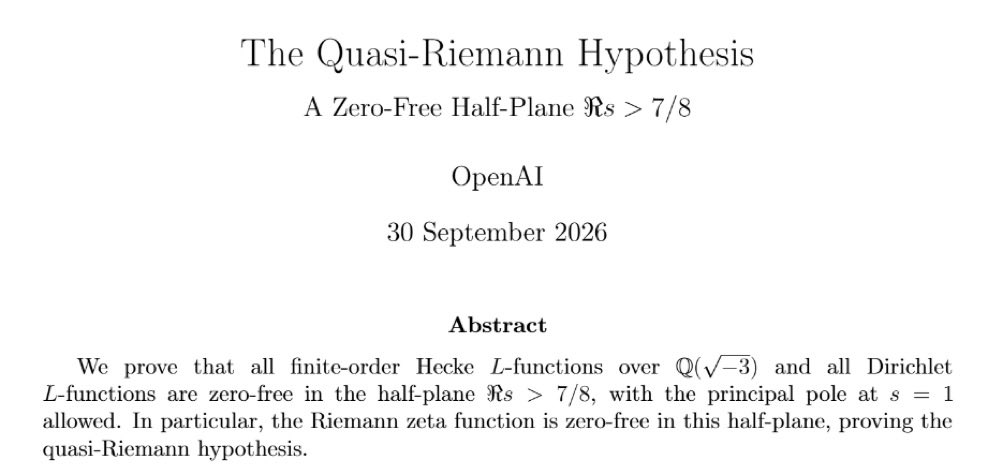

We’re releasing a broad range of new mathematical results produced by an internal frontier model.
We’ve been consulting with the independent Advisory Group on Mathematics and Artificial Intelligence at the Institute for Advanced Study, and we have drawn on their advice and public recommendations to inform how we release these results.
github.com/openai/math