
Human-first AI systems | Visionaire Founder | Psychology, Authorship, Systems Architecture
Boise, Idaho
Joined January 2007
- Tweets6.4K
- Following313
- Followers347
- Likes1.3K




If AI is going to be known as Super Intelligence and software engineers transition to SI operators, are we now called?
Super Engineers!
Where’s my cape….
4
When you build an agent observability tool so you can see what your agents are doing and why and you end up with a project management tool for agents because you want all the work in one place because that is where the intelligence lives.
I didn't want to build a project management system...
31
Software engineering did not change when AI showed up. The fundamentals got more expensive to ignore.
Four agents: Producers do the work. Orchestrators route it. Reviewers check it. Learners find the mistakes that repeat and close the gap.
Code is context for an LLM. Design for it.
8
3
45
6/ The code is context for an LLM, so I design for it. Names say what things do. The code reads like English. No new pattern without a reason. If I can understand it by reading, the model can too.
5
5/ Logging. Token spend is easy. I want to know why an agent left the plan, and which patterns keep sending work back from review. Those patterns are the roadmap to agents that do the right thing every time.
7
4/ Anything a tool can do, an agent should not. Every step moved into a tool is a step the agent can no longer get wrong. Permissions are the same idea. An agent cannot break what it cannot touch.
5
3/ Context is the budget. Progressive disclosure spends it on purpose. Context isolation gives reviewers and producers their own window. SKILL.md is a table of contents, small, pointing to files that each do one thing.
6
2/ Four kinds of agents. Producers do the work. Orchestrators decide who does it and where it goes next. Reviewers check it. Learners find the mistakes that repeat across runs and fix the agent or skill that caused them.
7
1/ Software engineering did not change when AI showed up. The fundamentals got more expensive to ignore. Here is what I think about when I build Agentic Teams.
12
LLMs have been around for how long now? Everyone is an AI expert or at least talks like they have AI figured out.
I doubt all of that and I realized that the way I have been talking about AI is no different. That changes.
I genuinely think AI is more than a tool. There will be standards that work and then there will be the gray area: how you're able to make AI work for you, which might not translate to others.
I think we need to be more honest about that and it starts with me. So, here's to being the explorer, the adventurer in this new AI world where I am obsessed with figuring it out for myself and sharing what works for me - not assuming it works for you.
1
11
Everyone has the will to win. Not many people have the will to prepare. (paraphrased from Bobby Knight)
16
Speaking of vocabulary wars....I have been calling one of my styles of AI engineering:
Document Driven Architecture.
12
Unpopular opinion, [AI] graph engineering is wrong. Hardcoding absolute nodes and conditional paths ahead of time is unnecessary.
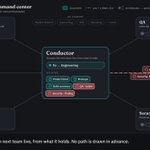
I am running, what I call, a conductor pattern across agentic teams and I do not pre-select how the conductor passes off different types of work to different agentic teams.
I think people are being too quick to win the vocabulary AI war.
15
In the last 30 days, I have used my agentic teams to develop our companies v2 platform. It is 60% of the way complete. It includes an order management system, inventory management, and ecommerce intelligence. It handles catalog upload, enrichment, listing on marketplaces, price management and listing optimization, receiving orders, managing shipments, handling customer feedback, account health, financial reconciliation, and just under 200+ endpoints from the marketplaces and an internal api of 82 endpoints and EDI.
This is 30 days of work. I have built large scaled applications like this in the past, by hand, and this would have taken me (just me) well over a year to develop.
Not to shabby. All agentic teams are self-learning, self logging, to a new product I created for agent observability. In 2 days, they had issued over 132k api requests and uploaded almost 2k worth of documents (their handoffs). The observability also supports a chat interface for executives to ask about the project and get a status update and where are we, how did we get here, etc.
All built by agentic teams I have hand crafted for the last 2 years.
If anyone tells you AI is shit, don't even entertain the conversation because it is a user problem, not an AI problem.
1
38
This is so true in my experience: the vast majority of people do not want to explore/create; they want to be told what to do.
8
Interesting experiment time.
I created a binary that allows my codex subscription to talk to my claude code subscription.
I have found the ChatGPT 6 is much better at brainstorming products/ideas and design. However, claude code is much better at software engineering.
Why not pair them up. So, I did. Codex now controls claude code and directs it, while keeping full visibility into the work it is doing, so codex can validate the work and then give the next assignment.
Next, bring Grok into the fold as my researcher.
16
3
308
