

Building the first stop for AI monetization.
Greater Boston
Joined January 2012
- Tweets1.8K
- Following210
- Followers1.6K
- Likes4.2K




Damn Zoom, I owe you an apology. I wasn’t familiar with your game!
TIL that Zoom not only has a speech to text model, but also that its #1 in accuracy according to Artificial Analysis.
Why does this matter for Zoom?
Zoom has their own Meeting Assistant, and using their own model means they get all the margin back that they’d otherwise have to pass off to the labs.
Further, because they have more control over cost, they can be extremely competitive with pricing for their Assistant.
Beyond all that, they can credibly say they have the most accurate meeting assistant on the market.
I did not have this on my bingo card, and love to see it.

1
17
OpenAI is overthinking pricing for Dots, their agent product.
They already changed the plan, and I wouldn’t be surprised to see it change again.
The original plan was to start charging $50 per Dot in Enterprise plans this week, but the ChatGPT website now says billing for enabled Dots will start in January.
This approach would mean a blend of flat pricing and token pricing for Enterprise customers.
Simon Smith, a current Enterprise customer, shared why this is problematic for his company.
To summarize:
▶ They’ve gotten really good at attributing token costs to specific projects
▶ That has allowed them to build these costs into their own prices
▶ Dots complicate their planning process because the amount of work they'll tackle on each project is dependent on the user
Simon mentioned that the annual cost for the Dots he’s paying for would buy 9B Opus 5.5 output tokens. If its unclear what value Dots will deliver, that’s a difficult trade to make.
The funny this is, SpaceX has already shown the right approach here. They bundled Grok Bot with their Cursor subscriptions, and made Grok Bots just another way to consume compute.
They don’t publish Enterprise pricing, but according to Reddit, it’s also based on shared compute with no explicit costs for Grok Bots.
I like this because there’s no friction to creating or using Grok Bots. It’s just another way to draw tokens from your subscription.
If OpenAI fights against this, Dots are likely going to be an inconvenience when they should be a usage accelerant.
Simon's full post: teapaw.org/_simonsmith/status/211…


Awaiting clarification from OpenAI, but it seems Dots will cost $50+ per user in ChatGPT Enterprise starting November 18. I'm not sure they're worth it yet.
About 19% of active ChatGPT users in our organization currently use Dots, including me. From what I've experienced, and what I've seen, they're more of a convenience currently, and sometimes an annoyance, and definitely not worth their equivalent cost in tokens that could be used in either ChatGPT or Claude, since we're customers of both.
Even at just 19%, the annual cost is equivalent to about 9.24 billion Claude Opus 5.5 output tokens. If we scaled to all our active users, that's about 48.6 billion output tokens.
This is also, for Enterprise, a regression from usage-based pricing that we've been able to start building a strategy around. With token-based usage, we can track how many tokens get spent against different initiatives and deliverables, and then account for those costs, and incorporate them into our own pricing models. With the new Dots pricing, it's less clear how this will work, since you only pay for usage Dots delegate to threads, and Dots themselves are a fixed fee, but what Dots delegate or don't delegate isn't going to be consistent because it's partly dependent on user behavior.
Across our business, we use Google Workspace, Microsoft 365, ChatGPT, and Claude, each with AI offerings that we're constantly evaluating in comparison to the others. With the competition we know is coming, including from Anthropic with Claude Duet, it's just too early for us to lock in to a persistent agent platform.
So, if this $50+ per dot pricing persists, OpenAI, I think you're going to see a significant reduction in usage, which will create an opening for competitors.
This said, I'd like to know what other ChatGPT Enterprise customers on X think. Maybe I'm wrong. Maybe people think it's worth an extra $50/user/month for each Dots user.

1
85
Rob Litterst retweeted

imagine telling someone from the 80s that one of these guys was a socialist and the other one was the capitalist


This is cool. Similarweb popped after earnings yesterday thanks to a booming AI story.
AI-related deals made roughly two-thirds of the new recurring revenue added last quarter (the second quarter in a row where AI drove most of the new business).
Now almost 20% of Similarweb's revenue is AI-related, up from 11% at the end of 2025.
The big unlock is agents.
Customers used to log into Similarweb's platform to look at web and app data, and that’s still the core business. But now models and agents are pulling the same data directly through API and MCP.
CEO Or Offer said when customers buy data this way, the deals are larger from day one AND more profitable.
I love finding SaaS companies with a strong AI story. This is a great example of a company built to thrive in a headless world.

41
Shopify stock was down 5% yesterday, part of a wider SaaS selloff.
But Shopify is not like most SaaS companies. It's more like a tollbooth for eCommerce.
In the early days, subscription fees made up most of Shopify's revenue, but that's no longer the case (and hasn't been for a while).
In Q3, subscription fees made up 22% of total revenue, while merchant solutions made up 78%.
Here's how it works:
▶ Subscriptions are the monthly plans.
▶ Merchant solutions are services that grow with what merchants sell (e.g., payments, shipping labels, loans). Most of that revenue moves up and down with total sales on the platform, so its perfectly tied to the success of their customers.
This week Shopify added a new merchant solution: Tax Calculation.
Merchants who let Shopify calculate their sales tax now pay 0.35% on Basic, Grow, and Advanced, or 0.25% on Plus, after an introductory discount.
Tax calculation is another small toll for Shopify's customers that only gets paid if they make the sale.
Full briefing on PricingSaaS: pricingsaas.com/news/article…

70
Clay’s two credit pools make sense to me. Notion’s don’t.
We dug into two-pool credit setups in Office Hours last week.
Clay’s split is easy to defend. Data enrichment and agent actions are different jobs with different pricing power. I get it. Customers get it.
Notion credit pools differ by who picks the model, not what the credits are helping you do. Then there’s a third pool that can top up either one.
If one pool can cover both, why have two (or three)?
I’m sure there’s a reason Notion is doing this.
But as a general rule I’d only split credits when you have multiple jobs that are genuinely different, and a customer can quickly understand the difference.
If you need a third pool to glue the first two together, you probably only needed one pool all along.

57
Claude inside Excel was supposed to be a game-changer.
Instead, Microsoft says it's no big deal.
According to The Information, Microsoft's internal data shows weekly users of Claude inside Office are less than one-tenth of paid Copilot users, and the gap is growing.
A few reasons this is an interesting story right now:
▶ It's Anthropic's IPO week. The timing isn't an accident
▶ Anthropic just launched its own spreadsheet and data tools (MSFT dropped on the news)
▶ I actually think this is the wrong conclusion
Copilot is supposed to compete with Claude. To use Claude in Office, you need a separate Claude plan and you need to activate an add-in. That’s a fair bit of friction.
I also don’t think using Claude in Office is the best user experience. Most heavy Claude users likely use Connectors in Claude or just drop the files they need into Cowork.
Lastly, the people living in Office all day don’t strike me as the ones most likely to reach for Claude anyway.
Through that lens, 10% of paid Copilot customers using Claude inside Office is actually kind of impressive.
But I get why Microsoft is leaking this now.
They’re fighting over the center of gravity in the enterprise, and for the first time in a long time, they have a real challenger.

1
152
Howard Marks thinks AI could be taxed like people.
In his latest Oaktree memo he asked: "What's to say AI won't be taxed like people? Many of today's top earners are taxed at combined rates of 50% or more."
Crazy when you realize taxes on people's pay (income plus payroll) make up 86% (!!!) of federal revenue.
I'm already seeing it in my own business. We used to pay contractors about $10k a month for design, writing and QA. Today AI does most of that for less than $1k. No full time employees got fired, but it's kept us from hiring. Those contractors paid taxes. Our AI bill doesn't.
So if the government acts, how would it even work?
▶ Tax tokens used?
▶ Tax jobs replaced?
▶ Tax profits?
And who pays: the labs, the companies using AI, or both?
It feels early, but the more I think about it, the more it feels inevitable. And whoever pays, the cost will flow down to the people using it.
How would you tax AI?

77
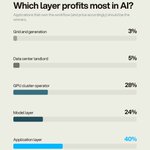
The application layer takes 40% of the gross profit in the AI stack.
That's from a new breakdown by Tomasz Tunguz. He traced the money from the power plant to the software the customer buys, and asked who keeps what's left after direct costs.
Here's the split:
▶ Grid and generation gets 3%.
▶ Data Center landlord gets 5%.
▶ GPU cluster operator gets 28%.
▶ Model layer gets 24%.
▶ Application layer gets 40%.
Two caveats:
1. The 40% for the application is an assumption. Tunguz modeled a 40% gross margin on the app. If your product does more valuable work, you can charge more, and your share grows.
2. The GPU cluster operator's 28% is before counting GPUs wearing out. After that cost, Tunguz says their share could shrink to almost nothing.
If you sell an AI application, your pricing strategy is the whole game. If you can own the workflow AND charge for it, you’ll be in good shape.
Honestly makes me bullish on the next era of software.

1
82
One part of Five9 is growing 91%. The other is growing 8%.
Guess which one they just spent $325 million on?
The 91% is AI. The 8% is the contact center software Five9 is known for.
AI is still only about 17% of subscription revenue, so the slow-growing core brings in most of the money. Together they add up to 16% growth.
Last week Five9 announced it’s buying Level AI, an AI company for customer service, for $325 million in cash. Level AI brings in about $20 million a year in recurring revenue, growing about 50% a year. That’s roughly 16x revenue.
Five9 already builds AI. So why buy it?
Because Level AI can sell to customers Five9 can’t reach today: companies that use a competitor’s contact center software, or that aren’t ready to move to the cloud. They don’t have to buy Five9’s seats first.
That flips Five9’s playbook. It used to lead with the contact center product and add AI on top. Now it can sell the AI first and win the seats later (or never). The AI revenue shows up either way.
Five9 isn’t alone. Salesforce, Zendesk, and Gainsight have all bought AI companies recently too.
Building takes years (and may not work). Buying takes one check.
Think we’re going to see A LOT more of this.

65
So…
If the UI is commoditizing...
And features are commoditizing...
And intelligence is commoditizing...
What’s worth paying for?
THE WORK.
Plan (and charge) accordingly.

63
Open job listings for FDEs are up 361% in a year.
Front-end engineer listings fell 51% over the same stretch.
That split tells you where the value is moving.
If anyone can ship your feature list in a weekend, the feature list stops being the reason customers pay you. The reason becomes the work you get done for them.
That's why companies are hiring engineers to sit next to customers instead of polishing the app.
This changes how you price too. When the product is the outcome, charging for logins makes less sense than charging for the work.
Source: Lenny's Newsletter, with data from TrueUp (Oct 2025 to Oct 2026).

76
Devin just introduced BYOK with ChatGPT.
In plain English:
You can log in to Devin with the ChatGPT plan you already pay for on Pro, Max, and Teams.
▶ Cognition is betting you’ll pay for Devin because it finishes specific work better than other agents and that the model underneath doesn’t matter.
▶ ChatGPT is betting that vertical agents will outperform general purpose models, so might as well allow users to work where they want.
Think this makes a ton of sense for both sides. Both are offering customers flexibility at a time when it makes a ton of sense to be customer-friendly.
Full briefing on PricingSaaS: pricingsaas.com/news/article…

73
One benefit of Linear selling AI at costs is it protects them if they choose to offer BYOK.
Hit publish on this yesterday, and they just announced BYOK with OpenAI and Anthrhopic this morning.
Love when this happens

Agents now create 50% of the work in Linear.
Linear still charges per seat. And sells AI tokens at cost (no markup).
It sounds like money left on the table, but I think it’s one of the smarter AI pricing moves out there right now.
I recorded a quick video covering:
→ How Linear’s seats and AI credits actually work
→ Why “at cost” builds trust (and kills discount requests)
→ Where Linear is quietly taking a margin
→ The ceiling risk if agents keep replacing seats
The big lesson: you don’t have to meter every AI feature. Linear includes everyday agent work in the seat and only charges credits for the heavy jobs.
Full write-up in this week's newsletter: lnkd.in/gpKAZukt
77
Agents now create 50% of the work in Linear.
Linear still charges per seat. And sells AI tokens at cost (no markup).
It sounds like money left on the table, but I think it’s one of the smarter AI pricing moves out there right now.
I recorded a quick video covering:
→ How Linear’s seats and AI credits actually work
→ Why “at cost” builds trust (and kills discount requests)
→ Where Linear is quietly taking a margin
→ The ceiling risk if agents keep replacing seats
The big lesson: you don’t have to meter every AI feature. Linear includes everyday agent work in the seat and only charges credits for the heavy jobs.
Full write-up in this week's newsletter: lnkd.in/gpKAZukt
Would you rather own a $100 million software company at 80% gross margin, or an $800 million AI company at 10%?
Both make $80 million a year in gross profit. One keeps 80 cents of every dollar. The other keeps 10, and has to sell 8 times as much to get there.
Honestly, this is a hard hypothetical if you don't know what kind of companies you're looking at.
On the AI side, the cost of running models has been falling. You'd think that 10% can climb over time. Maybe. Maybe not, if they keep cutting prices as fast as costs fall.
On the software side, 80% looks great until they add AI. Those margins are likely to come down. Maybe they can hold them if they price the AI well. Maybe not.
If this is a vertical software company, one that already solves a specific workflow for a specific niche, I take the software company all day.
(Hat tip to Sabba Keynejad for the original question.)

103
Slack just capped Slackbot at 15 messages per user per week on Business+
For context, Business+ is Slack's second most expensive plan.
Here's how Slackbot access now works by plan:
▶ Free and Pro are "consumption based."
▶ Business+ gets 15 messages per user each week
▶ Enterprise+ stays unlimited.
No new price here. Nobody's bill went up. But 15 messages a week is about three a workday. If you actually use Slackbot, you'll hit that fast.
My take: this turns Slackbot from a perk into something metered, and the only plan with no cap is Enterprise.
The page also doesn't say what happens when you hit the limit. Does Slackbot stop, or just slow down?
Full briefing on PricingSaaS: pricingsaas.com/news/article…

42
Rob Litterst retweeted

New!! Our Agents Never Picked Canva. 10 Learnings on Agent Pricing, Getting Picked, and Security From This Week’s “The Agents” With Ulrik Lehrskov-Schmidt
Agents pick once and stop looking.
Charge for real agents, not features.
saastr.com/our-agents-never-…

Agents went from creating 3% of the work in Linear to 50% in one year. And Linear is passing the AI cost straight through to customers.
Ulrik Lehrskov-Schmidt and I just broke down Linear's pricing on Pricing Page unPacked. It's one of the only companies we've seen that takes no markup on the AI models it uses.
They still charge for seats, but bill for AI with credits.
Credits work like a prepaid balance. You add dollars, top up from $10, and unused funds roll over for 12 months.
AI is billed at cost. For example, when Linear's agent writes code, you pay the model's published token price with no markup, plus a small fee for the time the agent's computer runs.
That means no bulk discounts, because there's no markup to discount.
All in all it's one of the most customer-friendly policies we've seen.
Some signs that its working:
▶ Agents are everywhere. They're installed in 95% of paid workspaces
▶ Linear recently passed $100M in annual recurring revenue
▶ Net revenue retention is 177%
The big question is what happens next. Agents are doing half the work, and Linear is giving that AI away at cost instead of profiting from it.
We're really interested to see how it plays out.
Listen to the full episode here: buzzsprout.com/2612036/episo…

47
Base44 has added $100M in ARR since Q1 while boosting gross margin from 0% to 58%.
The reason is Base 1, Base44's own AI model.
Founder Maor Shlomo says Base 1 works almost as well as Fable and costs about 4.5 times less.
It’s now kicking off a powerful flywheel:
▶ Cheaper inference means better margins
▶ Better margins means more money for marketing and user acquisition
▶ More marketing means more users
▶ More users = more usage, which improves the model
The big question is whether people stay. Most Base44 customers still pay month to month, so they can leave anytime.
If retention holds, Wix might have a rocket ship on its hands.

1
100