

astronomer / open software dev / data scientist / proud cat dad
New York, NY
Joined May 2011
- Tweets129
- Following141
- Followers468
- Likes1.2K
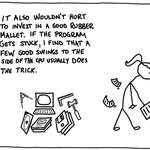
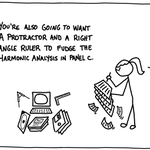
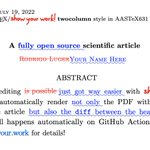


Collaborative editing just got easier with showyourwork!
It's now easier than ever to write open source scientific articles that can be reproduced--by anyone--with the click of a button.
github.com/showyourwork/show…


Hey science twitter: announcing the new release of showyourwork!, a workflow management tool for open source scientific articles.
github.com/showyourwork/show…
1/6
Use showyourwork! to make your research articles reproducible, extensible, and transparent. Automate your entire workflow, packaging it into a self-contained recipe that anyone can follow and—at the click of a button—use to reproduce your results.
2/6

ALT showyourwork! articles exist as GitHub repositories containing the source code for generating the article and all its dependencies (figures, tables, etc) alongside a complete environment specification and rules to download external datasets. The article PDF is automatically built on the cloud upon every commit using GitHub Actions.
New blog post on showyourwork, a new workflow for open source scientific articles.
I'm still actively developing it -- suggestions, feedback, and contributions always welcome!
luger.dev/blog/2021-12-03.ht…
Guys. I cracked the key to winning a Nobel prize.
A short thread.
Write N papers, and in each one, cite all your previous papers. The content doesn't matter -- just brag about how awesome you are.
🧵1/3
When it rains it pours. Second tweetstorm of the day, this time on a new open source scientific article workflow, showyourwork: github.com/rodluger/showyour…
Make your scientific articles transparent, reproducible, and truly open source.
🧵 (1/6)
I introduced showyourwork in my most recent paper on Doppler imaging: arxiv.org/abs/2110.06271
That paper was automatically generated using showyourwork from a Github repository that lives here: github.com/rodluger/paparazz…
🧵 (2/6)
1
8
Excited to announce paper 3 in our Mapping Stellar Surfaces series, this time on Doppler imaging!
Paper link: arxiv.org/abs/2110.06271
Github: github.com/rodluger/paparazz…
Code: github.com/rodluger/starry
🧵 (1/10)


As promised, two more papers on mapping stellar surfaces on arXiv today:
ui.adsabs.harvard.edu/abs/20…
ui.adsabs.harvard.edu/abs/20…
We developed an interpretable Gaussian process for stellar variability. Here are some samples from the GP:
@exoplaneteer @TheChedgehog

Building on this: if we *could* see a star from many different vantage points, we could learn up to *half* of all the information about its surface.


Today on arXiv: the first in an epic series of papers from @rodluger et al. where we investigates what we can (& can't) measure when mapping the surfaces of stars (or exoplanets) using time series observations: arxiv.org/abs/2102.00007

Meet Trappist-1h, a terrestrial-sized planet at the snow line arxiv.org/abs/1703.04166
@AgolEric @ethan_kruse

De-trended #TRAPPIST1 #K2Mission light curve looking awesome! Will make public in a day or two. @ethan_kruse @AgolEric
