

Co-Author of that Bill Gothard book: https://xitter.cf/t.co/3lokJ6AyZ3 | Author, Darby, Dualism, & the Decline of Dispensationalism: https://xitter.cf/t.co/jjO1dRBX3u | PCA
Cape Coral, FL
Joined May 2009
- Tweets77.6K
- Following2.1K
- Followers9.4K
- Likes205K




Pinned Tweet
⁴ ...we esteemed him stricken, smitten by God, and afflicted.
⁵ But he was pierced for our transgressions; he was crushed for our iniquities; upon him was the chastisement that brought us peace, and with his wounds we are healed.
—Isaiah 53:4b-5, ESV

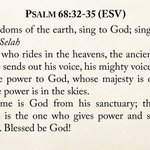
Psᴀʟᴍ 68:32-35 (ESV)
³² O kingdoms of the earth, sing to God; sing praises to the Lord, Selah
³³ to him who rides in the heavens, the ancient heavens; behold, he sends out his voice, his mighty voice.
³⁴ Ascribe power to God, whose majesty is over Israel, and whose power is in the skies.
³⁵ Awesome is God from his sanctuary; the God of Israel—he is the one who gives power and strength to his people. Blessed be God!

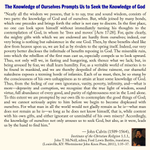
The Knowledge of Ourselves Prompts Us to Seek the Knowledge of God
“Nearly all the wisdom we possess, that is to say, true and sound wisdom, consists of two parts: the knowledge of God and of ourselves. But, while joined by many bonds, which one precedes and brings forth the other is not easy to discern. In the first place, no one can look upon himself without immediately turning his thoughts to the contemplation of God, in whom he ‘lives and moves’ [Acts 17:28]. For, quite clearly, the mighty gifts with which we are endowed are hardly from ourselves; indeed, our very being is nothing but subsistence in the one God. Then, by these benefits shed like dew from heaven upon us, we are led as by rivulets to the spring itself. Indeed, our very poverty better discloses the infinitude of benefits reposing in God. The miserable ruin, into which the rebellion of the first man cast us, especially compels us to look upward. Thus, not only will we, in fasting and hungering, seek thence what we lack; but, in being aroused by fear, we shall learn humility. For, as a veritable world of miseries is to be found in mankind, and we are thereby despoiled of divine raiment, our shameful nakedness exposes a teeming horde of infamies. Each of us must, then, be so stung by the consciousness of his own unhappiness as to attain at least some knowledge of God. Thus, from the feeling of our own ignorance, vanity, poverty, infirmity, and—what is more—depravity and corruption, we recognize that the true light of wisdom, sound virtue, full abundance of every good, and purity of righteousness rest in the Lord alone. To this extent we are prompted by our own ills to contemplate the good things of God; and we cannot seriously aspire to him before we begin to become displeased with ourselves. For what man in all the world would not gladly remain as he is—what man does not remain as he is—so long as he does not know himself, that is, while content with his own gifts, and either ignorant or unmindful of his own misery? Accordingly, the knowledge of ourselves not only arouses us to seek God, but also, as it were, leads us by the hand to find him.”
— John Calvin (1509-1564), Institutes of the Christian Religion 1.1.1, John T. McNeill, editor, Ford Lewis Battles, translator, (Louisville, KY: Westminster John Knox Press, 2011), 1:35–37.

There are times when the simplest way to Eph 4:26a is to keep my mouth shut and take my fingers off the keyboard. It requires lots and lots of practice.
It seems whatever situation our brother @SlowToWrite is in has triggered a zombie apocalypse of בְּנֵֽי־בְלִיַּ֙עַל (bənê-ḇəlîyaʿal) who ever lurk for opportunities to drain the life blood from God’s true people.
Other than that, it’s shaping up to be a pretty nice weekend.

For someone who questions sola Scriptura, how does @rootcausesleuth know that Grok isn’t inspired?

Question for Non-Calvinists: Are you one of the elect?


91%Yes.
0%No.
9%I Don’t Know.
32 votes • Final resultsWestminster Shorter Catechism (1647)
Qᴜᴇsᴛɪᴏɴ 8
Q. How doth God execute his decrees?
A. God executeth his decrees in the works of creation and providence.

Trying to think of a single Calvinist commentator, theologian, or author who claims that Paul’s objector in Romans 9:19 is an Arminian pastor.


Thoughts for Lord’s Day Worship:
Philippians 2:5-11 (ESV)
⁵ Have this mind among yourselves, which is yours in Christ Jesus,
⁶ who, though he was in the form of God, did not count equality with God a thing to be grasped,
⁷ but emptied himself, by taking the form of a servant, being born in the likeness of men.
⁸ And being found in human form, he humbled himself by becoming obedient to the point of death, even death on a cross.
⁹ Therefore God has highly exalted him and bestowed on him the name that is above every name,
¹⁰ so that at the name of Jesus every knee should bow, in heaven and on earth and under the earth,
¹¹ and every tongue confess that Jesus Christ is Lord, to the glory of God the Father.

This is timely.

Some thoughts on when friends turn against you . . .
jvfesko.com/blog/2026/10/5/w…

Either God is able to stop being the God of Scripture, @Soteriology101, or He is not.
If you have a low view of His omnipotence and omniscience, you think He is able.
If you have the biblical view of those attributes whereby He determines all things, you think He is not able.

Westminster Shorter Catechism (1647)
Qᴜᴇsᴛɪᴏɴ 7
Q. What are the decrees of God?
A. The decrees of God are, his eternal purpose, according to the counsel of his will, whereby, for his own glory, he hath foreordained whatsoever comes to pass.ʳ
ʳ Ephesians 1:4, 11; Romans 9:22-23.

For Calvinists: Which of these has influenced you the most?


5%Tim Keller
31%John MacArthur
10%John Piper
54%R.C. Sproul
1,206 votes • Final results
Thoughts for Lord’s Day Worship
Rᴇᴠᴇʟᴀᴛɪᴏɴ 19:6-7 (ESV)
⁶ Then I heard what seemed to be the voice of a great multitude, like the roar of many waters and like the sound of mighty peals of thunder, crying out, “Hallelujah! For the Lord our God the Almighty reigns.
⁷ Let us rejoice and exult and give him the glory, for the marriage of the Lamb has come, and his Bride has made herself ready;”

“Paul is insisting that people were really ‘made’ sinners through Adam’s act of disobedience just as they are really ‘made righteous’ through Christ’s obedience.”
— Douglas J. Moo, commenting on Romans 5:19 in The Letter to the Romans, Ned B. Stonehouse et al., eds., Second Edition, The New International Commentary on the New Testament (Grand Rapids, MI: William B. Eerdmans Publishing Company, 2018), 371–72.

“When you say ‘Genevan Consistory,’ people often picture the theocratic thought police, a city ruled with an iron fist by the tyrant of Geneva. The records tell a different story.…
“So I gathered three hundred of the most interesting cases from the Consistory’s registers and the standard scholarship…”
— Anthony Faggiano, “Three Hundred Cases From Calvin’s Geneva: Notes On Building A Case File,” The Heidelblog (@Heidelblog01), September 22, 2026.
heidelblog.net/2026/09/three…
