

cofounder @rhinofi 🦏 - The stablecoin activation stack. Rhino enables enterprises to accept stablecoin deposits from any chain. @echodotxyz group lead
Joined April 2014
- Tweets2.8K
- Following1.9K
- Followers7.1K
- Likes13.4K
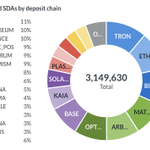






Over 3m rhino.fi Smart Deposit Addresses are now live in production.
1m new SDAs are being launched by clients every 4-6 weeks, with the most popular routes by volume being from Tron & BNB Chain to Base, Tempo, Polygon, Solana and Optimism.
SDAs work around the clock to monitor, screen, bridge, route and activate stablecoins, enabling frictionless cross-chain deposits & pay-ins for complex business flows, without users needing to connect a wallet.
Over 50% of transaction volume now makes use of rhino's 1:1 Stablecoin FX/settlement feature


Ross retweeted

Today, we’re announcing Tenka’s $2M pre-seed round, led by @Maven11Capital with participation from @Gami_Capital to build the market infrastructure for asset-backed finance, from book-building to secondary transactions.
🤖 Made with AI

Ross retweeted

Introducing @EthenaPay: the internet money neobank.
→Card spend cashback at 5.0%
→Best-in-class 6.0% dollar savings rate
→Borderless, free, instant global money transfers
→Free global onramps in USD, GBP, EUR and local FX
→Multi-currency high-rewards savings accounts in local FX
→Unified fiat IBAN integration with self-custodial stablecoin accounts
→Buy Now Pay Never where your savings rewards covers daily expenses
Not coming soon™️. Live now to download on iOS.

Introducing Ethena Pay: the internet money neobank, built on @avax.
Live now to download on iOS.
Ross retweeted

When do companies decide it’s time for a major makeover?
For us, it came after a pretty significant eight months. Looking at how much Rhino has grown this year, it felt like the brand deserved a makeover too.
📈 7x cumulative volume growth YTD
📩 5 new chains for SDA acceptance and cross-chain movement
💸 12 new stablecoins and tokens
Rhino has grown. It felt like the brand should too.
Ross retweeted

I used to say the neobank explosion wouldn't end well for 95% of them. I still think that's roughly right, but I was sloppy about who I meant. It's 95% of the startups launching one. Neobanking itself is fine but building distribution from scratch while regulated and burning cash is a nightmare
A couple of musings:
Over the last year more neobanks have launched than have died, and it hasn't been close. This time last year I was expecting the opposite
Who's launching right now? FC Barcelona. Sports leagues. Car brands. Clothing labels. Marketplaces. These aren't companies trying to win customers, they've had them for decades. They've got databases zland a level of loyalty the challenger banks spend a fortune trying to copy
When people push back on this they usually reference Xinja, Bo and Volt but those were standalone challengers going after primary accounts against banks with customers who were more likely to divorce than change their account. A club with 400m fans is doing something else entirely. It doesn't need share of wallet. It needs a fraction of its base holding a branded card, topping up on matchday, spending on it abroad in the summer. That's a very different business model with an entirely different CAC
What's actually changed underneath is the cost of trying. Licence, scheme membership, processor, treasury, a year and a half of build.. all those used to be the barrier to entry and it filtered out almost everyone who wasn't primarily a fintech. Stablecoin rails and a strong BaaS partner like @wirexdevelopers have turned most of that into an integration and a commercial conversation. So the question isn't really whether you can build a bank anymore. It's whether you've got an audience that's worth doing it for
The revenue side has got a lot more interesting too and this is the part I think gets underrated. It's not interchange or bust. With Wirex BaaS you can take payments, on/off ramp, accounts, FX, yield, prediction markets, perps, stocks, predictions, push-to-card all onchain, one API, and modular so you take what suits you and leave the rest. A football club will monetise its base completely differently to a car brand or a broker, and there's no reason they should end up with the same product just because they're on the same rails. You build around where the money already is for you rather than taking a fixed stack and shoving it in someone's face. I don't think this flexibility has ever really existed before and certainly not at this price
Margin still scales with distribution, though. That bit hasn't changed and never will
One last thought. People still talk about fintech and digital assets as separate things. DeFi is fintech. It's the settlement layer that made any of this affordable for a company whose actual business is selling football shirts or anything else for that matter
We built @wirexdevelopers on the assumption that eventually the client list is every fintech or corporate with a customer database
Ross retweeted
that’s not really onchain credit if the underlying assets aren’t issued, serviced and monitored onchain.
for this to actually work efficiently, you need:
- underlying performance that is verifiable onchain in near real time
- a regular NAV from an independent valuation agent
- a liquid market that leverages both so capital can make informed decisions when providing liquidity
anything else than that and if you start looping illiquid credit at high LTVs, you’ll blow up sooner or later. very liquid, short duration assets like MMFs or T-bills are obv a different story.
the details really matter here because even if you get the valuation methodology right and provide regular NAV updates, looping long duration assets still has implications.
and you don’t even need the underlying credit to deteriorate.
private asset-backed credit is generally valued using observable benchmark curves and comparable credit spreads, alongside asset level performance data. those benchmarks will never represent the underlying perfectly.
you could have a macro event where spreads move violently, NAV drops, while absolutely nothing has changed with the underlying credit and the assets continue to perform as expected.
for a long term holder, it’s fine but if that same asset is being used as collateral in a lending market, it does matter a lot.
if LTVs, liquidation thresholds and haircuts aren’t calibrated properly to the type of credit, its duration, liquidity and how the NAV is calculated, you can end up liquidating performing credit because of a temporary mark to market move.
this is where having the underlying data onchain is necessary so the market can bring in liquidity in time.
there will always be capital willing to buy well performing assets at the right discount. the issue is whether that capital can underwrite them fast enough when liquidity is actually needed.
even a daily NAV doesn’t tell you enough to do that. you need to be able to look through to the underlying collateral and understand very quickly whether something trading at a discount is cheap because of the market or because it is actually deteriorating.
this is exactly what @tenkafinance and @TranchedFi are solving for together.

How an RWA credit facility blows up
1. You deposit USDC into an onchain credit facility and get a yield-bearing stablecoin in return ("USDX"). USDX is backed by a portfolio of loans to offchain borrowers, according to the marketing.
2. USDX's issuer creates a Morpho market where you pledge USDX and borrow USDC, up to a 91.5% LLTV. You go to Morpho, post your USDX, borrow USDC, buy more USDX, and repeat. You now have 10x leverage.
3. Morpho values USDX using the portfolio’s NAV, relayed onchain by a “Verified NAV Oracle.” The oracle doesn't verify that the loans are worth that amount, or that the collateral can be liquidated. They pass along the issuer's self-reported NAV, which increases mechanically at par plus the coupon rate. If you bought on Day 1 at $1.00, and the annual coupon was 7%, it would be worth $1.07 on Day 365.
4. The borrowers begin to deteriorate offchain, payments stop flowing in, covenants are busted. Your Morpho position looks fine because the USDX price from the oracle continues to increase.
5. Finally the issuer marks down the NAV, on the quarterly schedule. Assuming a 91.5% liquidation threshold, a position at 90% LTV only needs a 1.64% decline to be liquidated. Several looped positions immediately fall underwater.
6. The markdown causes a run. USDX holders submit redemptions at the published NAV. The issuer pays the first redeemers from its cash sleeve, leaving the remaining token supply backed by a less liquid loan book.
7. Once the cash is exhausted, the issuer pauses redemptions, or begins selling loans at a discount. USDX is listed on DEXs - to facilitate orderly liquidations in situations like this - but it trades far below NAV because it can no longer be converted into cash.
8. On Morpho, USDC suppliers withdraw the remaining liquidity, causing borrowing rates to spike and pushing the debt positions further underwater.
9. A liquidator shows up and buys USDX, repaying a portion of the debt. They try and trade it on the DEX but it can't absorb the volume. They try and redeem directly with the issuer but they are stonewalled. They find out the token doesn't actually represent a legal claim on the collateral, or really anything, despite what the marketing said.
10. No other liquidators show up. At a 91.5% LLTV, the liquidation bonus is only ~2.6%, not nearly enough to step in and pursue recovery.
11. You lose your initial investment. The CEX "Earn" depositor who unknowingly funded the whole operation (via an embedded curator vault), loses their entire position.

Ross retweeted
Rhino.fi is live on @StellarOrg 🚀
Up to $2M in a single transaction, settling natively to USDC on Stellar in under 10 seconds, from 30+ chains.
Committed liquidity. Deterministic execution. Built for Payments flows.


Ross retweeted

From capital to perps markets.
Instead of adapting to different chains and assets, EVEDEX traders can simply focus on trading.
✓ Transfer directly from CEXs
✓ Deposit from supported networks
✓ Exchange tokens from 60+ chains
Powered by @RhinoFi's routing infrastructure 🦏

Ross retweeted
💶EURC is now live on Rhino.fi rhino.fi/.
Stablecoins made the dollar move instantly. Euro just caught up.
Now you can move between euro and dollar stablecoins in one integration, both directions:
💶 EURC → USD: Your users deposit EURC to a Smart Deposit Address on Base or Ethereum. Rhino screens, converts and settles it as USDC/USDT on any chain.
📩 USD → EURC: Your users deposit USDC/USDT from any chain, and Rhino settles it as EURC.
🚅 Deterministic execution in seconds, on our own liquidity. The rate we quote is the rate that settles, with KYT built in.
For euro-denominated cards, neobanks and cross-border payment corridors, this is the euro leg you've been waiting for.
Talk to our team to get EURC activated → rhino.fi/contact
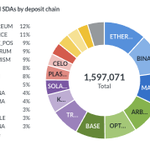
Over 1.5 million rhino.fi Smart Deposit Addresses are now live on mainnet, powering seamless cross-chain & CEX stablecoin deposits for hundreds of projects and millions of end users.
There's a good chance you've already used a rhino.fi Smart Deposit Address behind the scenes without even realising it!

Ross retweeted
Over $15bn settled for enterprises and we are just getting started. Instant, scalable, stablecoin movements. Monthly volume at an all time high.
The ceiling now is liquidity, not demand.
So we're opening our first USDT credit market on @WildcatFi, deployed on @Plasma, paying 10%.
Delta neutral. Backing stablecoin throughput and revenue.
Opening at $2m. Scaling from there.
app.wildcat.finance/lender/m…
Ross retweeted

ArcX Private Beta is LIVE.
・Get 50x exposure to @extendedapp points.
・Earn 20% APY on USDC.
Here’s how it works 👇

Ross retweeted

two months bootstrapping a neobank fintech:
1) i think our main lesson last month was: don’t rely on a single partner for money orchestration
on sales call, they have everything you need, but when time comes, sooo many issues present
- some partners have great fees, but very poor api/docs (basically non-implementable, gotta do everything manually)
- some have great API, but extremely rigorous compliance (you integrate the whole thing, to only then find out they wont approve your clients)
- some have great support, but wont cover all rails your clients need (pix only, no ACH, no swift, no named accounts, no microdeposits, etc)
- some have everything you need, but charge a high monthly minimum with 2x fees you got from the other provider
- not to mention the perfect partners, but with abusive contracts that makes our lawyer Claude go crazy
we spoke with ~15 orchestration partners for USD, BRL, EUR, AED, CHF and CNY, and realized there’s no “one size fits all” unfortunately
so we are basically analyzing what each client needs and activating partner XYZ for them - it’s working fine, besides the tech complexity
(though i have already fully integrated 8 partners and it's now taking me 1-2 days to get the whole thing up and running, while larger teams would take weeks - that's the power of repetition)
2) we initially decided on using Base USDC for our backend (even though our clients don’t really see anything stablecoin-related on the dashboard, as a product strategy)
but some banking partners wouldnt work on that chain, and Solana seemed to have better coverage and speed
so we had to build our own bridging process using circle’s CCTP (to make sure no % fees incurred, eating the low fees we charge) - this was pretty cool but very hard to make it work
so now we became not only multi-partners but also multi-chains (no USDT support though, that additional 0.1% was a no-go for us)
3) one of our clients (who turns out to be an old friend), brought his while whole Payroll to Dolafy
i built a special dashboard area so they could add all employees/collaborators, enter their banking details, salary and pay date
then in a single click every month, they would pay that employee anywhere in the world (via ACH, WIRE, PIX or SEPA), using their Dolafy balance
had to work for 20 hours the day it went live, but worked really well and their finance team loved it
(much more organized and simple than the bulk-payment via CSV they were doing at Husky)
the Payroll product itself is not so profitable in comparison to other clients moving millions in one txn, but it was really satisfying to be able to see all these people getting paid by Dolafy
4) the Credit Cards implementation has been my biggest frustration - i even had nightmares with it and woke up many days in terrible mood
even though i implemented their whole API in 2 days, it’s been over a month already and their compliance and legal teams keep slowing us down
things like: “hey, you cant mention the term unlimited cards, must be multiple cards” and then i fix it in 5 minutes, and they submit for approval that takes 7 days again
and then they come back with “you actually cant talk about cards at all on the homepage, must create a separate page for that”
“unlimited back and forth” seems a reasonable term to describe them though
in the end, the partner changed the whole copy of our site and we still couldnt get the approval after 40 days ughh
tbh, im not sure they are that slow because of bad management or because they try to push the onboarding longer to monetize the setup fees
(even though they are losing revenue during this period)
anyway, i hope we have cards live in the coming days which will be huge to get more clients and make the current ones move more money with Dolafy
(unfortunately there are not many BIN Sponsors for Corporate Cards that we could use besides them)
5) my partner is thinking about moving with his wife to Floripa so we can set up a Dolafy office here
the magic island is now the center of crypto and fintech companies in Brazil, plus many of our clients are living here (quality of life and safety for the rich)
them startup offices are mainly in the SC/Jurere area (which is opposite side from where I live on the island) but it’s cool to be a short drive away to people with high synergy instead of a long flight
so yeah, that’s it for now.
talk to you again on our 3rd month building a fintech, hopefully after processing millions in Meta / Google Ads txns (that's what our clients need cards for)
thanks for following
Very excited to see Tempo's new virtual address feature announced yesterday
Rhino.fi has built this across 20+ chains to enable stablecoin collections & activation from multiple ecosystems (including Tempo!)
Using rhino.fi's Smart Deposit Addresses you can enable your customers to onboard to your app from multiple chains, in USDT & USDC, and have the deposit available in their embedded wallet on the chain of your choice within 15 seconds.
If you are building on-chain you know how complex this type of infrastructure is to build and maintain. Rhino.fi does all of the heavy lifting, meaning you can launch your product quicker and immediately tap into customers from multiple ecosystems.
There are over 800,000 rhino.fi deposit addresses live & being monitored for customers, processing $10bn+ of deposit volume per year. Quickly becoming enterprise-grade essential infrastructure for any serious app!


I am genuinely stoked for @tempo's new virtual addresses feature that they announced yesterday. I think this could be a real sleeper hit and I'm guessing that most people who don't have first-hand experience building on-chain don't realize it.
In almost 8 years building in crypto I've had to solve the deposit-address problem at literally _every single company_ I've worked at. Every time its the same build out:
Generate a unique address per customer
Sweep funds back to a master wallet
Manage gas in every leaf address
Reconcile timing differences
Handle the edge cases
It's the kind of thing that sounds simple in a design doc and then can end up eating a quarter of your team's roadmap.
It is _so cool_ to make this a protocol primitive - and totally obvious in hindsight. No sweeps, no per-address gas, no state bloat from millions of customer accounts sitting around with minuscule amounts of dust in them.
This is another one of those things that - if you've built any kind of systems in payments before - seems like an absolute no-brainer, yet somehow we don't have any blockchains with virtual accounts as a first-class citizen yet (Solana's ATAs partially get there but you still need to pay rent per account).
Bullish on how much friction this will remove for teams bringing AR / AP on chain and on more protocols bringing more "obvious" payments primitives on chain in general. Hat tip.
Ross retweeted

The Arbitrum Security Council has taken emergency action to freeze the 30,766 ETH being held in the address on Arbitrum One that is connected to the KelpDAO exploit. The Security Council acted with input from law enforcement as to the exploiter’s identity, and, at all times, weighed its commitment to the security and integrity of the Arbitrum community without impacting any Arbitrum users or applications.
After significant technical diligence and deliberation, the Security Council identified and executed a technical approach to move funds to safety without affecting any other chain state or Arbitrum users.
As of April 20 11:26pm ET the funds have been successfully transferred to an intermediary frozen wallet. They are no longer accessible to the address that originally held the funds, and can only be moved by further action by Arbitrum governance, which will be coordinated with relevant parties.