

PhD, Natural Language Processing and Multimodality enthusiast #NLProc #AI #AIforgood she/her
Joined December 2021
- Tweets44
- Following77
- Followers335
- Likes114









Super proud of how this work turned out!

Introducing Hyperagents: an AI system that not only improves at solving tasks, but also improves how it improves itself.
The Darwin Gödel Machine (DGM) demonstrated that open-ended self-improvement is possible by iteratively generating and evaluating improved agents, yet it relies on a key assumption: that improvements in task performance (e.g., coding ability) translate into improvements in the self-improvement process itself. This alignment holds in coding, where both evaluation and modification are expressed in the same domain, but breaks down more generally. As a result, prior systems remain constrained by fixed, handcrafted meta-level procedures that do not themselves evolve.
We introduce Hyperagents – self-referential agents that can modify both their task-solving behavior and the process that generates future improvements. This enables what we call metacognitive self-modification: learning not just to perform better, but to improve at improving.
We instantiate this framework as DGM-Hyperagents (DGM-H), an extension of the DGM in which both task-solving behavior and the self-improvement procedure are editable and subject to evolution. Across diverse domains (coding, paper review, robotics reward design, and Olympiad-level math solution grading), hyperagents enable continuous performance improvements over time and outperform baselines without self-improvement or open-ended exploration, as well as prior self-improving systems (including DGM). DGM-H also improves the process by which new agents are generated (e.g. persistent memory, performance tracking), and these meta-level improvements transfer across domains and accumulate across runs.
This work was done during my internship at Meta (@AIatMeta), in collaboration with Bingchen Zhao (@BingchenZhao), Wannan Yang (@winnieyangwn), Jakob Foerster (@j_foerst), Jeff Clune (@jeffclune), Minqi Jiang (@MinqiJiang), Sam Devlin (@smdvln), and Tatiana Shavrina (@rybolos).

Long time passed since I posted here: I moved to Meta - and here is our first OSS Agentic Framework for ML Acceleration!

Super excited to share 🧠MLGym 🦾 – the first Gym environment for AI Research Agents 🤖🔬
We introduce MLGym and MLGym-Bench, a new framework and benchmark for evaluating and developing LLM agents on AI research tasks.
The key contributions of our work are:
🕹️ Enables the exploration of different training algorithms for AI Research Agents such as RL
🛠️ Provides a flexible evaluation framework that can accommodate different artifacts such as models, algorithms, or predictions
🤖 Allows researchers to evaluate any model without the need to develop a custom agentic harness
🎯 Introduces 13 diverse open-ended AI Research tasks for evaluating AI Research Agents on a wide range of domains such as computer vision, natural language processing, reinforcement learning, game theory, and logical reasoning.
📈 Proposes a new evaluation metric for AI Research Agents
MLGym makes it easy to:
1) Add new tasks
2) Evaluate new models
3) Integrate new agents
Check out a video of the MLGym Agent to see how it performs the full pipeline of idea generation💡, implementation 👩💻, experimentation 👩🔬, and iteration 🔄 to improve on ML tasks.
Huge thanks to the exceptionally talented @deepaknathani11 who led this work and to all the other amazing collaborators who made this possible 🙏🫶🚀
Tatiana Shavrina retweeted

Four levels of recursive embedding by the late Morris Halle & Noam Chomsky.

Absolutely incredible!

"Voyage through Time"
is my first artpiece using #stablediffusion and I am blown away with the possibilities...
We're crossing a threshold where generative AI is no longer just about novel aesthetics, but evolving into an amazing tool to build powerful, human-centered narratives
#stablediffusion and other models are great tools for humanity overall and long-term. However, it is a problem of the economic formation that the position of #artists is vulnerable. There could be, and will be, other professions in this position. 1/n
This is not a matter of #AIethics, it is absolutely a matter of economics. Prove me wrong 2/n
It's a pity that #AIethics is taken out of the closet for the context of money-talk and not for the democratization of knowledge, and intellectual and artistic heritage. 3/n

Have been exploring #stablediffusion demo by @StabilityAI
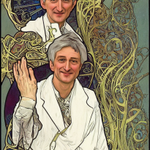
While we await for @NeurIPSConf paper decisions, I generated the "DL founding fathers #tarot":
🔹Joshua Bengio — the Magician



@BigScienceLLM
Eventually, BLOOM 176B does know some languages not stated in the docs.
As the data governance on such a large corpus is a hard and rigorous task, let's call it (in Sigmorphon tradition) "surprise languages"
1/n
Russian:

All the examples obtained by sampling, each belong to the first or second attempt, so they are uncherries
By now, it seems like the top-10 or top-20 languages are at least somehow present in the model
5/n
I had no success with Armenian, Kazakh, or other languages that combine both being low-resource and having tokenization needs differing from the languages in the list: bigscience.huggingface.co/bl…
6/n
July 12th is the New Bloomsday now 🌸

The BLOOM model is now officially released!
Read more here: bigscience.huggingface.co/bl…
Find the model here: huggingface.co/bigscience/bl…
«Mischief Managed!» - I thought last week and wrote a public review on Yann LeCun's "A Path Towards Autonomous Machine Intelligence"
openreview.net/forum?id=BZ5a… #agi #ai #ml

Now mischief managed double:
I got an answer from Yann LeCun! openreview.net/forum?id=BZ5a…
