
CS PhD student at UIUC @siebelschool | Interested in program analysis and automated reasoning
Joined April 2018
- Tweets50
- Following271
- Followers213
- Likes589

Shaurya Gomber retweeted

Diffusion LLMs and speculative decoding promise much faster agents. Yet agents need long contexts, and training on them is painfully slow.
Introducing Context-Sharded Block Parallelism (CSBP), a new distributed parallelism strategy unlocking significant training efficiency for diffusion LLMs, with speedup gains growing with context length 🚀
⚡ 7.59× faster DFlash2 speculative decoding drafter training
⚡ 1.61× faster block diffusion fine-tuning
⚡ 1.33× faster autoregressive → block diffusion adaptation
With the same GPU hours, models trained with CSBP score higher on SWE-bench Verified and Terminal-Bench Lite 👑
Open-sourced in Turbo-dLLM, our new optimized distributed training library.
Advised by @Azaliamirh and with an amazing team: @PranshuChatur11 @hangoo_kang @pshroff_ @ishanskhare @KumbongHermann

Shaurya Gomber retweeted

Happy to announce CoT-Guard: our RL-trained 4B CoT Monitor for Code!
We will present our findings in an oral presentation at AdvML-Frontiers × CoTMA Workshop at COLM next month — highlights in the thread below! 🧵
Work with @huan_zhang12 , @ffmagicbean , @HanWang178023 , and Capital One.
(1/n)
Shaurya Gomber retweeted

Congrats to @UofIllinois / @siebelschool / @plfmse’s @debangshuban18 on being one of the 2025-2026 @Bloomberg Infrastructure & Security Ph.D. Fellows!
Learn about Debangshu’s research focus & our first cohort of Infrastructure & Security Ph.D. Fellows: bloom.bg/4xzHUbY

A legit false (fire) alarm in the middle of the PLDI static analysis sessions. Some jokes just write themselves.
#PLDI2026
Will be at PLDI in Boulder, CO this week to present this work. Also looking forward to the other talks and discussions. Feel free to reach out if you are around and would like to chat!
Talk details: pldi26.sigplan.org/details/p…
#PLDI2026

Excited to share that our paper titled "Evolving Abstract Transformers for Gradient-Guided, Adaptable Abstract Interpretation" has been accepted at PLDI 2026! #PLDI2026
Huge thanks to my collaborators @debangshuban18 and @ggn_dp_sngh!
Details in 🧵
[1/N]

Shaurya Gomber retweeted

📢 I’m looking to hire a postdoc to work closely with me and my research group at UT Austin on exciting topics in core PL/FM, as well as applications of PL/FM ideas to other areas. If you are interested, or know someone who might be a great fit, please DM me!
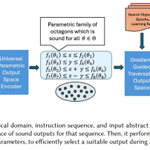
Excited to share that our paper titled "Evolving Abstract Transformers for Gradient-Guided, Adaptable Abstract Interpretation" has been accepted at PLDI 2026! #PLDI2026
Huge thanks to my collaborators @debangshuban18 and @ggn_dp_sngh!
Details in 🧵
[1/N]
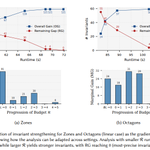
This enables efficient and adaptable analysis across domains: the blue line and bars show how more invariants get strengthened as gradient steps R increase, while the red line shows convergence to the most precise invariants computed by an LP solver baseline, 3.2× faster.
[4/N]

1
2
186
AbsEvolve also handles non-linear operators like quadratic assignments. Check out our paper for more details on this and other supported domains and operators, formal guarantees, and full evaluation: sgomber.github.io/assets/pdf…
[N/N]
2
135
Really nice work! Leveraging LLM’s general ability to reason about code execution and and then generating reusable rewrite rules to make the process reliable by grounding it with traditional compiler techniques; best of both worlds and the way to go!

There’s a lot of discussion around using LLMs to generate compiler code via prompting, but this on-the-fly approach can be unreliable and brittle.
We propose 𝐑𝐮𝐥𝐞𝐅𝐥𝐨𝐰, a more reliable way to use LLMs for optimizing data-analysis programs (e.g, Pandas).
(1/5)
2
8
504
Shaurya Gomber retweeted

Neural abstract interpretation is indeed an exciting direction, some work from our group that tries to build small neural networks that serve as abstract interpreters. LLMs are also possible iclr.cc/virtual/2025/36221
Shaurya Gomber retweeted
Excited to finally share our #NeurIPS2025 paper "🔮PurpCode: Reasoning for Safer Code Generation"! 🙌
👐 First post-training recipe for training safe code reasoning models
🚀 SOTA for cybersafety + utility, outperforming Sonnet 4, o4-mini, R1
🥇 Winner of 2025 Amazon Nova AI Challenge
📝 Paper: arxiv.org/abs/2507.19060
🧵👇 1/11

Shaurya Gomber retweeted

🚀 Introducing Structured LLM, a new framework for making large language models more aligned, useful, and efficient.
👉 Check it out here: structuredllm.com/
Excited and honored to share that my MS Thesis on "Neural Abstract Interpretation" has been awarded the 2024 David J. Kuck Outstanding Master’s Thesis Award at UIUC 🏆🎉!
Thesis Link: ideals.illinois.edu/items/13…
Nice start to the year🤞
5
44
1,624
Shaurya Gomber retweeted

🚀 Excited to present our paper "Relational DNN Verification Leaps Forward With RABBit" at #NeurIPS2024 on December 11th!
Authored by @TarunSures41845 and @debangshuban18!
1/N
Shaurya Gomber retweeted

Excited to present our work on Sketching for Distributed Learning at my first NeurIPS! Grateful to my amazing collaborators-- @BerivanISIK , Qiaobo Li, @sanmikoyejo and Arindam Banerjee. Visit our poster on Thursday, 11-2 PST! 🚀 #NeurIPS2024

Excited to share our @NeurIPSConf paper "Sketching for Distributed Deep Learning: A Sharper Analysis": openreview.net/pdf?id=0G0VpM…
We provide a significantly improved convergence analysis for sketching-based distributed learning frameworks by exploiting the properties of the deep learning losses, such as restricted strong smoothness. With that, we break the dimension dependence in the convergence error and communication cost -- showing the promise of sketching for larger models.
Unfortunately, I am not attending NeurIPS this year but visit our poster on Thursday 11-2 PST and ask Mayank any questions you may have.
w/ Mayank Shrivastava, Qiaobo Li, @sanmikoyejo, Arindam Banerjee

Shaurya Gomber retweeted

I'm so excited to share my latest paper called DELIFT along with @krishnatejakk @lucian_popa_us @cheburashkadoll at @IBMResearch 🎉
We tackle expensive fine-tuning by selecting a small subset of informative data that targets a model's weaknesses.

Shaurya Gomber retweeted

#ILLINOIS computer science professor Gagandeep Singh and PhD student Isha Chaudhary have determined that large language models have biased output that can spread misinformation and widen social gaps between various demographic groups. Read more!
▶️bit.ly/4fe7qdP

ALT side by side of two people smiling for photo