

🇩🇪Insect nerd🚫No AI🏆2021-Nat. Geographic science pic📔2022-Author „Ganz nah dran“🎥2023-Netflix Life on our planet📔2024-Author „Von Angesicht zu Angesicht“
Besigheim, Deutschland
Joined July 2021
- Tweets3.2K
- Following657
- Followers13.4K
- Likes10.8K


Pinned Tweet
Wer hätte es gedacht? Ein Insektenbuch als Bestseller!
Unser Buch 'Von Angesicht zu Angesicht - Auf Augenhöhe mit heimischen Insekten' wurde in die Spiegel-Bestsellerliste aufgenommen. Mit diesem Herzensprojekt wollen wir den Insekten eine Bühne geben, ihnen auf Augenhöhe begegnen und zum staunen anregen. Denn nur was wir sehen und kennen sind wir bereit zu schätzen und zu schützen.
Zusammen mit Thomas Hörren und Dominik Eulberg konnte ich dieses Projekt nach vielen Jahren Arbeit umsetzen und bin mehr als zufrieden mit dem Ergebnis und den Reaktionen. Vielen Dank an Alle die uns unterstützt haben.
Erschienen bei Kosmos
ISBN 9783440179000


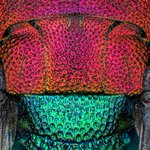
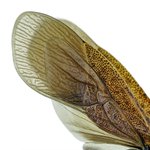
Cuckoo wasp, Hedychrum nobile. Here you can see the dorsal view of the wing joints. This specimen is from the archive of the Krefeld Enromological Society. Focus-stack from 214 single shots with a stepsize 0,004mm. It’s a 10:1 magnification with the @laowa_lens Aurogon.
Focus-stack from 214 single shots with a stepsize 0,004mm.


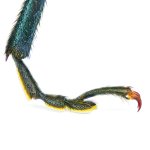
Insect feet mostly are a short chain of tarsal segments ending in claws. Some end in a single hook. Some carry paired claws, padded lobes, combs of spines, or dense fields of adhesive hairs. Same class of structure. Completely different solutions.
At this magnification the differences stop looking ornamental. The foot is where an insect meets the surface, and the surface is never one thing. Bark, leaf, flower, prey, soil, and the body of another insect each ask for a different grip. Claws lock into roughness. Pads and setae hold on smoothness. Spines brace, rake, or keep the leg from slipping sideways. A foot built for walking is not a foot built for holding, climbing, or seizing.
Comparative work across orders shows that segment count, claw shape, pad size and the hairs between them occupy a very large design space. There is no single hidden insect foot underneath the variation. The legs we notice first are usually the long ones, or the ones with colour. The working end is easier to miss. That range is old. Once legs could specialise, the tip split into hooks, cushions, brushes, and tools that are barely feet at all. Joints, sockets, pigment and structural colour repeat as themes, not as copies.
This is why insect feet keep rewarding extreme macro work. The subject is not rarity. It is variability packed into millimetres.


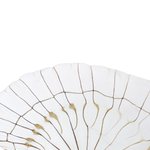
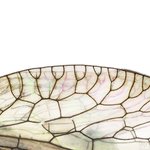
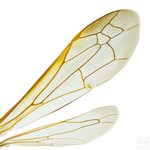
Insect wings are a thin cuticle sheet braced by veins. That much is shared. Almost everything else is not. Some membranes are nearly clear. Some are dense, stiff, narrow, mottled, or reduced to a fringe. Same class of structure. Completely different solutions. At this magnification the differences stop looking ornamental. Comparative work across hundreds of wings and many insect orders shows that outline, vein topology and the membrane cells between veins occupy a very large design space. There is no single hidden "insect wing" underneath the variation. Butterfly wings are the surfaces we most often reduce to colour and prettiness. The rest of the insect world does not follow that habit.
That range is old. Once forewings and hindwings could diverge, the organ split into shields, flight surfaces, signals, covers, and wings that are barely wings at all. Vein junctions, sockets, pigment and structural colour repeat as themes, not as copies.
This is why insects keep rewarding extreme macro work. The subject is not rarity. It is variability packed into millimetres.


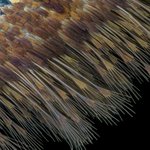
Forewing margin of the honeysuckle clearwing, Synanthedon soffneri.
The outer scales are the fringe. Work on other moths has shown that elongated marginal scales can interlock and hold the trailing edge as a single, flexible sheet in flight. On this narrow, largely clear forewing that fringe is what remains of the outline.
Moth scales can also absorb ultrasound and weaken the echo that returns to a bat. That effect has been measured on the dense scale coat of nocturnal species, not on the sparse fringe of a day-flying clearwing. For S. soffneri the outer scales are therefore better read as an aerodynamic edge than as acoustic camouflage.
Inward, the covering is still the usual overlapping plates. At the edge those plates give way to the long scales that do this work.

When we look at butterflies, we almost always look at the wings. Collections, field guides and most photographs reduce them to colour patterns seen from above. That view is beautiful, but it is also incomplete.
This series is the other way around.
Each frame is a frontal portrait, photographed at high magnification and assembled from many focus slices. Antennae, palps, compound eyes and the tiny scales on the face become the subject. The wings fall out of the frame on purpose.
Seen like this, the species stop looking interchangeable. One face is rounded and almost gentle. The same structures that look like decoration from a distance turn out to be tools: lenses made of thousands of facets, sensory palps, mouthparts folded and waiting. Once you meet them at eye level, even familiar European species stop being “the one with the pretty wings” and become individuals with a face.
That is all this series is meant to do: hold still for a moment in front of something we usually only see from behind.


Compound eye of the large pine weevil, Hylobius abietis. A real photograph, stacked from 433 frames at 20:1.
Adults girdle young pines and spruces by eating the bark. Unprotected plantings can lose half their trees. A adult beetle may live 2-3 years. The pale daggers are flattened yellow setae, the same scales that mark the thorax and wing cases. Near the eye they sit with stiffer vibrissae on a folded ridge of cuticle.

Wing scales of the Green Hairstreak, Callophrys rubi. This is a real photograph, not a rendering.
At this magnification a single scale is only a fraction of a millimetre long, yet each one is a tiled roof of chitin with a serrated tip and fine longitudinal ridges. The colour is not pigment. Inside the scales sit three-dimensional photonic crystals known as single gyroids: porous, chiral lattices of chitin and air with a unit cell around 310 to 360 nanometres. Those lattices scatter and interfere with visible light. Different crystal domains lean in different directions, so one scale can flash teal, lime, gold or almost black while the whole underside of the living butterfly still reads as a matte leaf-green. That combination of local iridescence and overall camouflage is uncommon among butterflies and is one reason C. rubi has become a model species for biophotonic research.
Because a 60x microscope objective has almost no depth of field, this frame was built from 148 exposures. The focus plane was stepped through the subject in increments of 0.0004 millimetres. Software then kept only the sharpest pixels from each frame and merged them into one image in which the overlapping scales stay sharp from tip to base. The method is called focus stacking, or z-stacking: many thin optical slices become a single photograph with usable depth.
What looks like painted metal is cuticle, air and geometry.

Sixteen species from Central Europe, arranged wing to wing. Butterflies and moths share the same order, Lepidoptera, and this collage puts some of the region’s most recognizable patterns side by side: eyespots, swallowtails, tiger stripes, copper fire, and lichen green.
From left to right and from top to bottom.
🔬-🇬🇧-🇩🇪
1Aglais io — European Peacock — Tagpfauenauge
2Gonepteryx rhamni — Brimstone — Zitronenfalter
3Zerynthia polyxena — Southern Festoon — Osterluzeifalter
4Lycaena hippothoe — Purple-edged Copper — Lilagold-Feuerfalter
5Cydalima perspectalis — Box tree moth — Buchsbaumzünsler
6Papilio machaon — Swallowtail — Schwalbenschwanz
7Callimorpha dominula — Scarlet Tiger — Schönbär
8Nymphalis antiopa — Mourning Cloak — Trauermantel
9Euplagia quadripunctaria — Jersey Tiger — Spanische Flagge
10Arctia caja — Garden Tiger — Brauner Bär
11Anthocharis cardamines — Orange-tip — Aurorafalter (male)
12Aporia crataegi — Black-veined White — Baum-Weißling
13Trachea atriplicis — Orache Moth — Meldeneule
14Iphiclides podalirius — Scarce Swallowtail — Segelfalter
15Vanessa cardui — Painted Lady — Distelfalter
16Argynnis paphia — Silver-washed Fritillary — Kaisermantel

Green, red, blue, yellow-orange.
The eyes of Polydrusus formosus, Graphosoma italicum, Meloe violaceus and Vespa crabro. Four extreme macros of the same region: the eyes.
Insects hold more color for the human eye than we usually see.Something for everyone. An endless range.


The buffalo carpet beetle (Anthrenus scrophulariae), also known as the common carpet beetle, can draw its head and antennae back into a recess in the pronotum until both almost disappear. Disturbed adults often fold their legs as well and lie still. The beetle itself is only 2.5 to 3.8 millimetres long, oval, and patterned with black, white and orange-red scales that wear off with age. Adults live mostly outdoors and feed on pollen and nectar, often on pale flowers. The damage begins later. Females lay batches of about 30 to 60 eggs on animal fibres. The brown, densely haired larvae feed on keratin in wool, fur, feathers, silk and dried specimens. In museum drawers they work quietly for weeks, leaving cast skins and a fine dust of frass. Entire insect boxes can be reduced to hollow remnants. Shed larval hairs may irritate human skin. Outside collections the same larvae belong to a scavenger lineage that breaks down dead animal material. Indoors, that habit makes them one of the most feared pests of natural history collections.
Source:
* University of Florida / IFAS, EENY-482: Common Carpet Beetle (Kopf größtenteils unter dem Prothorax verborgen, 30–60 Eier, Larvenentwicklung ca. 66–70 Tage, Museumsschäden, Dermatitis durch Larvenhäute).
* MuseumPests.net, Fact Sheet Buffalo Carpet Beetle (Adulte 2,5–3,8 mm, Larven 2,5–5,5 mm, Schäden an Textilien und Präparaten, Adulte vor allem Blütenbesucher).
* USDA-Circular „The Carpet Beetle, or Buffalo Moth“ (historisch: bei Störung Beine und Fühler angelegt, Totstellreflex).
* Wikipedia: Anthrenus scrophulariae (Beschreibung, Lebenszyklus, Kopf unter dem Pronotum verborgen, Schuppenmuster, weltweite Verbreitung).


What you see here is one of the most fascinating processes in the insect world: a fly (in this case, Phormia regina) emerges from its rigid barrel-shaped pupa. To break open the cap at the front end, it everts a thin, membranous structure—the frontal bladder, scientifically known as the ptilinum. Through rhythmic pulsations, it fills this bladder with hemolymph—the blood of insects—thus generating the pressure needed to open the hard shell. As soon as the path is clear, the bladder retracts back into the head. All that remains is a fine seam, the ptilinal suture—a lasting reminder of this unique feat of strength. This is followed by the unfolding of the wings and the hardening of the still-soft body.


Freshly emerged and still soft: here you see a firebug right after its final molt. The fully developed wings make it clear that this is the adult stage – the imago. After hatching, the chitin armor is still pale and flexible. Only in the hours that follow does it harden and take on its final coloration. The bright red and black patterns do not appear immediately, but develop gradually as the armor sclerotizes and the pigments are deposited.
A brief and fascinating moment in the life of these small insects.

