

Founder and CEO @kalqix | Founder @QuickSwapDex | Big time Ethereum fan
New Delhi, India
Joined July 2009
- Tweets1.6K
- Following637
- Followers6.3K
- Likes6.2K





Pinned Tweet
2 years of hard work finally coming to fruition. I am really excited about tomorrow. Are you??

The hardest part of launching an exchange
isn't the code. It's the first trade.
A new venue opens with an empty book. Wide
spreads, thin depth, and traders who leave
after one bad fill. That's the cold start, and
most teams underestimate it.
That's why KalqiX is one shared order book.
Every partner keeps its own brand, frontend,
token and community. Every partner's flow
lands in the same book.
Ten venues, ten books: ten thin markets.
Ten venues, one book: one deep one.

One design choice shaped most of KalqiX:
matching never waits for a proof.
ZK proofs take time to generate. A trader
placing an order shouldn't feel any of it.
So we split the two. The Rust engine matches
by price-time priority in under 10
milliseconds. SP1 proves each batch
afterwards. A contract on Base verifies the
proof, and trade data goes to Avail DA so
anyone can rebuild the state.
Your trade never waits on the prover. The
contract never takes the engine's word.
Speed where you feel it. Proof where it
counts.
JPMorgan is taking JPM Coin to Ethereum, Base
included, for institutional clients.
The easy read is "banks are coming to crypto."
The detail I find more telling: it stays
restricted to approved counterparties.
Permissioned money. Public rails.
Even a bank that decides exactly who can hold
its token picked a shared chain to move it.
Who gets in can stay private. Where it settles
works better in public.
It's the same split we built KalqiX around.
Partner exchanges keep their own brand,
frontend and community. Every trade underneath
settles on Base with a proof.
Access is a product decision. Settlement is a
public good.
Monthly AMA, round two.
Fair game: the Ledger supply chain mess and
what it means for self custody, building
QuickSwap to $200B, ZK proofs, liquidations,
why exchanges keep dying, or whatever else is
on your mind.
No PR filter. I'll answer every real question
today.
In 2020 I co-founded an AMM.
Today it checks our order book before every
trade.
Since July, each swap on QuickSwap asks one
question: does the KalqiX book offer a better
price than the pools?
If yes, the trade routes through Avail Atomic
and fills completely or not at all. If not,
the AMM handles it as usual.
Same app. No bridge. No custody handoff.
Taking QuickSwap past $200 billion in volume
taught me AMMs earned their place. They're
great for the long tail. Liquid markets want a
book.
Pools for reach. Books for depth.
The best price picks the venue.

Headcount is a cost dressed up as a trophy.
Every layer you add between the person who
decides and the person who ships converts
energy into meetings.
Small teams aren't a budget constraint. At
this point they're a strategy. Ten people who
own outcomes beat a hundred who attend
standups about them.
The best products you use were probably built
by a team you could feed with two pizzas.
Raising before you've built is a loan against
your focus.
Money arrives with a calendar attached.
Updates, milestones, a story that has to sound
good every quarter.
We started building KalqiX around the start of
2024 and didn't raise outside capital until
the product was built.
So the hard questions got answered in code,
not in a deck. Matching, proofs, settlement.
Then the conversation.
Money first sets your deadlines.
Product first sets your terms.

Everything you use to hold crypto reduces to
one question: what are you actually trusting?
A CEX: a company.
A hardware wallet: a device, and its supply
chain.
A software wallet: your phone, and every app
on it.
A smart contract: the code, and its audits.
This week showed what happens to the links
nobody verifies.
Full breakdown in this week's essay.

The fastest growing market category of this
cycle runs on order books. Not pools.
Prediction markets priced elections, sports,
and macro all year. Regulators are fighting
over them. Brokers reportedly want in.
Notice what nobody built: a serious prediction
market on an AMM. The biggest one actually
started there, then migrated to an order book
years ago.
When the product is "price discovers truth,"
you need real bids, real asks, and real depth.
The market already voted on market structure.
Crypto should read its own results.
Sameep Singhania retweeted
Big day for Polygon!
Polygon is now a fully regulated payments company. With the completion of the Coinme acquisition, Polygon Open Money Stack is now a U.S. regulated payments platform, with coverage across 48 states.
We’ve spent years building the infrastructure to move money onchain. Today, we have more of the infrastructure, licenses, technology and distribution to make that happen.
With Open Money Stack, teams can make onchain money movement seamless for people and businesses, bringing stablecoins into everyday payments.
And the first customers are putting it to work: @Tazapay for cross-border business payments, @Meshpay for account funding, @useToku for global payroll and Kira for U.S. dollar access.
Proud of everyone who made this happen. This is a massive milestone. And we are just getting started!!

Sameep Singhania retweeted

BREAKING: Polygon Labs is now a U.S.-regulated payments business.
The Coinme acquisition is complete. It brings regulated U.S. money movement into Polygon Open Money Stack.
@Tazapay, @meshpay, @useToku, and Kira join as the first set of businesses moving money with the unified stack.

"Self custody failed" is the wrong lesson from
the Ledger reseller drain.
Self custody didn't fail. A supply chain did.
Every security model has a root of trust. A CEX
asks you to trust a company. A hardware wallet
asks you to trust a device, plus every hand it
passed through on its way to you.
The industry sold "buy a hardware wallet" as
the end of the sentence. It was the start of
one.
The fix isn't going back to custodians, who
concentrate the exact same risk at bigger
scale. It's making every link verifiable:
attested hardware, direct supply chains, and
setups where no single secret is fatal.
Trust didn't get safer last week. Verification
got more necessary.
The Ledger drain story, with the detail that
matters most:
Ledger itself wasn't hacked. Devices sold
through one third party reseller in Southeast
Asia reportedly shipped with implants hidden
behind the screen. A tiny board with a cellular
modem, sending buyers' 24 word phrases home.
Estimates so far: $72M to $90M+ drained since
Oct 9, across hundreds of wallets.
If you've EVER bought a hardware wallet from a
reseller or marketplace: move your funds to a
wallet whose seed was generated on a device
bought directly from the manufacturer. A
compromised seed is compromised forever.
Resetting the device fixes nothing.
Buy security hardware the way you'd buy a
parachute. New, sealed, and never through a
middleman.
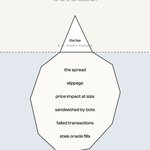
Traders were stuck choosing between two bad options.
CEX: fast, but you hand over your funds.
AMM: you keep custody, but you pay in slippage, impermanent loss and MEV.
ZK proofs make a third option possible: encrypted orders, fast matching, settlement anyone can verify.

Reputation is the only asset with no unlock
schedule.
Tokens vest. Equity cliffs. Funds lock.
Trust compounds in one direction only, and
there's no secondary market to dump it on.
Every shortcut you skip is accrual.
Every promise you keep is yield.
Slowest asset to build. Only one that
survives every cycle.
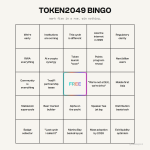
TOKEN2049 wrapped. My honest read from
watching two weeks of Asia conferences:
The main stages talked about a $10 trillion
tokenized future. The hallways talked about
something smaller and more useful: where any
of it will actually trade.
Seoul gave a date and a statute. Singapore
gave a mood. Both matter, but only one of
them ships.
The industry doesn't have an ambition
problem. It has a market structure problem.
And the people who fix it won't announce it
from a stage.

TOKEN2049 opens today. 25,000 people at
Marina Bay. What I'm actually watching:
1. RWA talk vs RWA plumbing. The slides will
say $10 trillion by 2030. Meanwhile only 12%
of tokenized assets today are meaningfully
usable in DeFi. Ask who's building the market
structure, not the wrapper.
2. Stablecoins and agents. Seoul said the
next users aren't human. Watch how fast that
crosses to Singapore's main stage.
3. Perp venues. Everyone pitches leverage and
points. Count who mentions execution, oracle
design, or what happens when the insurance
fund runs dry.
4. The word "verifiable." Every time an
institution says it unprompted, my 2027
predictions age a little better.
The main stage sells the future. The hallways
price it.

Asia is crypto's center of gravity for two
straight weeks. Seoul just wrapped. Singapore
opens Wednesday.
What Seoul actually said: Korea set a legal
date for tokenized securities (Feb 2027), the
central bank pushed deposit tokens to nine
banks, and the AI track was about agents
needing payment rails, not trading bots.
What Singapore has to answer: 25,000 people,
160 countries, and one honest question
underneath the yacht parties.
The institutions showed up. Is the market
structure ready for them?
My bet for the week: the real news out of
TOKEN2049 won't be a token. It'll be rails.