

Software engineer & entrepreneur for 25+ years. Founder/CEO of samlinux development. Exploring agentic building, data sovereignty and the Internet Computer.
Klagenfurt
Joined May 2009
- Tweets3K
- Following1.2K
- Followers397
- Likes295




PHP2Shell: Zeit, Webhosting neu zu denken.
samlinux.at/de/blog/php2shel…
KI hilft, Sicherheitslücken aufzudecken und komplexe Exploits zu entwickeln. Gleichzeitig lassen sich ältere PHP-Anwendungen oft nur mit erheblichem Aufwand aktualisieren.
Muss jede Unternehmenswebsite eine öffentliche PHP-Runtime nutzen?
Unsere Webseiten wie samlinux.at oder soveri.at laufen bereits als statische Webseite auf dem Internet Computer. Mit Soveri Content bleiben Inhalte komfortabel bearbeitbar – die öffentliche Website kommt ohne PHP aus.
Mehr dazu in meinem neuen Artikel.
#PHP2Shell #InternetComputer #Soveri

samlinux.icp retweeted

We'll be spending a lot more time trying to understand the outputs of language models. A few thoughts, tips & tricks:
Writing. Something I've had success with: Ask your LLM to explain something in ASD-STE100, it's a controlled language specification originally developed for aerospace maintenance documentation. LLMs well-versed in this language and it comes with heavy constraints on clean writing style that I often find a lot more readable. Sometimes I've tried to soften it a bit e.g. ask for "80% of the way to ASD-STE100" because the spec is quite stringent. But even better:
Diagrams / images. Instead of writing, ask your LLM to create a diagram. These can be a lot easier to process, parse, and understand. But even better:
Web pages. Ask for output "in HTML" to get a beautiful, interactive webpage. LLMs are getting really good at frontend and can create beautiful experiences, animations, etc. But even better:
Explainer videos. The output format I am most bullish on is fully custom / bespoke explainer videos generated on any arbitrary topic. Experiment with things like "Create a 3b1b style video explainer on X. Use my ElevenLabs API key for audio narration". (you'd need an API key for the latter or you can ask your LLM to find you decent free alternatives that use your local compute). This is actually starting to work!
In summary:
- As LLMs get better, they will do more and more of the legwork autonomously, and a lot more of our work will rise up the abstractions into oversight and understanding.
- Luckily, LLMs can help here too because as intelligence and code are increasingly abundant, you can ask for large, custom, discardable software artifacts (e.g. web apps, video explainers) that would have never made sense to create before. Push the boundaries here and you'll be surprised.


AI is not only changing how I write software. It is changing my role as a software engineer and entrepreneur.
After 26 years as a software engineering and entrepreneur, I am moving from writing every line of code myself towards becoming an agentic builder: defining architectures, coordinating agents and tools, setting boundaries, and remaining accountable for the result.
In my new article, I reflect on this ongoing transformation through three change-management perspectives: the Shannon–Weaver communication model, the Kübler-Ross change curve and the ADKAR model.
Because working with AI is not merely a technical upgrade. It is an individual change process—shaped by uncertainty, learning, trust and responsibility.
And while code is often publicly available, our data must remain sovereign.
Read “The Agentic Builder” on SOVERI:
soveri.at/en/news/the-agenti…
#AgenticAI #SoftwareEngineering #ChangeManagement #DataSovereignty #AIEngineering #SOVERI


samlinux.icp retweeted

🚨 The widespread attacks against the Internet Computer continued again today, and thankfully, have failed again.
The cabal's latest attack targeted the ckBTC "bitcoin twin" minting canisters. This time, they spent thousands of dollars on ICP tokens in the course of their attack, but only caused minimal disruption.
What did happen: the attacks revealed the need for some useful hardening, and the NNS (i.e. the network's autonomous governance and orchestration system) took down the ckBTC canister for an upgrade. The downtime was ~1hr.
Though the disruption was minimal, we must not thank the attackers for helping improve the network, because they are criminals.
The attacks reveal more about who they are:
1. They are willing to throw buckets of money at their attacks, confirming they are professionals on a mission, rather than amateurs.
2. Since their attacks lack a common thread (such as trying to steal tokens), we can see their true purpose is to harm the reputation of the Internet Computer by causing disruption.
Of course, as an ecosystem, we have experienced widespread attacks designed to harm our reputation before, albeit in different forms.
Most famously, in May 2021, the Internet Computer was widely seen as a potential crypto industry disruptor.
A key narrative at the time was woven around the potential of web3 apps that would actually run on blockchain networks i.e. "onchain," as per the original meaning of that phrase.
The fly in the narrative's ointment, however, which was being used to sell the potential of some major up-and-coming chains, was that the Internet Computer was the only network that could actually host general-purpose apps and services built from "smart contracts" (which are far better called "network code") thanks to years of R&D by the DFINITY Foundation.
A successful launch of the Internet Computer threatened to puncture this web3 apps narrative, which was at the heart of their marketing and fundraising efforts. Furthermore, their insiders were aware of the years of R&D at scale that had been performed to create the Internet Computer network, and they were downright terrified of the competitive threat it posed.
Simply put, in the fever of 2021, they feared that if the Internet Computer launched successfully, it might dramatically reduce their ability to hoover up billions from the markets in the crypto bull run.
The resulting attacks by corrupt but powerful industry actors involved massive market manipulation on an exchange before/after launch that made the ICP token price crash, lawsuits by a corrupt law firm secretly on the payroll of a big industry actor, and massive further manipulation of public perception using huge social media astroturf armies, paid crypto press, and even a huge mainstream publication whose key reporter was linked to an actor who is now in jail.
Events took place on a historic scale that was completely extraordinary, and I hope the full story, including what it was like dealing with what took place, makes the light of day some day — I am pleased to say there is no comparison to what is happening today.
As a result of these past events, to this current day, a large majority of people who consider themselves crypto industry aficionados, and interested investors and journalists, remain completely unaware that most blockchain networks can only host tokens and lightweight financial logic. The corruption and criminality of the time successfully hid what the Internet Computer does differently from other networks, and created a reality distortion field that persists to this day.
Crypto Leaks, an investigative journalism website that publishes reports based on covertly recorded video created by undercover investigators, has exposed what was behind some of the extraordinary happenings.
Thankfully, several of those exposed by Crypto Leaks now sit in jail, and American judges later took action against the law firm involved, among other wins Crypto Leaks gifted to the industry. However, many of those exposed have so far escaped major consequences, and crypto press has often taken a hear-no-evil see-no-evil approach, preventing people from learning what happened. That's a shame, because we all want the crypto industry to be a clean place, where competition is fair and normal.
My personal view, is that the happenings of 2021 marked a pivotal moment for the industry, when the original crypto movement, and technical folks and idealists interested in making the world a better place through innovation and advanced cryptography and computer science, were overwhelmingly steamrollered by sharp-elbowed speculators and manipulators.
The Internet Computer ecosystem would have set a standard for the crypto industry that kept it honest, but as a result of its suppression at the time, we got an age of speculation and scams, and vaporware and narratives, in which money could often much more profitably be invested into hyping rubbish than into R&D that produces technological utility.
Thankfully, what happened is now far in the rearview mirror for the Internet Computer ecosystem, because it has moved on to mainstream pastures, and has a incredibly exciting future ahead. Those currently paying for the new tide of poisonous trolls on web3 social media, and black hat hackers, will be disappointed to find this isn't 2021.
Initiatives such as Caffeine (see caffeine dot ai), the AI chat service that builds apps on the Internet Computer, have shown that the network has enormous mass market utility, which does not depend on tokens and speculation — for example, 99% of those building on the Internet Computer using Caffeine have no idea that their apps run on a secure crypto network that can play the role of cloud.
Now, forthcoming advances like ICP "cloud engines", and initiatives such as Open SaaS and the Internet Intelligence Gateway, and growing sovereign tech adoption, and many other things currently underway, promise to take the network to another level entirely.
Crucially, as intended since work began in 2015, the network is becoming a revolutionary new tech stack for the AI era, and for the sovereign tech movement generally. While the massive potential exists in mainstream fields, projects like MULTI/DEX (dot ai) also continue to demonstrate how the extraordinary capabilities of the network can also be applied in fields such as defi.
As the Internet Computer rapidly approaches escape velocity all over again, the moment when its stunning differentiating features and capabilities will become obvious within the web3 industry also approach again.
Today, networks talk about AI tokens, and digital currencies for AI. Cynically, one might imagine these things were created because they are easy for retail investors to latch on to, if not undestand.
Meanwhile, the Internet Computer has pioneered a new kind of onchain "AIware" software (Motoko), which, when compared against software running on traditional technology stacks, creates apps and services that integrate AI in game changing and previously impossible ways, which software can also be written and maintained far more effectively and safely by AI agents working autonomously without human oversight.
The potential of AI is real and truly beyond anything we have seen before, and I predict that AIware will power one of the largest business transformation stories in history.
For the Internet Computer, an exciting event horizon approaches all over again, and my guess is this is agitating some people in the crypto industry. It may even be reactivating bad actors from the past.
But, we in the ICP community are not afraid, because these bad actors are a spent force. Moreover, the Internet Computer's future now depends on the mainstream world much more than it goes the crypto world, and the mainstream world affords these bad actors no power.
Of course, crypto would be better without them, and that's why DFINITY continues to offer substantial rewards to anyone who can provide information that exposes them, but —
This latest growing wave of attacks is in fact just a hot signal that it's game on again for the Internet Computer, which we should all welcome.
And, seeing the Internet Computer reach its potential, after all the years of toil and effort, is what keeps my fire, and the fire of many others, burning bright. We stay focused in pursuit of our goals, no matter how long it takes.
We are creating the next tech stack for the AI era, we remain undeterred, and the potential of what we have created is tremendous.
My thanks again to the ICP community 💪
Your phone can transcribe speech offline—but should it? I compared local Whisper with cloud-based Voxtral in a mobile web app. The real trade-off isn’t just accuracy: it’s speed, privacy, usability, and what happens to the transcript next. soveri.at/en/news/your-phone…
🤖 Made with AI

samlinux.icp retweeted
Vadim, you've missed nearly every relevant part of the ICP x AI story, so your article works as a straw man argument for misleading uninformed readers. I think you wrote in good faith, and put a lot of effort in, so I'll breakdown ICP x AI for you and readers that got mislead.
1. Onchain AI inference on ICP
As you discovered for yourself, ICP/the Internet Computer network, can run neural networks fully onchain, and even very basic LLMs too.
Important note in the following: when I say "onchain," I mean actually running on the network (here in the form of an asynchronous smart contract with vastly greater capacity, efficiency, speed and capability than has ever been seen anywhere else, which is what makes this is possible). I *never* say that something is "running onchain" when it is actually running offchain, for example on Amazon Web Services, justifying that by the fact there is an associated token that actually is onchain — I understand that the rest of the industry does this, but I never do. I use onchain like "on-cloud." Period.
You also correctly make the case that AI running onchain in its current form cannot satisfy mainstream AI needs, because it comes with limitations, and is too costly.
However, focusing on this, you then pivot, without have enumerated more than a tiny fraction of the whole ICP x AI story, to trying to convince the reader that there is consequently nothing to be seen here. The reader is invited both to conclude that ICP x AI isn't interesting, and misdirected to believe that whenever they hear anything about ICP x AI, that it's probably not anything interesting technologically going on. It works as a classic straw man argument, and potent disinformation, even if you didn't mean it that way (and I really like to believe that NEAR wouldn't engage in that kind of bottom-scraping behavior).
I want to get on to the ICP x AI story, but before ending this point, I should cover why ICP running inference onchain is incredibly significant for anyone interested in general-purpose networks.
When I did the onchain facial recognition demo in 2024, recognizing a few faces probably consumed more compute that NEAR (or any other blockchain) processes in a full year. It reflects the fact that while traditional blockchain is stuck being a pocket calculator, which can only store tokens, little bits of data, and process DeFi/update numbers, the Internet Computer has progressed to offering cloud functionality — in this regard, it is orders of magnitude more capable, and that's a testimony to the army of engineers and researchers who have worked on it over the years. There's simply nothing else like it.
To put this in perspective, creating a service like Caffeine (caffeine.ai), which builds apps on the Internet Computer using AI, is out-of-the-question on any other network, because it's not actually possible to build apps onchain, only to give them associated tokens. Very soon, cloud engines (opencloud.ai) will take the Internet Computer into mainstream tech territory — based on pure tech utility, without speculative incentives and token narratives being involved.
You can't run a frontier LLM inside normal code on Amazon Web Services. The fact that inference runs as Internet Computer code is very impressive, and that's something you seem to have missed.
Separately, there are niche uses of onchain inference. For example, onchain neural networks that do facial recognition could be used in automous KYC schemes, helping build out the blockchain vision in another powerful way.
So how should apps on the Internet Computer do frontier-level inference? The following explains.
2. Intelligence Gateway
The Internet Computer ecosystem will soon see something called the Intelligence Gateway, which is roughly similar in concept to OpenRouter, but provides an API that allows onchain code to conduct inference using multiple models and pay with cycles (what's called gas on other networks).
Note that it's already possible for apps on the Internet Computer to use "outcalls" to perform inference on existing AI clouds and services, like Coreweave, or Anthropic, say. For example, while MULTI/DEX (multidex.ai) will switch over to the Intelligence Gateway alpha within days, currently it directly calls into Anthropic (it allows users to perform account and book analyses, and to orchestrate trades, through onsite chat, and also through MCP).
Intelligence Gateway helps apps remain fully decentralized by enabling them to pay with cycles, rather than requiring a developer to maintain an account at an AI cloud, say, and adds convenience. But, it will also add *verification* to supported open weights inference run at *any* remote location — in another important worldwide first from the Internet Computer ecosystem.
That means that can app can configure its inference to run on some AI cloud that it doesn't fully trust, and get a guarantee that:
— the input prompt, context, etc, wasn't modified;
— that inference ran on the specified model that was paid for (e.g. on Kimi K3, not some crappy alternative to enable the cloud to make more money), and;
— that the output wasn't modified.
To verify a single inference doubles the cost, but in practice, apps will configure the Intelligence Gateway to spot check 1 in 100 inferences, and have it auto-scale checks up only if problems are detected, such that verification can add just 1% to inference costs.
The value of using Intelligence Gateway verification within a project like MULTI/DEX, where frontier inference can be directing what happens with large amounts of money, is obvious, but we believe traditonal enterprises running on cloud engines, and software like Open SaaS, will choose to use it too: algorithmic blockchain-style security at near standard cost.
3. Cloud engine "AI nodes"
There's a major shift towards sovereign compute around the world, which cloud engines are leaning into. Many enterprises and governments also wish to run sensitive inference workloads on hardware they control that's located in their own jurisdiction (things like the US CLOUD and RISAA Acts are part of the reason).
Cloud engines allow specialized AI nodes of the kind I mentioned earlier to be added (essentially node machines with a bunch of expensive GPUs installed), which allow those running engines to enable their onchain code to run their inference on sovereign hardware.
In the future and if there's sufficient demand, Intelligence Gateway technology will be used to allow multiple AI nodes to verify each other, which some super sensitive workloads warrant in the sovereign setting. For those willing to pay extra for inference, this can allow even huge models like Kimi K3 to be run with blockchain-style security.
4. AIware
The Internet Computer is *designed* for AI in two ways: 1) as a platform where AI can build more effectively, and 2) as a platform where services can be build using a new kind of AIware software.
1—Motoko is a language for writing onchan code on the Internet Computer, and it's the only language in the world that has been developed specifically for use by AI agents that are building, rather than humans per se (try building something with by directing your agent to skills.internetcomputer.org)
As you may know, on the Internet Computer, code runs in persistent memory ("The Program is The Database") and Motoko surfaces this in the purest way possible. App data lives inside software's logical abstractions in a system of "orthogonal persistence" that strips away much of the complexity of softwre and greatly fuels the modeling power of AI that's writing code by unlocking greater program abstraction, enabling AI to write and update code faster, and with far fewer errors, and at lower cost/fewer tokens.
Of course, it also helps that the code produced is tamperproof and always-on — AI doesn't depend on human security and systems admin teams to be safe.
In the future, and even really already, AI will write all software code and build all our services. That it can already build and update more effectively on the Internet Computer than anywhere else available today is a seminal achievement for our industry.
Ironically, though, I predict that it will go huge in the mainstream world first, as the result of cloud engines.
2—The paradigm enables software to function as AIware, because external AI can be given direct access (through a permissioning system of course) to the realtime data in memory, and to the functionality of apps, without anything special having to be done during the build process.
If you can run your enterprise on the Open SaaS suite, say, you become an agentic enterprise, that's much faster, more efficient and vastly smarter. In the future, teams will only 30% of their time inside the UX of their SaaS apps, and 70% inside agentic chat.
It will be possible to make previously impossible requests like, "make me more profitable." The hidden secret is that AI can already be as good at running companies as it is at writing code.
Very soon, cloud engines will become available, with Open SaaS (an open source suite of ~20 key enterprise apps/platforms). Open SaaS comes preinstalled on evaluation engines and is seeded with dummy data, so readers will be able to test AIware for themselves and make up their own minds, and I will leave off from further explanation here.
TLDR; the Internet Computer ecosystem is pioneering the future of AI—which goes beyond just securely running inference for somebody, into questions about how the services and platforms we will run the world on will be built or customized (now "remixed") and updated in the future, and what the future nature of software will be (we say it will be AIware, and the Internet Computer ecosystem will define that frontier).
The Internet Computer is the bona fide real deal when it comes to the intersection of ICP x AI and is advancing the game on every axis. The network provides a new alternative tech stack for the AI era — again, read that, the Internet Computer is a complete end-to-end tech stack designed for AIware.
Those wishing to build on the Internet Computer don't have to find a craft coding engineer willing to learn new skills. They just have to point their AI agent at skills.internetcomptuer.org.

Meet HUGO 🤖
Our experimental AI customer support agent uses tool calling, not guesswork. Architecture, lessons learned & demo. soveri.at/en/news/meet-hugo-…

samlinux.icp retweeted

☝️Let’s spend the night together! 🚴🤘
Already booked your vacation? Then here's an invitation from a certain Slovenian cyclist! 😉
#TadejPogačar #Pogačar #PogiChallenge #Cycling #VisitSlovenia #Slovenia
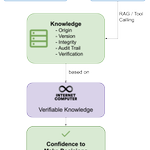
Everyone is racing to build better AI models.
Our latest article explores why the next evolution of AI is verifiable knowledge, and how the Internet Computer and Soveri Content provide a foundation for trustworthy AI.
soveri.at/en/news/the-missin…
#Soveri #InternetComputer


Can you prove your website published exactly what you intended? SOVERI Content is a sovereign content platform built on the Internet Computer with cryptographic verification and publicly verifiable publishing.
soveri.at/en/news/soveri-con…
#DigitalSovereignty #InternetComputer

samlinux.icp retweeted

Full interview with Björn Tackmann on SEV Subnets, Confidential Computing, and the Internet Computer: youtu.be/aa7IL3yOQyE?si=5QIF…

samlinux.icp retweeted

Connect Claude, ChatGPT, Cursor, Perplexity, or Codex to Caffeine.
The Caffeine MCP server is live.
One URL. One browser sign-in.
Describe what you want built from inside your AI tool - it sends the prompt straight to Caffeine. Get updates on what's being built without leaving your conversation. When it's done, ask your AI to review it. It reads the Caffeine conversation directly, so it has full context on every decision.


samlinux.icp retweeted
Dear ICP community, the Internet Computer has now been running strong for 5 years 👏👏👏
Here is a celebratory preview of ICP "cloud engines," the sovereign frontier cloud technology the network shall soon provide from opencloud.org.
Main points:
— Cloud engines enable anyone to spin up their own sovereign frontier cloud. The technology involves an extraordinary inventive step, in which cloud is created from a mathematically secure network of nodes. The nodes run as part of the Internet Computer network (internetcomputer.org) but are selected and configured by the cloud engine's owner.
— The frontier cloud provided by engines is strongly focused on enabling AI agents to build and update online applications and services for us. The world is changing fast, and nearly all new online apps and services are already being built with the help of AI, and thus cloud engines target the future of cloud.
— Software hosted on cloud engines is tamperproof, which means that it is immune to infrastructure hacks, because it runs inside a mathematically secure network protocol, rather than on computers directly. This means that AI agents, and those building with them, don't need to have a security team in the loop, or to trust someone else's security team. This is crucial, because in the future, non technical people will demand the freedom to build with full automation — where they just need to issue instructions to AI about what to build, and don't need to worry about anything or anyone else. Of course, apps and services running on engines are also vastly safer from the new breed of hacker being enabled by frontier AI.
(The cloud engines themselves are also "tamperproof." Even if a hacker gains physical access to some portion of a cloud engine's nodes, and can make arbitrary changes, the computations and data of the hosted apps and services cannot be corrupted or interrupted so long as the network's fault bounds aren't exceeded. The recent hack of Vercel, a major cloud platform, which gave hackers access to the apps it hosted, provides additional perspective on the importance of this advantage.)
— Software hosted on cloud engines is guaranteed to run, so long as a sufficient number of the engine's nodes are running. This means that AI can build applications and services without the need to have a human systems admin team constantly tinkering with the underlying platform to keep it running, which is again crucial, because in the future, non technical people will expect the freedom to use AI to build without the support of others.
— New frontier programming language technology, in the form of the Motoko language developed by Caffeine Labs, leverages seminal "orthogonal persistence" technology that unifies program logic and data to deliver further unlocks for AI (Motoko is the first computer language being developed that targets agents that are writing software rather than humans engineers per se). Nowadays, AI can build and update production apps at a prodigious rate, even at the speed of conversation. But it can also make mistakes, and there's a risk that an update it creates might be "lossy" in the sense it causes some transformed data to be lost. Again, in this new world, it's both undesirable and impractical for everyone to have to have a systems admin team on-hand to detect lossy updates and roll them back, but Motoko provides a solution: it can detect new software updates are lossy before they are applied, reducing potentially catastrophic errors by AI to harmless coding retries.
— Software hosted on cloud engines is "serverless" but unlike traditional serverless software, directly it directly incorporates data through "orthogonal persistence." Another key purpose is simplify backend software logic and fuel the modeling power of AI by increasing abstraction (sorry for the technical language!!!). Put simply, this enables AI to produce more sophisticated backends, faster, and at dramatically lower costs, as measured by the number AI API tokens consumed during coding. (Tip for the technical: orthogonal persistence is a new paradigm where "the program is the database," and data lives inside program variables, which is possible because it's as if hosted software runs forever in persistent memory).
— An expanding database of skills at skills.internetcomputer.org shall make it possible to develop and directly deploy apps and services to your cloud engines directly from Claude Code, Perplexity, Codex and other AI platforms. Further, your account on caffeine.ai can be connected, so that new apps and updates created through conversation automatically appear hosted from your cloud engine. In the future, R&D is going to be very seamless. You converse with AI, and your secure and unstoppable apps or services are created or updated. Cloud engines are designed to directly support this "self-writing cloud" future where we can work hands-free.
— Tech sovereignty is becoming a huge issue worldwide, with governments and corporations seeking to create sovereign tech stacks owing to geopolitical tensions. Increasingly, people are realizing that tech provided by foreign nations can come with hidden backdoors and kills switches, from the base platform, right up through hosted apps and services. ICP technology is open source, and those building on ICP using AI own their own source code. When you have the source code, you can verify that there are no backdoors, and when you own the source code thanks to AI, you can update it at will, freeing you from vendor lock-in. But cloud engines take sovereignty much further...
— You create a cloud engine by selecting the nodes that will be combined. You can choose the class of nodes used, and their number, but more importantly, you can choose who operates the nodes, and where they are located. Almost any configuration is possible, because the Internet Computer scales the security privileges afforded to hosted software within the network according to configuration (software hosted on cloud engines can directly interoperate with software on other engines and traditional subnets, but base restrictions are applied according to security rules). A cloud engine can be created within a region such as Europe, to comply with regs such as GDPR, or completely within a sovereign state like Switzerland or Pakistan. But cloud engines go further still...
— Sovereignty is also about freedom from vendor lock-in. Cloud engines are essentially ICP (Internet Computer Protocol) network configurations, and this means the underlying compute nodes they combine can be swapped out without interrupting their hosted apps and services. This is a big deal. In addition, cloud engines now support nodes that are instances running on Big Tech's clouds, in addition to nodes that are dedicated specialized hardware, as per the Gen I and Gen II nodes that dominate the Internet Computer today. For example, it is possible to have an engine running across different AWS data centers, say, and then reconfigure the engine to run across a mixture of AWS, Google, Azure and Hetzner for even more resilience, without the users of hosted apps and services noticing a thing. That's true freedom.
— Sovereign AI is becoming increasingly important too, and cloud engines allow special "AI nodes" to be added to them, so that hosted software can perform inference on hardware provisioned by the owner from a location the owner has selected. Even though the AI nodes are only accessible within the cloud engine, they can still benefit from the forthcoming Internet Intelligence Gateway (IG), which will make it possible to validate inference performed on key frontier open weights LLMs, even when the inference is performed on completely independent AI clouds. When the results of inference are received, this technology can verify that neither the prompt+context (input) nor the inference result (output) have been modified, and that the results were produced by the precise LLM expected. This ensures that AI clouds don't cheat by running inference on cheaper models than are being paid for, and bad actors aren't modifying the inputs or outputs to surreptitiously insert advertising into results, say, or change facts, or insert malware when code is being generated. What's super cool about this technology is the cost of the verification is scalable. A very valuable additional security can be achieved with only 1-2% of extra cost.
— Scaling apps and services when they hit capacity limits is another thorny problem that cloud engines help the world address. Engines make scaling possible without rewriting or reconfiguring software. The query workload capacity of hosted software can be horizontally scaled simply by adding new nodes to an engine, and nodes can also be added in geographical proximity to demand. Meanwhile, update workload capacity can first be scaled-up by swapping an engine's nodes out for the next class up, and then when no larger class of node is available, horizontally scaled-out by "splitting" the engine into two, which doubles available capacity. (Technical tip: horizontally scaling update capacity by splitting engines requires multi-canister architectures).
— For those who have been following how Caffeine builds apps that can efficiently store large numbers of files, I should mention that apps built on cloud engines will also support the new ICP Blob Storage cloud network (since cloud engines currently have up to about 3 TB of memory, which apps storing large amounts of files can easily exceed). We are also working on allowing blob storage nodes to be added to cloud engines, to enable sovereign mass blob storage within an engine, similarly to how AI nodes can be added currently.
— Lastly, but certainly not least, I should mention that cloud engines are multi-blockchain capable, and ready for digital assets, thanks to the clever math at their core. For example, an e-commerce service built on a cloud engine can securely accept and custody stablecoin payments, or a multi-chain DEX could be hosted. Further, engines can support software autonomy (software orchestrated and controlled by other autonomous software, in a decentralized way) and can themselves be orchestrated by SNS technology, and thus run autonomously too.
Today, though, the focus is on *mainstream* cloud. This year, the cloud industry will generate approximately one trillion dollars in revenue. That number is already huge, but is expected to grow to two trillion dollars by 2030.
After years of continuous development, which have seen more than $500m spent on R&D, the Internet Computer network is now tacking directly toward this mainstream cloud market with cloud engine technology.
In their first version, cloud engines are not meant to be a cloud panacea. For example, currently they are not ideal for working with big data. You should use something like DataBricks for that.
Cloud engines are carefully targeted at enabling AI to produce traditional online applications and services, including SaaS, in a safer and more productive way, which represents a new market segment with tremendous potential. Of course, DFINITY will continue to work relentlessly to push forward ICP's capabilities, so expect further developments.
It's worth mentioning that this cloud segment isn't just about creating new apps and services using AI, it's also about replacing legacy systems and apps built on super expensive SaaS services. Caffeine Labs is working to produce technology (Caffeine Snorkel) that can study an enterprise's legacy systems and app built on SaaS, create replacement systems and apps, and migrate the data, while supporting key stakeholders through the process over email and chat, with full automation. Thus the legacy systems and SaaS markets shall also be addressed by cloud engines.
Zooming out, and reasoning in a more metaphysical way, we believe, as we always have, that there is room for a new kind of cloud created by mathematical networks, that provides seminal advances in the fields of security and resilience, as well as true sovereignty and freedom from lock-in. That this same technology, with the help of additional technologies like orthogonal persistence and Motoko, enables AI to build for us without the need for so much oversight, and to create more backend sophistication while consuming fewer AI API tokens, enables ICP to bring game-changing advances to the world.
Cloud engines will work synergistically with the Intelligence Gateway, which will enable apps and services running on engines to seamlessly leverage AI, wherever that AI is running, while providing verifiability at extremely low cost for open weights frontier models.
We believe that cloud engines represent an inflection point in the storied history of the Internet Computer project, and I'm very proud to be sharing the details with you on the network's fifth birthday 💪
I'll be back with more news soon!!


samlinux.icp retweeted
Internet Computer's 5th birthday on May 10th, 2026.
To celebrate, DFINITY will demo "cloud engines," including agentic builds, AI nodes, and more. This is a very big deal for ICP, cloud and agentic R&D. Engines will be the 1st frontier cloud/compute technology the wild⏱️


samlinux.icp retweeted
April 7th: Caffeine v3 is going to be a major leap for building apps through natural language alone.
But this release is only the start. Cloud Engines and the Internet Intelligence Network come later. A whole suite of products that work together and connect the Internet Computer to the mainstream markets: a cloud built for the agent era.
ICP

Caffeine v3.0 ☕️, Tuesday, April 7th
caffeine.ai
A new era begins on ICP in a few days. A huge Caffeine upgrade will take place. This is about more than the new features it packs: what can be built on the Internet Computer through chat alone shall advance by a quantum leap.
It will blow your mind, because you can go so much further: those wanting to build apps and services on self-writing cloud, where every technical task is automated and directed by natural language interaction, may rationally decide that the Internet Computer is the place to be thanks to the work of Caffeine Labs.
But, stunning as the v3.0 advance is, this only marks the beginning of a new beginning for ICP. Caffeine is just getting started, and will be joined by other major advances unfolding in the ICP ecosystem. Several things are coming together:
1) The architecture that powers Caffeine v3.0 will ensure it continues to grow more powerful as time goes on. We expect that it will be possible for non-technical people to build almost anything on the Internet Computer in the future. Eventually special features like "Caffeine Snorkel" will also make it possible to auto-migrate legacy apps and services to the Internet Computer.
2) For the first time, Caffeine will allow all users to publish the App Market, so that other users can install copies of their apps, and if they want, remix them, since apps from the market are mutable and can be changed as needed. This is important change will be followed by the activation of monetization features, which will kickstart a new open source onchain economy based around the AI-driven development of re-usable apps and services.
3) Caffeine apps use ICP Blob Storage (which is currently exclusively available to Caffeine owing to its ongoing development) to maintain copies of files and binary large objects. Coming advances will enable Caffeine apps to store data at the world's best $/GB — making the Caffeine the perfect plartform to use to build apps that must store and share large amounts of data (for example, for a photo sharing app, or a team communications platform where video meetings are routinely recorded and archived).
4) Caffeine will soon be joined by new ICP "cloud engine" functionality, and then, the Internet Intelligence Network (IIN) — two new parts of the Internet Computer. Cloud engines will provide enterprise users with much more control over how the Internet Computer hosts their apps and services. IIN will provide everyone with access to inference on open weights models at lower cost than is possible today (for example allowing a business to create an e-commerce website on the Internet Computer where every customer can be helped through product exploration by AI, without worrying about the cost).
5) Cloud engines, which are essentially private subnets that can be controlled via a control panel, enable the Internet Computer to provide a cloud experience that feels more familiar to prosumers and enterprises used to centralized clouds. Users will be able to select the nodes combined to power their cloud engines, and nodes can include cloud-on-cloud nodes, such as AWS instances, as well as traditional sovereign node hardware. These nodes can be chosen to match precise throughput needs, or regulatory requirements (e.g. GDPR). The Internet Computer is thus transforming into a mass market cloud solution.
6) Powerful additional advantages of cloud engines include a) since they are essentally Internet Computer subnets, as usual hosted apps and services are tamperproof and unstoppable, and don't require support by security and systems administration personnel, b) hosted apps can have their query throughput auto-scaled horizontally by adding nodes, which can be located in proximity to demand, and can have ther update throughput auto-scaled by splitting the engines — enabling auto-scaling where software does not have to be updated — and c) owners can traverse underlying compute vendors and geographies and jurisdictions, simply by adding and deleting nodes, which can be done without interrupting hosted apps.
7) The Internet Intelligence Network is an extension to the Internet Computer that we plan to propose to the NNS soon (which I have mentioned before). This will be powered by community-operated hardware devices, which crucially, in combination with new technology we are developing, shall shall facilitate provision of lower per-token inference costs than AI clouds can currently achieve within targeted market segments (low costs that are derived from the technology involved, in contrast to certain contemporary decentralized GPU networks that use token appreciation to drive unsustainable subsidization flywheels).
8) A key unique additional aspect of IIN is that inference is verifiable, just like onchain compute — that is, those supplying prompts and context will know that their results are correct, and shall not have to trust that the IIN nodes powering inference haven't changed their results (for example, by inserting advertising, or malicious content). The strength of the verification is configurable. In the default mode, there will be no discernible difference in cost or performance/time thanks to the techniques developed. In higher security modes, useful for special high-security purposes, verification cost will scale linearly with every node checking the inference, while the hit to performance/time remains very small. (Note that because inference is non-deterministic, inference verification is technically challenging and novel, and will advance the state-of-the-art).
In all, v3.0 is part of the Internet Computer's march towards the mainstream cloud market, which is predicted to generate $1 trillion in revenue in 2026, and $2 trillion in 2030.
While we see the Internet Computer as a revolutionary decentralized cloud platform, rather than a network beloning to the web3 industry per se, we note that after tokens (Bitcoin), and DeFi (Ethereum), onchain cloud is the first new decentralized network functionality to unlock mass market potential — and it's happeing exclusively on the Internet Computer, which is by far the most technologically advanced network the world has ever seen.
ICP is advancing to define an important new cloud sector, where the network is the cloud, and the cloud is self-writing.
