





Pinned Tweet
Announcing our first clinical trial.
Scribe has secured regulatory clearance from Australia’s @TGAgovau to initiate a first-in-human clinical study of STX-1150 for the treatment of hypercholesterolemia, a major driver of atherosclerotic cardiovascular disease (ASCVD).
Details🧵
Thanks to Bakar Bio Labs for inviting Ioana Aanei, our Director of Business Development and Alliance Management, to walk founders through best practices of dealmaking and what pharma companies look for in a partner. Catch up on key takeaways from the panel discussion 👇
𝗦𝗲𝘁𝘁𝗶𝗻𝗴 𝘂𝗽 𝗦𝘂𝗰𝗰𝗲𝘀𝘀𝗳𝘂𝗹 𝗕𝗗 𝗖𝗼𝗹𝗹𝗮𝗯𝗼𝗿𝗮𝘁𝗶𝗼𝗻𝘀 𝘄𝗶𝘁𝗵 𝗣𝗵𝗮𝗿𝗺𝗮 𝗮𝘀 𝗮 𝗕𝗶𝗼𝘁𝗲𝗰𝗵 𝗦𝘁𝗮𝗿𝘁𝘂𝗽 𝗖𝗼𝗺𝗽𝗮𝗻𝘆
→ Know when and how to approach pharma. Earning credibility matters, and keeping it matters even more.
→ Pharma BD teams have to champion an opportunity inside their own organizations. Proof points that validate your technology give them a case.
→ Watch for signals that an interaction is gaining momentum.
→ Deals can fall apart over IP, terms, or a stakeholder who isn’t fully on board.
→ Strong partnerships rest on a clear contract, good communication, and aligned incentives.


Ioana L. Aanei, our Director of Business Development and Alliance Management, is a @Biocom Life Science Catalyst awardee! Join us in celebrating her recognition today (her second of this month) for shaping the future of life science and genetic medicine in California and beyond.
Read about her leadership in her #BiocomCatalystAwards profile. Full link here: biocom.org/lifelines-article…
“Ioana Aanei is the bridge between Scribe Therapeutics and the outside world. Scribe engineers CRISPR-based genetic medicines designed to fix the genetic cause of disease in a single treatment, using highly specific guides to steer editing to the exact spot in the genome while avoiding off-target side effects.
Her advice to young scientists: deep training never goes away, and there are far more careers than bench scientist or professor. She sees the Catalyst Award as recognition of a leadership style: ‘You’re not just elbowing your way to the front, you’re bringing people with you.’”
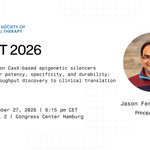
Next week, we’re in Hamburg, Germany, for #ESGCT2026! Principal Scientist Jason Fernandes (@jdf_ev) will present data on our epigenetic silencing technology ELXR and our engineering approach for improving potency and specificity.
ELXR underpins STX-1150, our clinical-stage PCSK9-targeting therapy designed to down-regulate PCSK9 transcription and deliver ultra-long-acting, potent LDL-C reductions for years – without permanently altering DNA.
Swing by on Tuesday to learn more about our epigenetic silencers at @ESGCT Congress. More details below.
🧬 Next generation CasX-based epigenetic silencers engineered for potency, specificity, and durability: from high-throughput discovery to clinical translation
🪧 Session 2b: (Epi)genome editing I
📅 Tuesday, October 27, 2026 at 6:15 pm CET
#ESGCTHamburg2026

At Ilmac Lausanne, our co-founder and VP External Innovation Brett Staahl gave a keynote on a belief we hold firmly at Scribe: AI is only useful if it is trained on the right datasets.
Brett’s talk, “Purpose-built CRISPR genetic medicines — Leveraging human know-how and AI to create better therapeutics faster,” showcased how Scribe’s CRISPR by Design™ iterative molecular engineering approach engineers CRISPR systems into precision medicines AND learns from the biology, turning those data into better predictions for Scribe’s platform technologies, XE and ELXR, and future therapeutic programs. The goal is to use AI and machine learning to move from broad screening toward targeted prediction, so we can test more hypotheses better, faster. He explained that while purpose-built CRISPR genetic medicines are the output, the proprietary sequence-function knowledge base is the compounding asset.
Brett also joined the “AI & Quantum in Life Sciences” panel discussion that clarified actionable steps that biopharma companies can take to implement AI/ML and reimagine their workflows.
Watch his interview to learn more about our work at Scribe 👇
youtube.com/watch?v=IeQ9R_0d…
Next week, our CEO @BenjaminLOakes will speak at the @Biocom CEO Summit in Sonoma. Industry leaders can tune in for the “CEO Perspectives: Pharma BD&L” session – a real-world tutorial for biotech CEOs and executive teams – on Friday, October 23.
This #BiocomCEOSummit panel will walk through how business development deals actually move through biotech and pharmaceutical organizations, breaking down the practical mechanics, workflows, and decision points that shape whether a deal gets done or stalls along the way.

Welcome to lesson #5 of 𝗦𝗰𝗿𝗶𝗯𝗲 𝗦𝘆𝗹𝗹𝗮𝗯𝘂𝘀, our educational series exploring how genetic medicine can tackle some of health’s most critical challenges.
We’ve started to explore how CRISPR works and how its main components comprise a tool that can be reprogrammed to target almost any sequence in the genome. Now we’ll dive further into the artful process of how CRISPR actually finds and edits DNA.
Leave your questions down in the comments!
📖 𝗖𝗥𝗜𝗦𝗣𝗥'𝘀 𝗺𝗼𝗹𝗲𝗰𝘂𝗹𝗮𝗿 𝗺𝗮𝗰𝗵𝗶𝗻𝗲𝗿𝘆 𝘂𝗽 𝗰𝗹𝗼𝘀𝗲: 𝗣𝗮𝗿𝘁 𝟮
Let’s return to two important components that make up the CRISPR system: the guide RNA (gRNA) and the Cas enzyme. In our last lesson, we learned that the gRNA (the “GPS system”) leads the Cas enzyme (“the scissors”) to the targeted DNA sequence.
This week, we will explore how these CRISPR components are delivered to cells, assembled, transported into the nucleus, and the process by which they scan the genome to make a defined edit at the target DNA sequence.
Dive in with our Substack post and follow along in our video. 🔗 scribetx.substack.com/p/scri…
We’re proud to have the support of @CIRMnews in advancing our cardiovascular programs into the clinic and to patients who need them most. CIRM features these two therapies – STX-1200 for Lp(a)-driven atherosclerotic cardiovascular disease and STX-1400 for severe hypertriglyceridemia – and our recent IPO in a new blog post.
“This investment helps Scribe to advance two programs that aim to deliver practical, one-time therapeutic solutions to patients throughout California that will enable them to avoid a lifetime of healthcare friction spent managing disease imperfectly.” - Brett Staahl, Scribe co-founder and Vice President of External Innovation
More from CIRM: blog.cirm.ca.gov/research-an…

Congratulations to Ioana L. Aanei, our Director of Business Development and Alliance Management, for being honored in @biospace's 40 Under 40! Here’s what makes her one of biotech’s most exemplary leaders:
⭐ Drives Scribe’s strategic partnerships to advance engineered CRISPR-based genetic medicines for heart disease and more
⭐ Community builder dedicated to connecting cross-functional resources within the biotech ecosystem to better serve patients and the broader field
⭐ Co-founded Calamores, an organization focused on parental well-being and science-backed self-care
⭐ Sustained advocate for emerging talent and active mentor through @Biocom and the @UCBerkeley Big Ideas program
Read more here: biospace.com/biospace-40-und…
Huge thanks to BioSpace for recognizing our Scribe team two years in a row. 💪

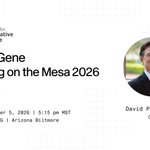
In Phoenix for the @alliancerm's Cell & Gene Meeting on the Mesa? Don’t miss today’s innovation spotlight presentation by our CFO David Parrot at 5:15 pm MST.
He’ll discuss our work engineering purpose-built in vivo genetic medicines for highly prevalent conditions like cardiometabolic disease. #CGMesa26

Welcome to lesson #4 of 𝗦𝗰𝗿𝗶𝗯𝗲 𝗦𝘆𝗹𝗹𝗮𝗯𝘂𝘀, our educational series exploring how genetic medicine can tackle some of health’s most critical challenges.
Now that we’ve covered CRISPR’s surprising and unassuming origin story, we’ll boil down how the technology actually works – and it’s much easier to understand than you might expect.
Leave any questions down in the comments!
📖 𝗛𝗼𝘄 𝗖𝗥𝗜𝗦𝗣𝗥 𝗪𝗼𝗿𝗸𝘀: 𝗣𝗮𝗿𝘁 𝟭
It may seem complex, but the beauty of CRISPR is that it’s a remarkably elegant tool. That simplicity is why scientists around the world keep finding new uses for it beyond its original purpose as an immune defense system.
In our last Syllabus lesson, we learned that CRISPR harnesses biological functions from bacteria that allow them to fight viruses. The entire CRISPR system has two main components: the 𝗖𝗮𝘀 𝗲𝗻𝘇𝘆𝗺𝗲 and the 𝗴𝘂𝗶𝗱𝗲 𝗥𝗡𝗔 (“𝗴𝗥𝗡𝗔”).
CRISPR’s revolutionary function is its ability to recognize, attach to and edit pieces of our DNA that predispose us to disease. In order to do this, it needs to identify the problematic sequence of DNA, and then cut it so the cell’s own repair machinery can modify it. That’s where the gRNA and Cas come in.
The gRNA finds the target DNA, and the Cas enzyme cuts it. Read all about it in our full post on Substack, and stay tuned for a deeper dive in part 2!
🔗 scribetx.substack.com/p/scri…
It’s #WorldHeartDay and #CholesterolEducationMonth. Take action against cardiovascular disease for yourself and your loved ones by knowing the numbers that make it the leading cause of death 👇
❤️🩹 Every 40 seconds, someone in the US has a heart attack.
❤️🩹 Americans have more than 1.5 million heart attacks and strokes each year.
❤️🩹 About 1 in 5 heart attacks are silent.
❤️🩹 63 million US adults have high LDL cholesterol (LDL-C), known as “bad cholesterol.”
❤️🩹 LDL-C is one of the largest drivers of heart disease, but only 20% of US patients with high LDL-C get treated.
To protect your #HeartHealth, get your LDL-C checked and treated early. Recent studies show:
💡 People at lower risk of heart disease may gain the most from lowering LDL-C.
💡 The benefits build over time: Keeping LDL-C lower for longer could mean fewer procedures down the line.
Sources: @American_Heart, @CDCgov, European Journal of Preventive Cardiology, American Journal of Preventive Cardiology
Learn about our work at Scribe to develop CRISPR-based genetic medicines that are safe and potent enough to address high LDL-C – among other major risk factors of cardiometabolic disease – to improve heart health for all: scribetx.com
Heart disease at a glance:
heart.org/-/media/PHD-Files-…
Separating cholesterol facts from myths: cdc.gov/cholesterol/about/my…
More on World Heart Day: world-heart-federation.org/w…
This week, tune into two events where our VP of Research Sarah Denny will break down the science and engineering approach behind our CRISPR-based genetic medicines.
1️⃣ 7th Genome Editing Therapeutics Summit hosted by the Cell & Gene Therapy Event Series, AKA #crispr2.0 (September 28-30, Boston)
2️⃣ Tech Spotlight: AI and CRISPR Genome Editing Webinar hosted by @Tech_Networks (September 29, virtual)

At #IPAVision 2026, our co-founder and CEO @BenjaminLOakes took the stage to discuss epigenetic silencing and gene editing as some of today’s most promising technologies and how they can address the world’s leading cause of death – cardiovascular disease.
Our thanks to the Institute for Portfolio Alternatives for the invitation to lead the conversation on breakthrough technologies for medicine, AI, and more.


In @biospace, learn about our differentiated epigenetic silencing technology, ELXR, and clinical-stage lead candidate STX-1150, purpose-built to offer durable cardiovascular risk reduction to patients in need.
STX-1150 is designed to silence PCSK9 and deliver sustained reductions of LDL-C or “bad” cholesterol after a single dose, without permanently changing the underlying DNA sequence.
Read more from Gabrielle Masson: biospace.com/business/scribe…
Learn more about ELXR: scribetx.substack.com/p/engi…

Welcome to lesson #3 of 𝗦𝗰𝗿𝗶𝗯𝗲 𝗦𝘆𝗹𝗹𝗮𝗯𝘂𝘀, our educational series exploring how genetic medicine can tackle some of health’s most critical challenges.
We previously covered the potential of genetic medicine to restore and improve everyone's health. In this post, we’ll go back in time to understand where CRISPR – one of the most powerful technologies for genetic medicine – came from and how it’s being used to develop breakthrough therapies today.
Have a question or a topic we should cover in a future post? Drop it in the comments.
📖 𝗛𝗼𝘄 𝗖𝗥𝗜𝗦𝗣𝗥 𝘄𝗮𝘀 𝗱𝗶𝘀𝗰𝗼𝘃𝗲𝗿𝗲𝗱
Decades before CRISPR was harnessed into a gene editing technology, scientists understood that DNA holds the natural blueprint for disease prevention. The problem was turning that knowledge into safe, reliable treatments. They lacked a tool precise enough to make efficient, accurate edits to the human genome.
The discovery of CRISPR closed that gap, and it all started with bacteria.
For the full post, head over to our Substack where we cover:
• The origin of CRISPR as a natural defense for bacteria to fend off viruses
• How Jennifer Doudna (one of Scribe’s co-founders) and Emmanuelle Charpentier showed that CRISPR could be engineered and reprogrammed to target any piece of DNA, not just viral DNA
• How CRISPR is being used today to improve human health across the globe
🔗 scribetx.substack.com/p/scri…
✍️ Image credit: IGI Glossary Icon Collection by Christine Liu of Two Photon Art for the Innovative Genomics Institute
Hear directly from our CEO @BenjaminLOakes about Scribe’s lead asset STX-1150, a clinical-stage epigenetic silencing therapy purpose-built to repress PCSK9, lower LDL cholesterol, and offer durable cardiovascular risk reduction to patients in need.
More on our cardiometabolic pipeline, engineering approach compared to first-generation CRISPR technologies, and more in his conversation with @bradloncar.
Full video is up on @BiotechTV: biotechtv.com/post/scribe-th…


𝐇𝐂𝐖 𝟐𝟎𝟐𝟔: @scribetx which represents the next generation of CRISPR, had its IPO in July - the first clinical program targets PCSK9. With Co-Founder & CEO @BenjaminLOakes. $SCTX
Full video: biotechtv.com/post/scribe-th…
🧬🔐 We built two-factor authentication into gene silencing. Read about it in our new blog and paper – links in the comments.
We call this approach 𝗦𝗲𝗾𝘂𝗲𝗻𝘁𝗶𝗮𝗹 𝗣𝗿𝗼𝗼𝗳𝗿𝗲𝗮𝗱𝗶𝗻𝗴. It’s engineered into ELXR, the epigenetic silencing technology built on our CRISPR-CasX platform.
The results? 𝗨𝗹𝘁𝗿𝗮-𝗹𝗼𝗻𝗴 𝗴𝗲𝗻𝗲 𝘀𝗶𝗹𝗲𝗻𝗰𝗶𝗻𝗴 𝘄𝗶𝘁𝗵𝗼𝘂𝘁 𝗰𝗵𝗮𝗻𝗴𝗶𝗻𝗴 𝗮𝗻𝘆 𝗗𝗡𝗔.
→ More than 10-fold greater specificity
→ More than 4-fold greater silencing activity across every target tested
→ No toxicity in stress tests, rescuing growth defects observed with Cas9-based silencers
→ Mechanism mirrors the cell’s natural regulation
Learn more about this work led by Emeric J Charles, Christie C Sze, @BenjaminLOakes, Sarah Denny, @jdf_ev, and team below.

Blog post: scribetx.substack.com/p/engi…
Full paper: biorxiv.org/content/10.64898…
This week, don’t miss these upcoming talks by our co-founders:
1️⃣ Fireside chat with CEO @BenjaminLOakes at the @HCWCO 28th Annual Global Investment Conference. This will take place Tuesday, September 15 at 2:30 p.m. ET in New York. #HCWConference
2️⃣ Panel discussion where VP of External Innovation @BStaahl will discuss “Advances in Gene Editing” at the Cell & Gene Therapy Symposium. The session begins Thursday, September 17 at 11:00 a.m. PT in La Jolla and is hosted by the @CALifeSciences, @CIRMnews, and Gene Therapy Initiative at @UCSanDiego.
