

PhD, he/him, @LosAlamosNatLab @um_midas @UWStat I am rarely on social media but will post informative threads when I publish a scientific paper.
Los Alamos, NM; Seattle, WA
Joined June 2020
- Tweets258
- Following152
- Followers121
- Likes881




Pinned Tweet
Presenting our new scan that uses IBD segments to detect genetic associations with cohorts stratified by a categorical variable (i.e., case-control studies).
biorxiv.org/content/10.1101/…

Seth D. Temple retweeted

🧬New from @sdtemple et al!
📄Multiple-testing corrections in case-control studies using identity-by-descent segments
cell.com/ajhg/fulltext/S0002…

Seth D. Temple retweeted

FLARE2: local ancestry inference with poorly-matched reference panels biorxiv.org/content/10.1101/… #biorxiv_genetic

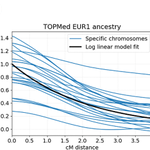
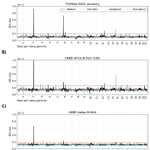
The final thesis chapter is published OA at @AJHGNews ! In short, we determine a valid significance level for a "selection" scan and apply it to 3 ancestry groups in 2 biobanks. 🧵 for updates from the helpful peer review.
sciencedirect.com/science/ar…
While we have improved (made a more conservative threshold for the African American analysis), there are still unmodeled complexities and likely fine-scale structure that violates our assumption. Buyer beware if signal is weak (barely GW significant)!
Overall, the method is a scalable and interpretable way to look for haplotype homozygosity in biobanks. I have spent a lot of time implementing it to make it user friendly. Running this can be important to check for confounding: see our other preprint.
pubmed.ncbi.nlm.nih.gov/4067…

Seth D. Temple retweeted
📣New from @sdtemple & Browning!
📄Multiple-testing corrections in selection scans using identity-by-descent segments
cell.com/ajhg/fulltext/S0002…

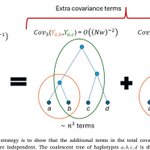
Our paper on the limiting distribution of IBD rates (Gaussian) is now published in TPB. Really an amazing experience to work with and learn from Prof Elizabeth Thompson!
doi.org/10.1016/j.tpb.2025.0…

The test is a two-sample modification of the one-sample selection scan from my prior work (Temple and Thompson, 2025): high IBD rates differences in cases versus controls could indicate a genetic association.
You can also run a fast scan with randomized phenotypes to double check if selection is confounding.

The mutation rate of SARS-CoV-2 is highly variable between sites and is influenced by sequence context, genomic region, and RNA structure academic.oup.com/nar/article…
