

Engineering leader, ex @eBay | Trying to find PMF in education | Free coaching for devs | The Notion learning packs guy | Dad | Marathonist
Dresden, Deutschland
Joined August 2015
- Tweets11.7K
- Following2.3K
- Followers26.2K
- Likes11.8K




Pinned Tweet
📚 Looking for a developer roadmap?
Here are 5 FREE Notion templates:
🎨 Frontend
⚙️ Backend
🖥️ Full-Stack
🔬Machine-Learning
🚄 Data-Eng
📦 83 resources, 40 tasks, 40 Cheat Sheets and 500+ practice questions!
sesigl.gumroad.com/l/ULTIMAT…

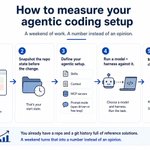
💯 Measure before you split.
I ran Opus 5.5 with and without Haiku subagents on a real work task:
- 48:02m → 29:35m
- $10.51 → $6.91
- correctness 6/10 → 5/10
Faster and cheaper, but not for free.
Subagents for simple, parallel work. Hard problems stay in the main loop.
How do you decide? 👇
xitter.cf/addyosmani/status/2114…

Before adding another subagent ask what problem it's solving. A bloated system prompt is often the issue.
Skills and tool search can fix that without splitting context across agents. My rule of thumb is to keep a subagent when the work is parallel, needs fresh context or one agent really can't pick the right tools.
Otherwise, fold it into the main loop, turn its prompt into a skill, run your evals and keep whatever wins.
Good write-up:
claude.com/resources/article…
Your AI agent can ship code. Can it also reduce your family’s bills?
I think personal assistants are one of the most underrated uses of AI.
We spend hours optimizing development workflows. Meanwhile, insurance documents, tax prep and planning the next family vacation still eat our evenings.
Here are 8 ways I use AI to reduce family spending and free up time:
1. Organize finances and insurance
Ask your agent to find and organize your documents in cloud storage. Give it scoped access to incoming documents so new ones land where they belong.
Sounds boring. But this becomes the foundation for almost everything else.
2. Make tax prep less painful
Once your documents are organized, AI can help find missing receipts, review potentially relevant expenses and prepare information for your tax return.
Much easier than starting with a folder full of “scan_final_2.pdf”.
3. Find supermarket discounts worth using
Teach your assistant what your family actually buys. Let it check offers and build a shopping list around useful discounts.
A discount on something you never needed is still spending.
Start with suggestions. Add purchasing permissions only when you trust the workflow.
4. Keep health information organized
Keep health records, test results and notes in one place. Use AI to prepare questions for appointments, summarize changes and help with scheduling.
I want to arrive better prepared and have useful context available when talking to a doctor.
5. Find benefits and reimbursements
Subsidies, insurance reimbursements, local programs. There are opportunities you probably don’t know about.
I recently discovered I could get 50% back on a battery repair.
Let your assistant check relevant programs, flag what might apply and help with the paperwork.
6. Plan the weekend
Every week, the same question: what could we do with the family?
Weather, nearby events, our calendar, travel time and what our kid enjoys.
A Friday email with three realistic options already saves a surprising amount of mental effort.
7. Support your training
Connect your activity data and share your goals. Use your assistant to draft training plans, check in regularly and adjust around your actual schedule.
The interesting part is continuity. What worked last month? What did you skip? What fits this week?
8. Plan vacations ahead
With kids, “let’s book something” quickly becomes a constraint problem.
Dates, travel time, budget, accommodation, activities.
Teach your assistant your preferences and let it shortlist options, compare total costs and track prices.
You still decide. You have less homework.
What makes this interesting to me is the compound effect.
Organized documents make tax prep easier. Saved preferences make the next vacation search faster. Feedback makes weekend suggestions more useful.
The value grows when you stop explaining everything from scratch.
But before connecting your whole life, apply the same engineering judgment you would at work:
- Understand where your data goes, how the provider uses it and what a breach would expose.
- Keep documents and useful context in storage you control and trust. If your assistant disappears tomorrow, you should be able to replace it.
- Use dedicated accounts and scoped tokens. Give each workflow only the access it needs.
- Separate suggestions from actions. Reading an offer, booking a trip and submitting a tax return need different levels of control.
- Think through failure modes. What could go wrong, how would you notice and could you undo it?
Pick tools that fit your expertise and risk tolerance. Start with one recurring task and make it reliable.
Saving a few hours and reducing recurring bills matters, especially when work and family already fill the week.
What have you delegated to a personal agent that actually made your life easier?
Share it below 👇
Everyone is talking about AI, which involves: search, embeddings, and sorting.
But how does that actually work? What if the perfect result are never shown to you or your agent?
No AI model can leverage what it never sees.
I’m starting a series on how search actually works, from simple keyword matching to modern AI-powered search.
Part 1: Find the words, then sort by date.
Let’s start with the basics.
sebastiansigl.com/blog/searc…

What does software engineering look like when your AI agents keep working after you close your laptop?
Well, I’m still figuring it out. But here is how it feels for me:
- You can’t personally approve every PR anymore.
You need AI to approve changes within boundaries you trust, and escalate the rest. That means getting clear about which mistakes you can tolerate and which you can’t. Mistakes will happen.
- Testing matters more than ever.
Especially testing “from the outside”: system tests, contract tests, end-to-end tests, and agents actually using what they built. Your agent saying “done” isn’t proof that it works. Keeping that feedback fast becomes a serious engineering challenge.
- You become a bit of a platform engineer for your own software factory.
Cost per PR, cache hit ratio, and human interventions per PR start to matter. You experiment with models and A/B-test changes to your setup. But your north star is still the customer: are people using what you ship? Are you solving their problems?
- Your time management needs an upgrade, too.
There is always another task you could start, another result you could check. You’re tempted to keep things running while you sleep, then check them before breakfast. If your factory works but you can’t switch off, you have another problem to solve.
- Learning and knowledge sharing need serious time.
I’d aim for 30% or more. Ask AI to explain code you don’t understand. Challenge the explanation. Write blog posts. Discuss decisions with peers. Make it an everyday university course that never ends while you keep building.
- Improving the agents becomes a huge part of the work.
Some days, it feels like 50% of mine. Measure where they get stuck, what needs human intervention, and what actually improves results. When a new model arrives, you want to be able to test whether it makes your setup better.
And we think software engineering will be a craft of the past? 😋
There is plenty of engineering here. The work is shifting, and so are the skills.
That also makes me optimistic about juniors. Those who use these tools to learn, question, and build can develop an intuition for AI-assisted development from day one. There is a bright future in that.
This list keeps growing. What has changed most in your day-to-day work with AI agents?
In the last 10 years I have written more than 50 blogposts by hand to share and learn at the same time. As you can imagine, AI has changed that…
But using LLM must not produce slop, it can improve the writers‘ and the readers‘ experience when done correctly!
For about 1 year, I experienced the „addiction“ of creating LLM generated content, but yesterday, I did it again, but this time completely by hand and experienced a complete different flow of state:
1. I create, change outlines quickly, evaluate LLM personas feedback to get a best in class outline.
2. The first writing is LLM based. It doesn’t read like myself (although I told it so). It’s hard to follow (I use astra having the best creativity and writing benchmark).
3. I generate images that help to explain key messages to make it more convenient for the reader.
4. I throw away many paragraphs, and rewrite all others myself, manually.
5. I ask the LLM to check my changes one by one and define and learn my writing.
6. I ask it to fix hard spelling and grammar mistakes and to NOT change my writing style.
7. I ask it to identify and check the common thread, about confusing parts, and any sort of conflicting expressions or wrong facts.
8. From there I make it using my writing style and read carefully every single suggestion, check if this sounds like myself, and if not give it feedback until it does.
9. The first draft is ready, after that I sleep 1 night and read again myself, and from now on, do all edits myself, usually smaller ones or if the outcome feels bad a jump back to a previous step.
10. I create assets and link it to the post all focused on providing learners the best possible experience. That means: an image fitting the style of the topic, infographic, quiz, flashcards and a podcast.
Here is what I got:
sebastiansigl.com/blog/searc…
The process and the outcome felt really good. I hardened my own understanding and it was a really nicely paced experience. The effort there compound quickly with skills and setup scripts to make it even less distracting due to technical concerns (eg how to setup coded cli to generate an image).
How you nowadays write blogposts?
Share your experience 👇

I compared Opus 5.5 (medium) with and without haiku subagents in a real work code benchmark:
No Haiku: 48:02m, $10.51m
6/10 correctness
7/10 simplicity
8/10 clean code
8/10 architecture
9/10 tests quality.
With Haiku: 29:35m, $6.91
5/10 correctness
9/10 simplicity
9/10 clean code
8/10 architecture
8/10 tests quality.
Time and cost were lower; scores were mixed.
I think it's a good idea to instruct to always delegate simple tasks.
After seeing @bcherny talked a lot about loops, graphs and how agents help us building such workflows, do you believe the next evolution are multi-agent systems?
He named some examples about potential roles for software engineers in companies like:
- sweeper,
- builder,
- protoyper,
- maintainer,
- and grower.
It feels for me these are really good agent role definitions. Humans could guide, refine, monitor and evolve them as they harden the platform they run.
👇Let me know your thoughts on if you believe that’s the next „maturity level“?
💡Working with autonomous agents: The Cleaner is your most important agent
Once you have loops rather than only chaining SDLC command, the most important piece seems to have a proper cleaning agent that wants to continuously improve the code base so it’s easy to change.
Easy to change doesn’t sound like a lot but it contains decades of knowledge related to software engineering.
How to make it work?
- ensure you have signals in place to measure how much your code actually does
- continuously scan your code and create bug / debt tickets
- measure bugs created and monitor errors in production
- take both defect metrics and divide it by how much features you have ( eg exposed apis or whatever fits for your application)
You and your cleaner agent can take such a metric as a truely relevant signal to measure the health of your „company OS“.
Am I going crazy or do you think in similar ways?
AI adoption in engineering isn't binary!
it’s an evolution across 5 distinct levels:
1️⃣ Ad-Hoc: Copy-pasting errors into web chats
2️⃣ Supported: Inline tab-autocomplete in the IDE
3️⃣ Assisted: Context-aware multi-file agent editing
4️⃣ Native: Spec-driven architecture & agent orchestration
5️⃣ Autonomous: Self-healing, asynchronous system loops
As you move up, the daily bottleneck shifts from writing code to verifying agent intent.
Where do you and your team sit on this spectrum today, and what's holding you back from the next level? 👇
I currently try to advance to autonomous loops but it’s hard to get right with all that different models, effort levels, …
Also the freedom I grant these agents isn’t easy. While Opus 5.5 does great things with more freedom, DeepSeek, grok and other workhorses needs a more narrow harness.
It eventually becomes a cost question 😵💫
Who of you uses Hermes or OpenClaw for autonomous coding agents?
Stitching these together instead of a more linear processing of ticket feels more powerful.
I currently have:
1 Software Engineer agent that owns the SDLC, who escalates to the CTO in case of questions and approvals.
1 CTO who is the most capable model and has a "company" goal in mind and the overview about everything existing.
1 Cleaner who scans the current codebase, analyzes a health dashboard and picks the most critical flaw and fixes it.
It someone is a higher level of making an agent team work in comparison to just prompt a product quickly.
Please share any experience you have in that direction ! Is that how you build products nowdays? Did you try it? If it failed, why did it fail?
Curious about your responses 🤓
🤌To everyone out there who thinks there won’t be any demand for software engineers in the future:
Just once, try to build a company OS for anything you like and tell me that doesn’t require:
- proper engineering skills
- a lot of experience
- continuous monitoring and adjustments
- new ways to solve unknown problems
I think that will increase the demand for engineers.
Single persons and small teams can do so much more now, hence there is new opportunity that wasn’t really profitable in the past which now suddenly is.
Also cheaper competitors will challenge the big players with a fraction of the price.
Exciting times to be alive
I’m 37.
Staff Engineer at Kleinanzeigen by day, dad and marathon runner to find my balance in the morning/afternoon, and trying (desperately) to become a solo founder at night.
Based in Dresden, Germany 🇩🇪
Looking to connect with more builders & indie hackers!

My private LLM plans for any kinds of work:
1. Grok 4.x subscription, amazing value for the price
2. Fable 5.x for the hardest challenges on demand
3. Opencode go using discounted models like Deepseek v 4.1 flash in case of plans hit their limits
How does your setup look like?
🤔I am not hearing much about remote agents replacing local workflows on top of Claude Code and other tools from regular engineers. Am I just in the wrong bubble?
Potentially a Hermes agent or anything else could just do what we do locally do day over day? We would give it:
- the tasks to pull
- explain where to put state
- required commands and skills
- ways to reach out to humans
It would solve:
- local git worktree mess
- encourage convergence into something shared with other engineers
- take metrics like feature shiped in realtion to bugs found
It would also mean a lot of work to be done to keep the system running, measure, experiment and evolve.
I will give it a try and share how it goes.
Did anyone try that? What issues did you face?
Unpopular Opinion: Writing books about technical topics like programming, architecture, data science, site reliability.
There was no real alternative. Knowledge has been persisted and distributed in a book format since centuries.
That’s going to change with AI.
WDYT?

The best signals for für coding agents I use daily:
- test failures
- static code analyzers
- architecture tests
- cyclomatic complexity
- mutation testing score
- duplications measured by lexical and semantic closeness
What signals do you use to maintain code quality with your agents?
While LLMs are getting smarter and cheaper I strongly believe that more libraries will appear that help humans to configure deterministic checks to provide feedback to agents.
We have a ton of them already but they become less popular due to engineering excellence:
- sonarqube
- crap metric
- mutation testing
- dependency metrics
I believe there will be much more in this direction. The goal: metrics that measure software quality.
What libraries and checks do you have in place?
Sebastian Sigl retweeted
This was a ton of fun!
xitter.cf/mattpocockuk/status/20…

In just over an hour, I'll be live with @unclebobmartin
We'll be figuring out if software fundamentals still matter in the age of AI.
Don't miss it:
youtube.com/live/zcLPGC-tvgk…
