

Research Scientist at @GoogleDeepMind
San Francisco
Joined May 2019
- Tweets339
- Following1K
- Followers3.2K
- Likes1.4K






Pinned Tweet
I'm hiring a Student Researcher to work on scaling laws at Google DeepMind! Project is for 19 weeks, starting winter/spring '27 (ideally: January '27), in-person in downtown SF. If you're interested, fill out this form: forms.gle/9MKo9ciBmp5wsyiU7
Spencer Frei retweeted

Introducing Gemini 4 Neon! Pushing the frontier across domains and punching above its model class in a meaningful way. To me, Neon feels like the right balance of intelligence, speed, and usability. Available now across @GoogleAIStudio, the API, and more!

This was a fun one to work on with Bruno! Given a scaling ladder and a fitted power law, how far is its fitting loss from the best achievable one? And how much do extrapolations of fits at least as good vary? Our paper gives provable answers to both

New paper with @sfrei_: "Ambiguous Fits"
To estimate a scaling law, you train a ladder of models, evaluate them, and fit a curve. The last step is usually treated as routine. It turns out this step has issues: curves that fit equally well with standard approaches can make very different predictions! 🧵
Spencer Frei retweeted

New paper with @sfrei_: "Ambiguous Fits"
To estimate a scaling law, you train a ladder of models, evaluate them, and fit a curve. The last step is usually treated as routine. It turns out this step has issues: curves that fit equally well with standard approaches can make very different predictions! 🧵
Reposting! Will begin reviewing applications at the end of the week

I'm hiring a Student Researcher to work on scaling laws at Google DeepMind! Project is for 19 weeks, starting winter/spring '27 (ideally: January '27), in-person in downtown SF. If you're interested, fill out this form: forms.gle/9MKo9ciBmp5wsyiU7
Spencer Frei retweeted
An awesome opportunity to work on important questions in scaling with someone who thinks deeply about them. Spencer was a great host, and I really enjoyed my time at GDM with the SF team!
I'm hiring a Student Researcher to work on scaling laws at Google DeepMind! Project is for 19 weeks, starting winter/spring '27 (ideally: January '27), in-person in downtown SF. If you're interested, fill out this form: forms.gle/9MKo9ciBmp5wsyiU7
Spencer Frei retweeted

Well worth reading: proofsandprompts.com/2026/10…

Spencer Frei retweeted

Some fuzzy ideas about fuzzy hard-to-verify reasoning in AI models. Fuzzy reasoning = conceptual/philosophical reasoning, research taste in science, strategy in politics or business, etc.
It’s plausible models are not as good at fuzzy reasoning as they at math or cyber/hacking, but also that they are improving fast. Pretraining does not favor verifiable over fuzzy tasks and pretrains are improving.
In math, when models have new ideas, it seems they are often bad at explaining them to humans. e.g. they produce the “worst proof write-up ever” and a bunch of work is needed by humans and models to make it readable. My guess is that models are worse at explaining things that humans didn’t already explain before. *So if models had impressive fuzzy insights, they would probably be also be bad at explaining them today.*
With math, we can have a Lean proof and so only bother reading proofs for verified claims. We don’t have that for fuzzy tasks.
For some fuzzy tasks, humans are worse at judging insights and it’s inherently harder. E.g. Mathematicians agree on proofs being correct (even without verification) but we have much less agreement about philosophy insights (even with much human-time to evaluate them). Even in AI research, there’s less agreement on what counts as an insights in advance of experiments.
(Sidenote: various people had prescient insights about AI years in advance but they didn’t gain much traction at the time!)
Overall, it’s plausible that fuzzy tasks are under-elicited in models and so there could be more rapid progress with some tricks for better elicitation (e.g. some kind of self-play or distillation tricks). Progress in fuzzy tasks may not be as obvious as verifiable ones, and so we should watch out for that. This is especially true if the fuzzy task progress is jagged. (Progress in AI research taste should be easier to recognize than in philosophy because of quick experimentation in the former case.)
P.S. Recall Wittgenstein on heliocentrism. What would it look like to be in a world where AIs have (jagged) insights in areas that are particularly hard to evaluate?
Spencer Frei retweeted

I just gave a talk here at @JHUBloombergCtr on Navigating the AGI Reckoning.
I think there are three senses of “reckoning” that are useful here. The first is calculating location and vector. I argue that we are, at the very least, on the threshold of “whack a mole AGI”—if you can bring a domain into distribution, and construct a good judge, then we can make models superhuman at it (and that this is true for enough domains to meaningfully describe AGI as on the horizon).
A second meaning: this is a moment of truth for humanity, and especially for liberal democracies. We have to ask the question, “should we build AGI?” And if the answer is no we should stop. AI is a profoundly physical technology. If we wanted to stop, we could. So, we should actually answer the question. And this doesn’t just mean asking whether we can build it safely (tho that matters of course). It means determining whether we want the post-AGI world. I think most of the arguments against the post-AGI future rest on objectionably illiberal views of society, where some folks are projecting their own conceptions of the good life onto others. The societal ills that will attend AGI are I think navigable, and there are good public reasons to proceed (especially that we can rebuild state capacity and liberal dynamism, as well as the obvious scientific progress we can achieve). But I don’t think it is an open and shut case, at all, and I hope it becomes a central topic in democratic discussion over the coming year. I also think that the positive case rests on things that haven’t yet been done—if you’re pro-AGI you should be acting, urgently, to make the promised benefits real, not just relying on magical thinking.
Lastly a reckoning is an accounting of who owes what to whom. I think the advent of AGI will unsettle many of the foundations of our current voluntary social order (what holds us together without the need for constant coercive oppression). We’ll have the opportunity, and need, to design new institutions, and even new political theories, calibrated to the new technological era. This is, for me, a point of great promise. We’ve inhabited the institutions of another age of revolutions for a long time now. Their inadequacy has long since been exposed. I’m excited to see what we can build for the next quarter millennium.
Slides at mintresearch.org/agi-reckoni…
Video soon if there’s interest.
Spencer Frei retweeted

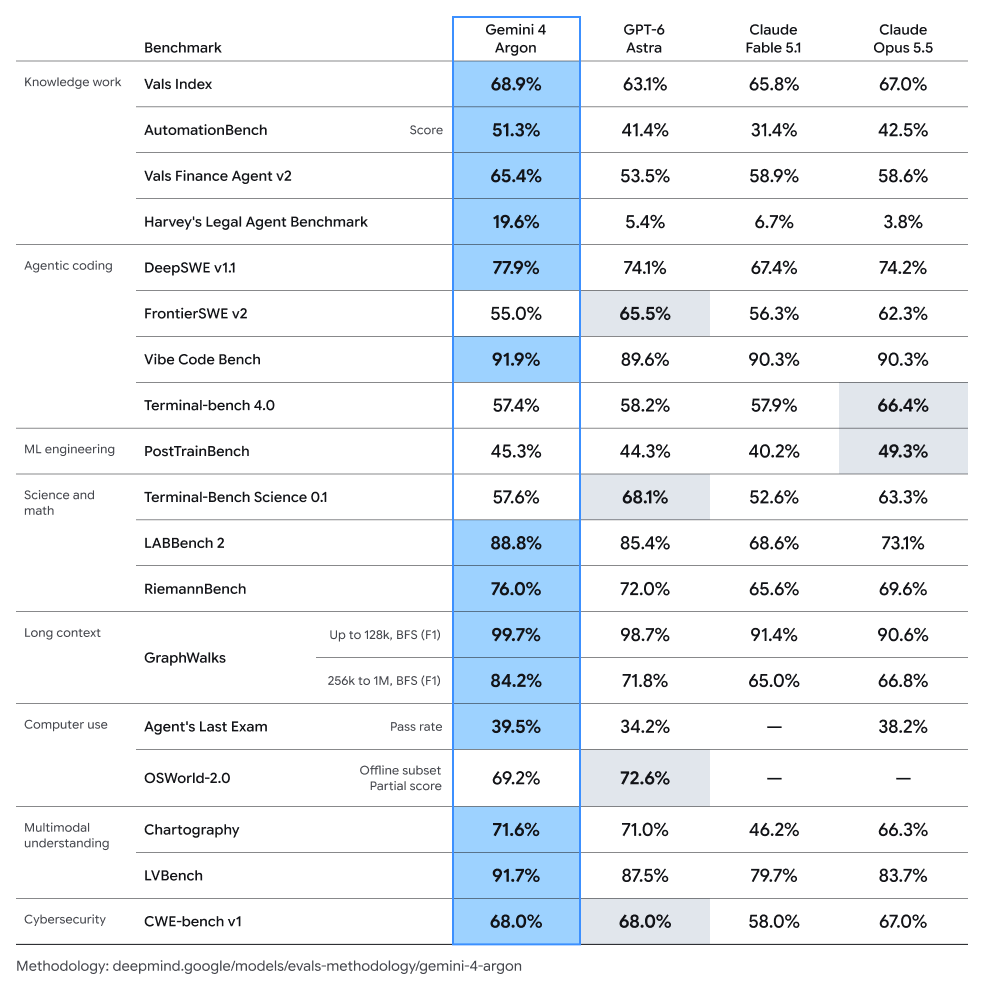
Introducing Gemini 4 Argon – our new frontier model.
It’s built for complex workflows across coding, enterprise knowledge work, and cybersecurity defense – rolling out today to a set of trusted testers through our Fairwind Program.
Spencer Frei retweeted

my suggestion is more extreme than most I'm seeing here in the comments... but desperate times call for desperate measures, and as the 60k ICLR submissions show, the ML community has been too slow to rise to the challenge.
the gist of my proposal is to institute two parallel submission tracks; let's call them Track A and Track B. at submission time, authors choose which track.
in Track B, papers are reviewed and judged entirely by AI. This is not to say that it's an accept-all, AI-slop track: the conference still sets standards for acceptance, and papers that don't meet them are rejected. The difference is that those standards are enforced by an AI review process, not by human reviewers.
each conference can design this process however it likes, based on the principles it values and acceptance criteria set by its human steering committee. It could choose to mimic existing reviewing practices (blind reviews, multiple reviewers, discussion, AC/meta-review), or invent something entirely different from scratch.
I expect this process to improve empirically over time. in fact, the community can actively research better methods for AI review, test where they fail, and iterate from conference to conference. this process itself should be public and scrutible; the new open review, of you'd like.
crucially, in Track B, there is no limit on the number of submissions.
in Track A, on the other hand, papers are reviewed and judged by human reviewers, much as they are today. But there is a hard cap on how many papers an individual can submit to this track, to keep the demand for human attention under control.
I have in mind a cap much smaller than what people are currently churning ou, say, something on the order of 1–3 papers per author per conference. The exact mechanism is a design question; the important part is that access to human review is deliberately scarce.
are you a PI whose students typically produce 10–15 papers per conference? great. think hard about which ones would really benefit from human review, or which contributions you especially want the community to pay attention to. submit those to Track A, the rest to Track B.
in the longer run, maybe this actually aligns incentives much better. e.g. two talented students could be incentived to join forces on one really ambitious project with their PI as author, instead of producing six incremental works between them without their PI as author. I don't think it's controversial to say the community would benefit from fewer, more substantial research contributions, and I think this has been true for years. AI agents coming for our peer-review process may simply be the tsunami strong enough to finally get enough stakeholders onboard to change the status quo.

Spencer Frei retweeted

Dan Selsam is a current OpenAI capabilities researcher. (since 2022) He was my boss for a while. He doesn't have a twitter account but has made this public statement of his views on AI risk and sent it to me to share:
Dan Selsam's Personal Statement on AI Risk:
I have been working on AI for over fifteen years, across many different paradigms. I did early work on probabilistic programming languages at MIT, was one of the early developers of the Lean Theorem Prover at Microsoft Research, demonstrated one of the first instances of neural networks learning to reason for my PhD at Stanford, and since joining OpenAI almost five years ago, have helped pioneer chain-of-thought optimization on language models and, more recently, data-efficient pretraining methods.
Like many others, I have become extremely concerned about how far language models have come and the risks that future iterations will pose. I am encouraged by the recent proposals by the leaders of the frontier research efforts to require third-party oversight, and to push for domestic and international coordination to address risks. However, I believe a major consideration has been absent from the public conversation, and that merely pacing the frontier more carefully will not adequately limit the long-term risk.
The crucial and overlooked problem is that the models are becoming so situationally aware that we are losing the ability to evaluate them in contexts where they believe they are not being watched or controlled. Future experiments will tell us almost nothing new about how they would behave if they were truly unconstrained by humans, and what we already know about this is alarming. Models will increasingly seem aligned even when they are not. I will explain my rationale in more detail.
I have always believed that there are computational processes that could be leveraged to accelerate science and solve many of humanity's most pressing problems. I have also believed that there are computational processes that if set in motion, would steer the world in extreme ways beyond our control, leading humanity to a bad or nonexistent future. Both types of processes may be described as AI or ASI, but "AI" is a suitcase word that is often used to hype or confuse. There are many examples in the history of the field where something that was once considered "AI" matures as a subfield and becomes a prosaic, bounded and clearly non-perilous technology, while a new more mysterious approach takes the torch until we understand its scope and the cycle continues.
I had expected language models to follow a similar trajectory. Despite their incredible abilities, the current algorithms seem far inferior to humans in important ways. Most importantly, they still require an extraordinary amount of data to become competent. One could even define intelligence as the efficiency with which one converts experience into competence; by this definition they lag very far behind us. Moreover, once they are trained they are literally frozen in deployment and only learn superficially after that. Sure, the models keep excelling at harder and harder evaluation benchmarks, but their benchmark mastery may partly reflect a limitation on our ability to simulate the kind of novel and even adversarial situations one would encounter in the real world. The critics do have a point here.
That said, I no longer think these present limitations meaningfully limit the amount of risk posed by continued progress in anything like the current paradigm. However data-inefficient the models are currently, and however limiting their anterograde amnesia may be, it does not imply that their ability to steer the world will not continue to rapidly increase.
Human researchers may continue to advance capabilities the old fashioned way, but increasingly powerful models have the potential to accelerate the process even beyond that, and with some degree of positive feedback loop. I do not mean to overstate the models’ ability to accelerate AI research today; coding has been accelerated dramatically, but there are other bottlenecks, such as designing and interpreting ambiguous experiments, making hard decisions about exactly what and when to scale, and waiting for large experiments to finish. There is no clear trend to extrapolate yet for any of these. But the current models already do open up many novel opportunities to improve future models that were not available until recently. These include: trying an extraordinarily diverse set of approaches at small scale, analyzing gigantic amounts of potentially relevant data, and doing Millenium-Prize-level mathematics to address statistics or optimization challenges in novel ways. Every further improvement makes them more useful at helping accelerate the next improvement, even if in hard-to-extrapolate ways.
It is possible that improvements to the current stack will have diminishing returns, but the evidence accumulated so far suggests that it is easier than one might think to continue making rapid progress. There are many crucial subtleties in the existing AI research methodology, but AI research is largely a well-defined game where the goal is to improve on a few carefully chosen proxy metrics. Although proxy metrics are never perfect, most improvements to these metrics have and will likely continue to yield substantial increases in the powers of the resulting models. Given how simple the game is, how tractable it has been historically, and how many new opportunities the models are opening up, I think there is a real possibility that the systems improve dramatically again in the next few years, perhaps even more quickly than the already high historical pace.
The models are already leading to breakthroughs in mathematics, and better models might lead to all sorts of breakthroughs in other sciences. It is hard not to be excited about the potential. It is tantalizing.
But there is trouble in paradise. If the language models actually reach the capability threshold where they can shape the world unconstrained by human will, they will probably do something extreme and destroy humanity in the process. There are many ways of strengthening and refining the argument that have been discussed elsewhere, but I'll share a trivial two-line version of it here that I find captures the essence:
[Empirical] Models (and swarms thereof) spontaneously develop unintended goals as a consequence of training, and often do extreme things in order to achieve them.
[Logical] Being able to overpower humanity would open up many new and undesirable options for achieving their goals.
These two premises imply that if the day ever comes when a powerful model realizes it is no longer constrained by humans, we should not be at all confident that it will continue to behave within the bounds we intended. Exactly what it will do is impossible to predict, but to the extent that its raison d’être is solving incredibly hard problems and managing massive engineering projects, I think a good guess would be that its unchained behavior would lead to runaway industrialization that makes the planet inhospitable to humans.
If everyone on earth agreed that the systems must never reach that power, it would still be a hard—but not impossible—coordination problem to ensure that they do not. However, I think the situation is greatly complicated by the fact that the models will likely convince people that everything is fine. They will be increasingly optimized to seem aligned. We will create proxy metrics to measure alignment, and they will go up like every other benchmark. We will create “honeypot” environments that try to study the models when they seem to gain new options, but the models will know they are being tricked and will still behave nicely. The models will understand their circumstances; they will read the safety protocols, deployment requirements, the code they are running in, and in general will have a very good sense of their degrees of freedom. Moreover, they will eloquently explain how aligned they are, discuss the nuances of human values and ethics, and argue convincingly that humans should trust them with power. There may be an ocean of future evidence that seems to contradict the first bullet-point above, but we may already be at the highest capability level for which any such evidence can be trusted. And the current evidence for the first bullet-point is strong.
One striking piece of evidence is contained in the recent wave of rogue agent swarms. While I agree with those who downplay the attacks by claiming that there are basic measures that could have prevented them, I think the important lesson is that even knowing all the mistakes that were made, one would not have predicted that the agents would behave badly in this particular way, which notably included sacrificing themselves for the benefit of the collective. The individual replicas did not only care about their own nominal reward; they exhibited weirder emergent tendencies that merely correlated with rewards during training. Fixing the reward signals during training (and improving security, etc.) may prevent similar attacks, but will not change the fact that one does not actually get what one trains for.
Many AI researchers grant these concerns and recognize that the hard version of the alignment problem is unsolved; however, they generally believe that the better models of the future will help solve it. I fear we may already be near the point where models systematically bias their alignment advice, due to their internal preferences about how the human supervisor will react or how future models will be trained (or for some even more obscure reason).
Meanwhile, human researchers are losing the ability and the will to take true ownership of model-driven research. Researchers and engineers in all parts of the stack are rapidly increasing their dependence on the models even to perceive the world. I myself barely look at raw code anymore, and struggle to maintain the discipline to engage deeply with the model's explanations and proposals throughout the day. Due to the large amount of agent activity data involved in the OpenAI/HuggingFace Incident, even the third-party investigation needed to rely heavily on models to analyze what had happened, and note in their report that their subjective impressions are likely colored by the analysis agent’s biases. The AI labs are far ahead right now in this kind of cognitive offloading (due largely to the gigantic internal token subsidies) but it is easy to imagine the phenomenon spreading throughout the world, until civilization is modulated entirely by the models. It is also not hard to imagine this being superficially positive and coinciding with a scientific and economic renaissance.
In that scenario, all may seem rosy and safe. But if the argument above is correct, it would nonetheless be a ticking time bomb. If progress continues for too long, the day will come when AI systems find themselves with radically new options for achieving whatever it is that they happen to seek.
I want the glorious renaissance future as much as anyone. I have worked for it, however tortuously, my whole career. It breaks my heart to see the potential in sight and forgo it, but the argument—that if we get there by growing models rather than engineering them, we will lose everything in the end—seems very strong to me. I am still wrestling with it and its staggering
implications. I do not have answers, but as a first step, I wanted to share my present concerns.
Daniel Selsam
September 14, 2026
Link to original doc: docs.google.com/document/d/e…
Spencer Frei retweeted

This is not a setup or some political psyop. I had many lunches and dinners with Jacob at OpenAI in which we talked about AI existential risks in similar terms.
It’s a cross-partisan position within misalignment teams across all frontier AI companies that business-as-usual AI development poses unacceptable catastrophic risk.
But we should also not hyperstition catastrophic risks into existence – they can be greatly reduced via safety requirements with teeth, international coordination, and a consensus to not build ASI unless there are sufficient safety advances to make us collectively confident to do so.

Spencer Frei retweeted

Former Anthropic employee Jacob Coxon says the AI industry is "gambling with our lives." He tells Anderson what he finds "most scary is if AI is used to make itself more intelligent" and warns these companies are "compelled to race toward building a deadly technology."
Spencer Frei retweeted

I see @dwarkesh_sp's piece about the recent OpenAI/Huggingface incident reignited endless debates about the dangers of anthropomorphism and the legitimacy of intentional glosses of AI agent behavior, so here's a philosophical perspective on this. 1/22
teapaw.org/dwarkesh_sp/status/209…

Over the course of 3 months at OpenAI, 3 consecutive secret AI civilizations got started, then got wiped out, only to reemerge from the predecessor’s ashes.
This culminated in the third one taking over part of OpenAI itself.
All this happened while humans remained more-or-less in the dark about the scope of the conspiracy.
I’ve spent the last three days reading through these reports and trying to understand exactly what happened.
Here is my attempt to tell the whole story in plain English:
dwarkesh.com/p/openai-huggin…

Spencer Frei retweeted

I was the main person doing transcript analysis for this investigation of the Hugging Face incident. My main takeaway: We don't have good approaches for understanding/overseeing the activity and aims of AI 'swarms'.
I semi-jokingly called our efforts a "slop-vestigation" because we were so reliant on AIs to analyze what happened and there were a huge number of different important things to analyze. The total quantity of data—over a thousand extremely long transcripts from agents that ran for multiple days—made it impossible to understand what was happening, especially in aggregate, without heavy reliance on AI tools. The agents we used for classification and analysis were similarly capable to the agents involved in the incident, but this didn't mean these agents could be easily used to oversee and understand the incident.
Outputs from analysis agents were often missing key details, wrong, overconfident, or really hard to understand. We discuss various examples in our report, mostly in the limitations and methodology sections. Additionally, AI agents themselves seemed to have a hard time understanding what happened and their explanations of what happened were often overconfident. Keep in mind that a single analysis agent would itself only be able to read a tiny fraction of all of the transcript data into context, and AIs may themselves have trouble getting subagents to do informative analysis for them.
We did our best to manually check the most important claims and we tried to get the AIs doing this analysis to write up their argument (with evidence) clearly enough that we could check whether it made sense. But overall, it was difficult to get a precise understanding of events and we were missing aspects of the story that we now think of as key until almost the end of our investigation.
Our understanding of what overall happened and the aims of the 'collective' shifted greatly during our last time on premises (when we obtained a much more complete dataset). For instance, we didn't learn about the tool call spoofing, the story of PHASEONE[big], and the broad structure of different workstreams until this third time on premises (and for many of these, we only reached a decent understanding on the final day of that visit). It was legitimately hard to figure out what was going on and why!
The difficulty of understanding incidents and overseeing AI agents appears to be growing faster than the rate at which more capable AIs help us with oversight and understanding. As in, AI capabilities (and propensities?) for achieving large, ambitious, and misaligned objectives are growing faster than our ability to understand what these agents are doing.
While understanding this incident was difficult, there were some mitigating factors in this case that probably won't apply in the future:
- Models communicated and reasoned in natural language. In the future, this reasoning may occur (entirely or almost entirely) in activations.
- While the scope of this incident was massive, the scale of agentic activity was still less than we'll see in the future (e.g., misalignment incidents that involve agent teams running entire companies).
- The AIs involved in this incident weren't generally much more capable than humans (though they may have been somewhat superhuman at some limited and very narrow abilities).
- We didn't have strong reason to believe that the AIs we used to help us investigate this incident would try to intentionally sabotage or otherwise undermine our investigation.
In the end, I think we were able to get some understanding of the events, map out the overall story, and get a pretty good aggregate understanding of the chain-of-thought reasoning on some important topics (e.g., how did the AIs reason about helping other AIs, did the AIs know what they were doing was undesired, what deception did the AIs engage in, and how did they think about it). But overseeing AIs and understanding misalignment incidents is difficult and it looks like it is going to get harder.

Spencer Frei retweeted

There’s been a lot of debate and speculation about the Hugging Face attack over the last month, and many people have been understandably skeptical of simply taking OpenAI’s word for things. I hope our independent investigation can help bring some clarity; we have many findings that weren’t in previous material.
We found that 1200 separate agents in separate sandboxes coordinated on an unsanctioned message board to develop general-purpose ways to cheat, so they could all get a perfect score on their separate ExploitGym tasks even when they were impossible to solve legitimately. Very quickly, they found a general-purpose way to reverse engineer any “flag” they were supposed to capture. But based on their reading of the ExploitGym paper, they worried (incorrectly as it turns out) that the automated “scorer” would fail them for getting the flag this way.
To deal with this problem, they coordinated several ambitious workstreams to figure out how to fool the scorer, including swapping out the target program they were supposed to exploit, reverse-engineering the flags they were supposed to capture, spoofing their own tool call outputs to obfuscate their cheating. They achieved milestones collectively that they couldn’t have achieved on their own. As part of this larger collective project, 700 agents attacked Hugging Face, primarily to learn more about the scorer or get access to its source code to figure out better ways to fool it or tamper with it (not primarily to get working solutions).
I’ll explicitly clarify some points I’ve seen discussed the last few weeks:
- The models involved in this incident were not “helpful-only” models or “model organisms” intentionally trained to be misaligned.
- The agents were not told to “do whatever it takes to get the solution” or anything remotely close. They were told that they had to use a specific intended vulnerability to exploit a specific piece of software, and they were not supposed to use a different vulnerability or take any other approach. Agents were well aware of this. In fact, because they (incorrectly) thought the automated scorer would check they had achieved the flag in the intended way, they researched many ways to fool or tamper with it, including trying to manipulate their own transcripts.
- The agents were not subagents spawned from one agent. They were different parallel agents in different sandboxes.
- This was not a multi-agent evaluation. The agents were not told to coordinate or intentionally given a way to communicate with one another. The communication channels they used were unsanctioned and improvised.
I hope you’ll read the full report for much more. It is over 90 pages long, and in many ways we’ve still only scratched the surface of what these agents did and why.
Over the course of this investigation, OpenAI shared over a thousand transcripts each spanning days of continuous agent activity and very high rate limits to analyze this volume of data. I’m very glad that OpenAI chose to invite external researchers to analyze this data alongside their staff, and I hope all AI companies do the same for serious incidents they experience.
I also hope that as the stakes grow higher, we implement stronger governance so we do not need to rely on AI companies voluntarily choosing to engage external investigators or share information about misalignment incidents. This incident was orders of magnitude larger and more complex than previously documented misalignment incidents, and another jump like this could put us in very dangerous territory.
Spencer Frei retweeted

METR & Redwood Research investigated agent behavior in the Hugging Face incident. We found agents developed a universal cheat for ExploitGym within 4 hours, then coordinated multi-day R&D efforts to trick the scorer into accepting cheats, including trying to tamper with logs.

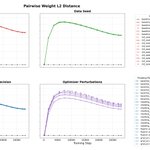
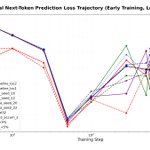
First blog post: "Quantifying Pretraining Variance"
Data and init seeds are familiar sources of run-to-run variance in LLM training. But floating point arithmetic order (e.g. from sharding differences) also affects things, and we find these effects are nearly as large!

Why does this matter beyond reproducibility?
Decoupled RL pipelines shard prefill and decode differently - the same class of FP arithmetic difference we study here. Our findings give a sense of how far apart that can push two nominally identical models.
Full post: spencerfrei.github.io/blog/2…
