

Historian, tour guide, podcaster, coffee drinker To the SHP shop: https://teapaw.org/t.co/5GV1hsDBzV
Joined October 2018
- Tweets2.5K
- Following612
- Followers411
- Likes55.5K
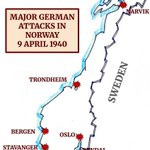


The latest episode of the Scandinavian History Podcast is all about the German invasion of Denmark and Norway on 9 April 1940. As usual, I rattled off a long list of names of places in Norway, and now you may be curious to know where they're located.
To help with that, here's a map.

1
1
77

Mikael Shainkman retweeted

As it becomes clear today that the Russian Navy is undergoing a rapid conversion programme, turning its ships into submarines, this image feels ever more apt...

On this day, but in 1286, the Danish king Erik Klipping was murdered in Finderup by a group of conspiring noblemen. The attention-grabbing painting by Otto Bache depicts these noblemen leaving Finderup after the murder. They seem a little worried as they look back toward the scene of the crime. And they had good reason to be worried. The new king, Erik’s son who (for clarity’s sake) was also called Erik, made sure to round them up and execute them within a year.
The murder of Erik Klipping was the last, or at least the latest, time a Danish monarch was killed.

1
31
The results from the Spotify Poll about episode 146 (The Winter War) are here! In the last episode, I asked you: In your opinion, what was the main factor behind the Finns ability to resist a Soviet occupation in the Winter War?
The options were:
1) Harsh winter conditions
2) Clever military tactics
3) The Soviet Union never intended to occupy all of Finland
The majority of you (62.5%) voted for the second option, crediting the clever Finnish military tactics for saving Finland's independence.
The photo shows the results of the so-called Motti Tactic that I talked about in the episode. This is what was left of a column of Soviet vehicles on the Raate Road after a Finnish ambush.
A new poll is up and running on Spotify right now. Go and listen to episode 147 (Operation Weser Exercise), and vote!

1
5
365
A new episode of the Scandinavian History Podcast is here, and the topic is about as cheerful as the late-November weather in Scandinavia. This time, we take on the German invasion of Denmark and Norway in April 1940.
When the Second World War broke out in 1939, all five Nordic countries–Denmark, Iceland, Norway, Sweden and Finland–declared themselves neutral, hoping to stay out of the fighting. But, just like Finland had experienced five months before, now it became obvious also to the Norwegians and Danes that the neutrality of small states meant little when Great Power interests were at stake.
Links to the episode in the comments below.

2
1
39


Throwback Thursday! On a visit to Copenhagen this summer, I took the children to Rosenborg castle. There, we could admire this pen. It may not look like much (the kids certainly weren’t impressed), but it holds a significant place in Danish history. This is the very pen that King Frederik VII used when he signed the new constitution into law on 5 June 1849, thereby signing away his own absolute power.
You may have thought the king was sad to give up all that power and influence, but you’d be wrong. Frederik supposedly quipped: “Great, now I can sleep in the mornings.”
Today, 5 June is celebrated as Constitution Day in Denmark.

60


Half a dozen Scandinavian places on this map. That's a lot of wishful thinking per capita in Scandinavia.


34
As I mentioned in the latest episode of the Scandinavian History Podcast, Joseph Stalin established a Finnish puppet regime at the beginning of the Winter War in 1939. This regime, under the leadership of Otto Ville Kuusinen, was set up in the seaside resort of Terijoki, and is therefore known to history as the Terijoki government. Officially, though, they claimed to be the legitimate government of the Finnish Democratic Republic–the Communist state that was supposed to replace independent Finland after the expected Soviet victory.
The Terijoki government was only ever recognized by the Soviet Union, and when Stalin realized it would be too costly to occupy all of Finland, he swept Kuusinen and his collaborator government aside, and opened negotiations with the legal Finnish government in Helsinki instead.
The Finnish Democratic Republic was dissolved after the peace treaty was signed, ending the Winter War in March 1940.
The attention-grabbing image depicts the seal of that short-lived puppet state.

During the Winter War, some 12,000 Swedes volunteered to join the fighting in Finland against the Soviet invasion. To recruit soldiers, the Swedish Volunteer Corps used the slogan “Finland’s Cause is Ours!” (“Finlands sak är vår!”), here seen in a classic poster from the time, depicting a Finnish and a Swedish soldier on skis, side by side.
If you're curious, the text at the bottom of the poster says "For a Greater Struggle, Join the Volunteer Corps".

Ladies and gentlemen, meet Simo Häyhä, also known as “the White Death.” He served as a sniper during the Winter War, and he is estimated to have killed more than 500 Soviet soldiers in less than 100 days. That’s extra impressive when you take into account that there are few hours of light during a Finnish winter day.
The stories of Häyhä’s success soon spread, and he was frequently used in Finnish war propaganda. It’s also said that the Soviets had offered a large reward to anyone who’d manage to kill him.
On 6 March 1940, Häyhä was shot in the face and lost consciousness. He was in a coma for a few days, but woke up again on 13 March, the same day the Winter War ended. He went on to live a long life, and only died in 2002.
Colorized image: Julius Jääskeläinen

52
During the Winter War, thousands of Finnish children were evacuated abroad when the Finnish authorities feared that a Soviet occupation would lead to a humanitarian catastrophe in Finland. The lion’s share of these so-called “war children” were sent to Sweden. In the winter of 1939-1940, some 9,000 children were evacuated to Sweden. Since children under three were accompanied by an adult, about 3,000 mothers or other elderly relatives also went to Sweden. Of these children, 926 stayed in Sweden permanently.
Even though the intentions were to save the children from the horrors of war, in retrospect, the evacuation has been criticized. In some cases, the separation between children and parents turned out to inflict a greater psychological damage on the evacuated children than the damage suffered by those children who remained in Finland.
The first photo shows children in Turku on the way to Sweden. The second photo is a close-up of one of the identification cards hung around the neck of each child.


Mikael Shainkman retweeted

Another exciting archival find, never cited before: a detailed 1710 eye-witness account by a Swedish visitor to England of a football match, at Leicester:
“As I came out of the town on the other side, I saw an endless crowd of people on one side of my road. They were shouting, whooping, running, laughing and more besides, so I could tell something was afoot. Among them was a large group running about in their shirt-sleeves and white breeches, busy with something; I couldn’t make out what from so far off. So I rode over, and saw they had a ball, which they call football.
It works like this. Since the town consists of two parishes, each chooses 12 people to play against the other. They are on a long, level ground, and each side has its own goal, as in a tournament. They come together midway between the goals, and they have a ball as big as a head, stuffed inside with hair or something else to make it light. It is thrown up into the air, and then each of the two sides tries to play it to its own goal. The side that first gets it to the goal wins.
Over this they shove, grapple, knock into and hit one another, so that the blood runs from their noses and mouths. They tear one another’s shirts and clothes to pieces, so that the man who gets away with a whole skin counts himself luckiest. One bold hero among them was running with his body stripped bare above his breeches, no doubt because he had had to leave his shirt in pawn beforehand for the chance to kick the ball once.
The others were all hot and bloody about the nose and mouth, holding their sides and panting from their hard labour. But anyone who could kick the ball fairly high was proud of it. Then the crowd standing round raised a tremendous shout of joy, threw their hats about and called out “Huzza, huzza!”, the usual English cry of joy, which rang out to the skies.
After such a war, happily and well ended, they go off to drink. But I didn’t share in that pleasure; I rode on my way.”
On this day, but in 1665, the Danish king Frederik III signed the so-called King’s Law, establishing both the absolute power of the monarch, and the line of succession. From that day, Danish kings enjoyed absolute power for almost two hundred years.

Today is International Sandwich Cake Day. You didn’t know that? You don’t know what a sandwich cake is? Sandwich cake, or “smörgåstårta” in Swedish, is a savory–not sweet–dish first invented in Sweden, but today it’s eaten in other places in Scandinavia as well.
It looks like a cake, but it’s made with bread, and the fillings can be almost anything you can put on a regular sandwich–as long as it’s bland. The cake isn’t covered in cream or frosting, but in sourcream and mayonnaise. The garnish is usually vegetables and shrimp. You slice it and serve it like a normal cake.
People like to serve them at family occasions like birthday lunches, baptisms or funerals. It’s popular because you can prepare it in advance, and feed a large group of people on one cake. Especially if your guests aren’t Scandinavian.
Photo: Johan Andersson


