

DevRel leader. Scottish Drummer. Motorcycle enthusiast. Dad, with jokes. Opinions are my own
Charles Town, WV
Joined November 2009
- Tweets8.4K
- Following1.9K
- Followers986
- Likes8.2K







1/ Three things happened this week in AI + education that signal real change. Not the usual hype, but actual shifts with evidence. 🧵

2
1
84
4/ Shift 3: Assessment dies, learning analytics lives
Traditional testing → continuous assessment
- New EduEVAL-DB dataset comparing human vs AI explanations
- Quizlet's AI active practice tools
- Instructure's national Mastery Predictive Assessment rollout
We're shifting from measuring learning to supporting it.
1
37
5/ The AI education conversation is maturing.
Winners: Tools that augment human intelligence, build in safety, and focus on continuous improvement.
Losers: "AI solves everything" vendors and "AI destroys everything" fearmongers.
Full analysis: blog.hurrey.dev/p/three-shif…

22


1/ We tell students to trust AI-powered search. Meanwhile, Google's AI Overviews are being weaponized to spread scams, and Gemini got hit with 100K+ extraction attempts.
The tools we're building curricula around are under active attack. 🧵
New on The Learning Edge: blog.hurrey.dev/p/the-tools-…

1
2
50
5/ Three things schools should do now:
1. Teach the exploit, not just the tool
2. Demand incident transparency from vendors
3. Build redundancy into research workflows
No single AI tool should be the sole source for anything.
1
1
8
6/ Trust isn't a governance checklist you complete once. It's a living system under active attack.
When we adopt AI platforms for education, we inherit their attack surface.
More at blog.hurrey.dev
1
8
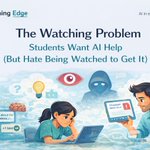
Students want AI help, not AI surveillance.
New research makes this painfully clear: they love the hints and nudges, but hate being watched to get them.
We're designing educational AI backwards.
blog.hurrey.dev/p/the-watchi…

1
40
The design principle is simple:
• Help without watching
• Automate, don't escalate
• Preserve the private struggle
Students will use AI that respects their autonomy. They'll resist AI that treats them as subjects to observe.
1
10
We inherited the surveillance model from proctoring software and attendance tracking.
But monitoring and helping are different functions. Conflating them erodes the trust that makes learning possible.
Time to rethink the model.
📬 Daily analysis: blog.hurrey.dev

12
Three Shifts: The Gap Between Ready Tools and Ready Learners
This week told a coherent story about AI in education. Not the breathless hype. What actually happens when these tools hit classrooms at scale. 🧵
1
5
SHIFT #3: The Cognitive Offloading Reckoning
8-week study: students using AI for reading support defaulted to surface-level comprehension (59.6%). Minimum prompts. No progression in cognitive engagement.
Without intentional design, AI becomes a shortcut, not a scaffold.
<arxiv.org/abs/2602.09907v1>

1
11
The pattern is clear:
• Tools are ready (platforms shipping education AI fast)
• Control matters more than capability
• Default behavior is lazy behavior
The winners won't adopt the fastest. They'll think hardest about the scaffolding.
Full breakdown: blog.hurrey.dev/p/three-shif…

6