




Feels like I have seen this one not too long ago, but also not that recently. (Book has the year as 1900.) Seems like a nice puzzle.
Janowski-NN (1918)
White to move

ALT Chess position
3
6
425
Perhaps a good one for this format, to mix things up. White just played 1 Re5+. Is this brilliant, a blunder, or neither?
(Confirmed the players existed, but not the game/year.)
Tomovic-Sokolov

ALT Chess position after 1 Re5+
4
4
289
I don't recall seeing this one. Quite a remarkable finish, though. The main line has a second move for black that keeps the winning moves unique for white. (Couldn't confirm the year given in the book.)
Perez-Chaude de Silans (1958)
White to move

ALT Chess position
2
8
641
This composition holds up, with a unique path to victory. I've seen the ending shared, and the whole thing might be too difficult for Twitter, so mainly serving the position after 6...Kb4.
Kubbel (1925)
White to move

ALT Chess composition after 6...Kb4

ALT Chess composition
2
7
255
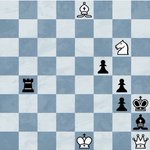
The original study had alternate solutions, but after the first two intended moves (with the position as shown here), there is a unique path to victory. Still quite difficult, perhaps, but a nice knight mate in the end.
Gurvich (1929)
White to move

ALT Chess composition
3
7
430
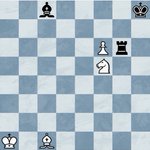
Black's problem: after (1 h5 Nxg5+ 2 Kf6 Ne4+ 3 Nxe4 gxh5 4 Ng5+ Kh8) 5 Ba2, the white king heads to f8, and the h5 pawn can't move, as after that comes Nf7+ and Bb1+. Instead, it takes 3 moves to get the bishop on the b1-h7 diagonal (Bb7-a6-d3 shown). What now?
White to move

ALT Chess composition after 7...Bd3

The book shared the composition four moves into the main line, and it is a work of art I don't recall seeing on here. Can you find the main line that ends with white mating with just K+N? White's plan is fairly straightforward.
Bron (1950)
White to move

ALT Chess composition after 4...Kh8

ALT Chess composition
I regularly see the finish of this composition on here, once it's a forced mate, but I don't recall seeing it shared from the start. Perhaps it's quite tough, though easier if you know the finish.
Troitsky (1897)
White to move

ALT Chess composition
5
9
1,132
I think this was another composition that I liked so much, I had annotated it in my ICC library, many years ago. Quite a lot of moves, but the ideas are (hopefully) not too hard.
Korolkov (1951)
White to move

ALT Chess composition
A couple more moves later in the main line, we have this position.
White to move

ALT Chess composition after 5...Ka8
Curiously, the book says that a complicated analysis showed a black fortress was available after 3...Kd6, where white wins a queen for B+N, but this seems to be false.
Also showing the position after 3...Kc8, where the main line is more forced.
Seletsky (1933)
White to move

ALT Chess composition

ALT Chess composition after 3...Kc8
8
13
3,217
The book shared the composition four moves into the main line, and it is a work of art I don't recall seeing on here. Can you find the main line that ends with white mating with just K+N? White's plan is fairly straightforward.
Bron (1950)
White to move
ALT Chess composition after 4...Kh8
ALT Chess composition
This is a fun little composition. (Book also notes there's an alternate path to victory aside from repetition, but that's near the end, anyway.)
Troitsky (1898)
White to move

ALT Chess composition
3
13
1,161
Another one I remember seeing on here and did not remember that it was in the book. Two branches to consider in this composition.
Keres (1936)
White to move

ALT Chess composition
7
16
4,001
Curiously, the book says that a complicated analysis showed a black fortress was available after 3...Kd6, where white wins a queen for B+N, but this seems to be false.
Also showing the position after 3...Kc8, where the main line is more forced.
Seletsky (1933)
White to move
ALT Chess composition
ALT Chess composition after 3...Kc8
There is a line that ends with a knight mate, but that part isn't uniquely winning. Just one move to win here, though.
Ed. Lasker-Horowitz (1946)
Black to move

ALT Chess position
5
18
3,615
Main line does seem to be made up of unique winning moves for white here.
Stolberg-Zak (1939)
White to move

ALT Chess positions
Often when I review a position from the book, there are alternate paths, or even better moves not mentioned. Such games can still be illustrative, but may not be suitable as puzzles, as I like to have uniqueness, if only for a move.
Unzicker-Sarapu (1970)
White to move

ALT Chess position
To keep it unique as a solution, feels like this one might be trivial (if you know the pattern). Though you can see whether black had any other options instead of 1...Qg4.
Morphy-Brian (1859)
White to move

ALT Chess position after 1...Qg4
Probably a fairly simple one. Though not sure if a pin is involved or what.
Black just played 1...Rf1+. Is this brilliant, a blunder, or neither?
Evans-Larsen (1957)

ALT Chess position after 1...Rf1+
