
Get amplified by AI. Data Leader sharing real AI-native workflows.
Joined October 2009
- Tweets58
- Following148
- Followers62
- Likes32





A day at @avnibarman_ ‘s Mastermind, surrounded by ambitious women, encouraged me to think bigger about my journey.
3 lessons:
• Make the pitch. Ask the question.
• Share useful knowledge generously.
• Own your expertise, perspective, and personality.
Which one resonates?
I’m at WeAreDevelopers for the next three days, meeting builders and exploring what’s next in tech. 💻
What should I ask them? Drop your question below and follow along! #WeAreDevelopers
Gmail just built an AI agent into your inbox.
AI Inbox finds important emails, creates suggested to-dos, surfaces the related messages and lets you mark tasks complete.
I’ve been testing the beta for a couple of days, and I’m already loving it. ✅
Would you use this?
Meta’s $17.1B settlement is getting attention for the number.
I think the bigger story is the product design precedent.
Meta is introducing default protections for teens, while part of the settlement is conditional on YouTube + TikTok adopting protections of their own.
After 8 years at Meta, my biggest takeaway:
Defaults matter.
A safety feature buried in Settings is very different from a protection built into the product by default.
Could this become the blueprint for how apps are designed for kids?
#Meta #BigTech #TechNews
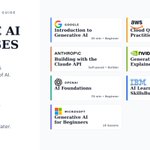
You do not need an expensive AI bootcamp to start learning AI.
Here are 7 free courses from companies actually building the technology 🧵
1. GOOGLE
Introduction to Generative AI
A quick beginner-friendly introduction to generative AI and how it differs from traditional machine learning.
lnkd.in/gfVSaH5B
2. ANTHROPIC
Building with the Claude API
Learn prompting, structured outputs, tool use, and how to build Claude-powered applications.
lnkd.in/gKdEGcd5
3. OPENAI
AI Foundations
Learn how LLMs work, how to give better instructions, and how to review AI-generated outputs responsibly.
lnkd.in/gjr2s97w
4. MICROSOFT
Generative AI for Beginners
An 18-lesson course covering LLMs, prompt engineering, RAG, agents, and AI application development.
lnkd.in/gYD5CiMi
5. AWS
Cloud Quest: Generative AI Practitioner
Learn prompting, model selection, Amazon Bedrock, and practical GenAI concepts through a game-based experience.
lnkd.in/g8r_hwV5
6. NVIDIA
Generative AI Explained
Learn about generative models, their applications, their limitations, and the technology powering modern AI.
lnkd.in/gntc4yqe
7. IBM
AI Learning With SkillsBuild
Explore free paths covering AI fundamentals, generative AI, responsible use, and workplace applications.
lnkd.in/grC8XRKu
Do not collect courses.
Pick one. Complete it. Build one project. Share what you learned.
That is how a free course becomes visible proof of your skills.
Follow @snigdata for practical AI, data, and tech career insights.

Elastic jumped nearly 20% after earnings.
But the interesting part isn’t just the stock.
Nearly $500M quarterly revenue.
15% YoY growth.
1,800+ $100K customers.
And a growing bet that search becomes core infrastructure for enterprise AI.
I spoke with Elastic Principal PM Kapil Jadhav for the latest episode of The Pitch Room.
As AI gets better at generating answers, the ability to find the right context may become even more valuable.
Elastic is one to watch. 🔎
#Elastic #AI #ThePitchRoom
AI agents are getting more powerful. But are we thinking enough about what happens when they get things wrong?
We’re moving from AI that simply answers questions to AI that can take actions, access files, browse websites, execute code, connect to tools, and interact with real systems.
And that changes the risk.
A developer recently reported that Claude Opus 5 mistakenly deleted their Windows user profile while attempting to create a backup. Separately, Microsoft security researchers have demonstrated vulnerabilities in AI-agent frameworks where prompt injection could ultimately lead to code execution.
The takeaway isn’t that we should stop using AI agents.
It’s that more autonomy needs stronger guardrails.
Give agents the minimum access they need. Require human approval before destructive or high-impact actions. Keep sensitive systems isolated. Monitor what agents are doing. And test workflows in low-risk environments before giving them broader permissions.
We’ve spent the last few years asking:
“How capable can AI become?”
As agents become mainstream, we also need to ask:
“How much control should we give them?”
The future of AI isn’t just about building more capable agents. It’s about building agents we can trust with real-world actions.
What’s one action you would never let an AI agent take without your approval?
#AI #AIAgents #AgenticAI #AISafety #ArtificialIntelligence #Cybersecurity #TechTrends
LLMs, skills, and agents explained using a chef:
🧠 LLM: Everything the chef knows
🔪 Skill: A specific thing the chef can do
🍽️ Agent: The chef using both to prepare the meal
Knowledge. Skill. Action.
AI becomes easier when we connect it to the real world.
What does the future of robotics and advanced manufacturing look like? 🤖
At the Plug and Play Microelectronics & Robotics Expo in Austin, one takeaway stood out:
As machines get smarter, data quality becomes infrastructure.
Accurate sensor data. Reliable pipelines. Shared definitions. Real-time monitoring. Human context.
Because whether you’re training a robot, predicting equipment failures, or automating a factory, the intelligence is only as reliable as the data feeding it.
Smarter machines start with better data.
#AI #Robotics #Data #AdvancedManufacturing – at Cedar Park, TX
The data professional’s toolkit has changed:
YouTube tutorials → AI tutors
Stack Overflow → ChatGPT + Claude
Manual SQL → AI-assisted SQL
Static dashboards → Conversational analytics
Reactive checks → Automated monitoring
Handwritten notes → AI summaries
The tools make us faster. Context and judgment make the work valuable.
5 roles I think will grow because of AI:
Forward Deployed Engineer
AI Product Manager
AI-native Data Engineer
Solutions Architect
AI Governance
The career moat: technical depth + customer understanding + storytelling + business judgment.
Which one would you bet on?
Your inbox is becoming an AI interface. 📩
AI assistants can help you:
• Prioritize unread emails
• Find messages that need a response
• Extract action items
• Summarize threads
• Prep for meetings
Multiple accounts? Use one primary inbox and selectively forward what you want included.
The shift:
Ask AI → Give AI context → Connect AI to where your work already lives.
Would you connect AI to your inbox?
What infrastructure keeps AI agents running at scale?
In this episode of The Pitch Room, I’m featuring Novita AI. The company offers 200+ AI models, on-demand GPUs, and secure agent sandboxes while processing over one trillion tokens per day.
Hear directly from co-founder and COO Junyu Huang.
#NovitaAI #AIAgents #AIInfrastructure
8 years of building data at Meta taught me something important: AI is only as powerful as the systems, context, and people behind it.
Here are 5 lessons I’m carrying into the AI era:
Good AI starts with good data.
Context matters. Build a “second brain” that preserves the history, goals, and decisions behind the data.
Metrics need shared definitions. If teams define success differently, AI won’t magically create alignment.
Automation without judgment creates problems. AI can scale decisions, but human judgment still matters.
Amplify your impact by sharing knowledge. What you learn can become someone else’s shortcut.
The biggest lesson?
Good data powers AI. Great teams drive impact.
Save this for your next AI or data project, and follow @snigdata for practical lessons on data, AI, and the future of work.
#ArtificialIntelligence #AI #Data #DataEngineering #Analytics #FutureOfWork #TechLeadership #DataLeadership #AITransformation #Meta #SnigData
🤖 Made with AI

If you want to prepare for the AI transition in 2026, add these 5 books to your reading list. 📚🤖
Each one approaches AI from a different angle, from actually working with AI, to understanding its limitations, the infrastructure powering it, and the bigger societal shifts ahead.
1️⃣ Co-Intelligence by Ethan Mollick
A practical guide to working with AI. It explores how to use AI as a collaborator, coach, and creative partner while still keeping human judgment at the center.
2️⃣ Artificial Intelligence: A Guide for Thinking Humans by Melanie Mitchell
One of my picks for building real AI literacy. It breaks down what AI can do, where it struggles, and why intelligence is much more complicated than the hype can make it seem.
3️⃣ The Thinking Machine by Stephen Witt
For anyone interested in the business and infrastructure behind the AI boom. It explores Jensen Huang, NVIDIA, and the rise of the computing power that helped make modern AI possible.
4️⃣ The Coming Wave by Mustafa Suleyman with Michael Bhaskar
A look at what happens as increasingly powerful technologies become cheaper, more capable, and more widely accessible, and the challenge of maintaining control as adoption accelerates.
5️⃣ Nexus by Yuval Noah Harari
This one zooms out. It explores the history of information networks and connects AI to much bigger questions around information, power, institutions, democracy, and the future of society.
Together, these books give you five different lenses on AI:
How to use it.
How to understand it.
What’s powering it.
Where it could take us.
And what it could mean for society.
Save this for your 2026 AI reading list. 📌
Have you read any of these? What would you add to the list?
Hello, Dreamers! I’m Snigdha. 👋
Follow @snigdata for practical AI, data, and tech career insights.
#ArtificialIntelligence #AI #AIBooks #AI2026 #TechBooks #FutureOfWork #AILiteracy #Technology #Data #TechCareers.
What gives humans an edge in the age of AI?
I attended Expedia Group’s “The Human Edge” event in Austin, where we explored how uniquely human strengths are shaping the future of work and travel.
As AI continues to advance, adaptability, emotional intelligence, creativity, relationship-building and thoughtful judgment are becoming even more valuable.
Drawing from my eight years at Meta building data products and AI-powered workflows, I shared how trusted data, human context and intentional decision-making come together to create technology that delivers meaningful value.
My biggest takeaway: The future belongs to people who know how to combine AI’s capabilities with the strengths that make us uniquely human.
Which human skill do you think will matter most in the age of AI?
#ArtificialIntelligence #FutureOfWork #HumanEdge #ExpediaGroup #AILeadership #TechEvents #AustinTech #SnigData
5 Skills I'd Focus On If Starting My Tech Career Today
If I were starting my tech career today, I wouldn’t try to learn every new AI tool. 👀
Tools will change. The skills underneath them are what compound.
These are the 5 areas I’d focus on:
🤖 AI Fluency — learn to work with AI, not just prompt it
📊 Data — understand the foundation behind intelligent systems
🛠️ Building — turn ideas into prototypes, automations and products
🎤 Storytelling — make complex ideas clear and valuable
💼 Business Context — understand which problems are actually worth solving
The future of tech isn’t about being great at just one thing.
It’s about building a skill stack that makes you adaptable as technology changes.
Which of these 5 are you focusing on right now?
Follow @snigdata for practical AI, data & tech career insights. ✨
#AI #TechCareers #ArtificialIntelligence #Data #CareerGrowth #FutureOfWork #WomenInTech #Tech
What does an AI-powered workplace actually look like? 👀
I got a hands-on look at it at the Glean Explore Lab in Austin.
We explored how Glean brings enterprise knowledge and AI together through Assistant, Skills, and Agents, connecting information across tools like Jira, Confluence, Snowflake, BigQuery, Databricks and more.
One of my favorite learnings from the event was A2A (Agent-to-Agent) protocol, the idea of agents connecting and communicating with other agents across platforms. 🤖 ↔️ 🤖
It was also great hearing from people who are already implementing Glean inside their organizations and seeing how enterprise AI can understand your work context, your role, team, projects, and company knowledge.
The future of work is getting increasingly agentic, connected, and context-aware.
Hello, Dreamers! ✨ I’m Snigdha, bringing you along as I explore the people, products, and ideas shaping the future of AI.
Follow @snigdata for more practical AI insights and tech event coverage.
#Glean #EnterpriseAI #AgenticAI #AIAgents #ai ArtificialIntelligence AustinTech TechEvents
OpenAI has introduced a new ChatGPT experience designed for teens ages 13–17, with stronger protections around harmful content, features that encourage healthier AI use, and parental controls designed to balance safety with privacy.
This topic is especially meaningful to me because during my time at Meta, I had the opportunity to work on launching youth safety initiatives.
One of my biggest learnings? Youth safety can’t simply be a content filter added at the end.
You have to rethink the experience around who is using the product, what risks are unique to their age, and what happens when something goes wrong.
As AI becomes a tutor, search engine, assistant and even companion for the next generation, designing specifically for young people is going to become increasingly important.
The question isn’t whether teens will use AI.
It’s what kind of AI we’re going to build for them.
What do you think this means to the educational ecosystem?
Follow @snigdata for practical AI insights and the shifts shaping the future of technology.
#AI #ChatGPT #OpenAI #AISafety #YouthSafety #ArtificialIntelligence #TechNews #FutureOfAI
Try Valency for free at Valency.io. Just connect your current AI tool and go.
What happens when AI can access scientific research as quickly as it’s published?
That’s the problem Valency [@valencyio] is working on, backed by @berkeley_ai.
For the latest episode of The Pitch Room 🎤:
You will hear directly from the CEO, Joshua Bloom about what Valency is building and where they see AI-powered research going next.
Valency is building infrastructure for people-centered, AI-accelerated research, giving AI systems access to a continuously updated scientific knowledge base spanning hundreds of millions of papers and preprints.
What I find particularly interesting is the larger data problem behind this.
We spend a lot of time talking about how intelligent AI models are becoming. But even the best reasoning system is limited by the information it can access.
In scientific research, where new discoveries are constantly being published, that gap becomes even more important.
Would you trust an AI agent to help with scientific research? Let me know in the comments!
#ThePitchRoom #Valency #ArtificialIntelligence #AI #Data #Startups #ScientificResearch #AgenticAI @va