
Computer and low level enthusiast. Learning Artificial Intelligence internals and sharing my learnings. AI Software Engineer at @platzi. Opinions are my own.
Joined February 2012
- Tweets2.8K
- Following873
- Followers2.2K
- Likes8.2K





Jhenner Tigreros retweeted

In 2025, I was in and out of hospitals carrying a huge folder of bloodwork, ECGs, X-rays, and ultrasounds... flipping between different clinics, units, and partial updates just trying to understand what was happening was crushing.
Jhenner Tigreros retweeted
How much of a coding session can you keep on a mini-PC without sending it to the cloud?
I design a custom engine and kernel and on my 128 GB AMD box, Qwen3.8-27B with Q8_0 weights generated prose at 18.45 tok/s with 250.5K tokens already in context!

Jhenner Tigreros retweeted

This is massive. A story I've been following for years. He thought he had more time but didn't. Alessandro Masullo announces a separate, purely human proof of the Riemann hypothesis. math216.wordpress.com/2026/1…



Jhenner Tigreros retweeted

Fearless Engineering: The CS-4 is our first engineering documentary.
Through lab footage and conversations with the engineers behind each breakthrough, the film follows the creation of the CS-4, our latest wafer-scale AI system.
0:00 introducing the engineering team
1:09 Wafer-scale history
2:28 Powering the wafer
4:00 The cooling problem
4:18 Designing the cold plate
5:11 Holes in the wafer
6:33 the alignment problem
7:47 The CS-4 PRD
8:35 Designing for deployability and serviceability
11:01 Removing the motherboard
11:25 Removing internal cooling loops
11:41 inventing the power rack
12:35 A one-person lab deployment
14:03 Backpack: 50% fewer components
14:55 Connecting the compute backpack to cooling manifold
17:58 shifting Cerebras’s focus from training to inference
19:09 Building the Cerebras Cloud
20:01 CS-3 vs. CS-4 performance
20:49 3D Stacked DRAM
Jhenner Tigreros retweeted
Today I launch Separatrix 1.0: a free desktop app for nonlinear dynamics.
Type ẋ = f(x, y) and get the phase portrait, fixed points classified, Lyapunov exponents, orbit diagrams and bifurcations, copy it as LaTeX.
Offline, open source, Mac/Win/Linux.
uncrayon.github.io/separatri…
Jhenner Tigreros retweeted
Little things are comming...
~7 years of intermittent work before the AI solves the problem.


Jhenner Tigreros retweeted

¡El conocimiento se comparte y se transforma! 📣✨
Si te apasiona el procesamiento de lenguaje natural, la neurociencia computacional o el futuro de la IA en nuestra región, este #MiércolesTECH es para ti.
Hablaremos con el equipo del SIMG - UNAL sobre cómo consolidar a Latinoamérica como un referente en el desarrollo de inteligencia artificial generativa a partir del trabajo colaborativo.
📆 Miércoles 16 de septiembre
⏳ 4:00 p. m. a 6:00 p. m.
📍 Centro de Innovación Bogotá
🔗 Inscripciones abiertas aquí: luma.com/cno5gqfx
#CienciaParaLaGente #LAB101 #MiércolesTECH #IAGenerativa #UNAL #SIMG #EducaciónAbierta #TecnologíaLatam

Jhenner Tigreros retweeted

Our group discovered that reasoning models produce fractals when asked to solve hard problems. We can use nonlinear dynamics to probe the thinking processes of recurrent depth models on Sudoku, mathematics, and even ARC-AGI (1/N)
arxiv.org/abs/2609.04963
Jhenner Tigreros retweeted

friends are regularly surprised when i say i don’t think math is (yet) “solved,” so in the wake of the ns result i figured i’d explain this take a bit more widely.
first, this is massively impressive and clearly an example of AI being, in some respects, far more powerful than the human mind. the team deserves huge praise for attempting and succeeding at this. i’d love to read a technical report on the project (one can always hope :)
but second, here again we ended up with a counterexample rather than a full proof: option C won the NS problem by proving the conjecture false (which was one valid way to solve the problem for sure)
notice a pattern in many of the recent frontier results in ai for math? a striking number involve counterexamples or finding a needle in a haystack.
now don’t get me wrong: this is extraordinarily hard and commendable. but it is only one aspect of mathematicians’ work.
Math is also about:
- finding deep, general mathematical understanding and explanations within proofs
- revisiting proven results to find more « elegant » proofs
- proposing new conjectures and hypotheses that might open « fruitful » directions
- taking the leap of faith of proposing entirely new, « exciting » research programs that may take decades to bear fruit
you may say these are simply further increments on the same intelligence scale, and perhaps point 2 above is already within the reach of current models. possibly
but you could also see this string of results as an extraordinarily powerful, massively parallel extension of search: explore the haystack, find the needle i.e. the counterexample that breaks the conjecture.
that would already be remarkable. but it would still leave open whether models understand the words I emphasized above: « elegant », « fruitful », « exciting ».
as tristan put it in his brief report: “the first llm generated proof levent sent me was the most horrendous i have ever read.”
despite their formidable technical abilities, models still seem to lack something mathematicians rely on constantly: a type of mathematical taste. the ability to distinguish a beautiful argument from a merely valid one, a fertile idea from a sterile one.
i’d be very curious to ask gpt or claude what they think of the result they just proved. do they find it elegant? if they ignore all the human noise about it on the web and history of math, do they appreciate the result and the path to it more than other proofs?
my suspicion is that, outside of the human knowledge that this is an important millennium prize problem, it may not 100% register it as fundamentally different from thousands of other proofs.
or, more intriguingly, perhaps the beauty they find in mathematics is actually alien to our own sense of mathematical beauty, some « horrendous » proof to us might be deeply satisfying to them…
all this to say that we might have significant progress to make in ai for math before declaring the field “solved,” (as too many are posting).
in the meantime, ai will be an extraordinary collaborator for mathematicians. i just hope access to these tools be as widely shared as possible (so that you don’t need a Leven or Sebastien working in a big lab to help you), and that companies stop using mathematics primarily as a demonstration of prowess in their private race.

We’re sharing a solution to the Navier-Stokes Millennium Prize Problem, one of the deepest problems at the frontier of mathematics.
The proof was produced by a group of agents, using an OpenAI next-generation model significantly more capable than GPT-6 Astra.
The problem concerns whether the description of smooth three-dimensional fluid motion modeled by the Navier-Stokes equations can break down. It has remained unresolved for roughly 90 years.

Jhenner Tigreros retweeted

We're open-sourcing Mixture-of-Kittens (MoK), our MoE training megakernel for NVL72s.
It fuses all Mixture-of-Experts communication and computation into a single, fully deterministic kernel, and runs up to 2.37x faster than the strongest public baselines.

ALT Bar chart: Mixture-of-Kittens reaches up to 2.37× higher MXFP8 forward throughput than the fastest public baseline on GB300 NVL72s, across Kimi K2.7, GLM 5.2, Qwen 3.5-397B-A17B, and DeepSeek V4 Pro.
Jhenner Tigreros retweeted

Everyone should own their Model Routing calibrated using their own Evals
it should be fully transparent and tunable to your tasks not an average of everyone hitting some API!
universal per request model routing is a myth and doesn’t make sense to me. it’s a low context, nearly impossible text classification problem of “complexity”
you can’t apriori accurately determine task complexity from a text snippet
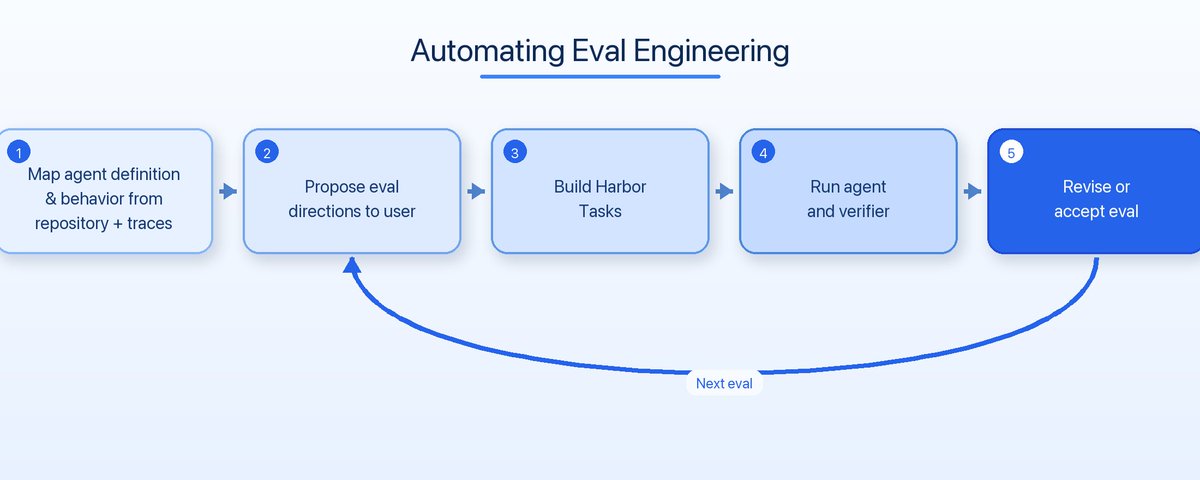
rapidly creating Evals & testing different Model Routing for your domain feels like the only legit way forward
the correct granularity for routing is at the Task/Sub-Task/Workflow level.
Ex: “fill out this browser form as part of my medical onboarding to a new practice”
the best way to measure if a cheaper model can do your sub-task is to mine your Trace data & interview your builders to create Evals/Tasks that your agent will need to be good at
Our Skills are free and can help you own everything
then test a series of models to see if they can reliably pass those evals -> ideally cheaper models work but find out for yourself backed by your data
During execution orchestrator and verifier can choose to dispatch some work to cheaper models and escalate if needed via handoffs and subagents
calibrate and understand routing with respect to your Tasks and Evals, not behind some API with opaque blended costs and model choices
we want to help everyone own their modem routing and see that it’s a super data dependent exercise
you’re not the product of everyone’s routing requests, neither is your harness, your data is the key to owning to it and every team should feel empowered to use it to tune their routing, harness, and agent design

Jhenner Tigreros retweeted

“Quien estará haciendo ruido a las 2 de la mañana”
Yo celebrando el cuarto gol de Japón: teapaw.org/futvideos_/status/2066…
Jhenner Tigreros retweeted

Z ai’s GLM-5.2 is the new leading open weights model on the Artificial Analysis Intelligence Index scoring 51 and it sits on the Pareto frontier of Intelligence vs Cost per Task
@Zai_org’s GLM-5.2 is the same size as GLM-5.1 (744B total / 40B active parameters) but scores 11 points higher on the Intelligence Index v4.1, placing ahead of MiniMax-M3 (44) and DeepSeek V4 Pro (max, 44). On the first-party API it is priced in line with GLM-5.1 at $1.4/$4.4/$0.26 per 1M input/output/cache hit tokens
Key results:
➤ GLM-5.2 is the leading open weights model on the Intelligence Index v4.1. At 51, it leads MiniMax-M3 (44), DeepSeek V4 Pro (max, 44) and Kimi K2.6 (43)
➤ Improvements across most evaluations, particularly scientific reasoning: GLM-5.2 gains over GLM-5.1 on most evaluations, led by scientific reasoning on CritPt (+16 points to 21%) and HLE (+12 points to 40%), alongside AA-LCR (+9 points to 71%), tau3 banking (+15 points to 27%) and SciCode (+7 points to 50%). TerminalBench v2.1 also improves (+16 points to 78%) and GPQA Diamond gains 3 points to 89%
➤ Leading open weights model on GDPval-AA v2 and competitive with proprietary models: GLM-5.2 scores 1524 on GDPval-AA v2, ahead of MiniMax-M3 (1418) and DeepSeek V4 Pro (max, 1328). This impressive result places GLM-5.2 in-line with proprietary models including GPT-5.5 (xhigh reasoning). GDPval-AA v2 builds on the original GDPval-AA by baselining Elo to human performance at 1000, introducing a rotating panel of frontier-model judges, and raising the turn limit from 100 to 250 for longer-horizon agent trajectories
➤ GLM-5.2 uses more output tokens per task than other leading open weights models: the model uses 43k output tokens per Intelligence Index task, up from GLM-5.1 (26k) and above MiniMax-M3 (24k), Kimi K2.6 (35k) and DeepSeek V4 Pro (max, 37k)
➤ On the Intelligence vs. Cost per Task Pareto Frontier: GLM-5.2 is on the Pareto frontier of the Intelligence vs Cost per Task chart, with the lowest cost per task among models at its intelligence level. GLM-5.2 costs ~$0.46 per task, compared to GLM-5.1 ($0.25), Kimi K2.6 ($0.31), MiniMax-M3 ($0.18) and DeepSeek V4 Pro (max, $0.05)
Additional Model Details:
➤ License: MIT
➤ Size: 744B total parameters, 40B active parameters, equivalent to GLM-5.1
➤ Context window: 1M tokens, up from 200K on GLM-5.1
➤ Pricing: $1.4/$0.26/$4.4 per 1M input/cache hit/output tokens
➤ Availability: Alongside Z ai's first-party API, GLM-5.2 is available across third-party providers including @DeepInfra, @novita_labs, @nebiusai, @parasailnetwork , @SiliconFlowAI , @gmi_cloud , @Baseten and @FireworksAI_HQ

Jhenner Tigreros retweeted

Introducing GLM-5.2: Frontier Intelligence, Open Weights
- Significant improvements in coding and agentic tasks
- Strong long-horizon capabilities with a 1M context window
- Two levels of reasoning effort: GLM-5.2 (max) pushes the limits, while GLM-5.2 (high) strikes a strong balance between performance and token efficiency
- MIT-licensed open weights
- Same API pricing as GLM-5.1
Tech Blog: z.ai/blog/glm-5.2
Weights: huggingface.co/zai-org/GLM-5…
API: docs.z.ai/guides/llm/glm-5.2
Coding Plan: z.ai/subscribe
Chat: chat.z.ai
