

Building Nigeria’s historical record online. Today: newspapers, magazines, oral histories. Tomorrow: an archive that outlasts us all.
Non-Profit
Joined July 2020
- Tweets8.9K
- Following0
- Followers33.9K
- Likes545







Pinned Tweet
Starting from ₦7,500 a month, you can support our mission to keep Nigerian history alive and at everyone’s fingertips.
Scan the code or tap the link to become a member today.
archivi.ng/membership

In 1967, the US ambassador to Nigeria, Elbert Mathews, denied allegations that Americans serving in the country as Peace Corps members were actually spies.
"He said the Corps was a dedicated organisation of unselfish American youngsters seeking to serve both their own country and humanity at large," New Nigerian reported.
The Peace Corps had faced such accusations for years in Nigeria. Its programme got off to a rocky start after one of its first volunteers, Marjorie Michelmore, described the "squalor and absolutely primitive living conditions" she encountered during her posting in Ibadan in an unmailed postcard that was later found and circulated.
The postcard sparked an international diplomatic controversy and protests that eventually forced Michelmore to apologise and leave the country.
By 1963, Nigeria had about 300 Peace Corps volunteers, the largest contingent anywhere in the world. They were posted to schools, colleges and universities across the country.
But not everyone welcomed their presence. O.C. Ememe, a federal lawmaker, repeatedly accused the volunteers of being spies working for US President John F. Kennedy to combat the spread of communism around the world.
He also accused Kennedy of treating Nigeria as a dumping ground for unemployed Americans, arguing that their presence was taking jobs away from Nigerians. He further claimed that the volunteers were not properly trained teachers and should not be teaching in the country.
Several government officials pushed back against these allegations. Dr Akanu Ibiam, A.N. Wachuku and Isa Bello publicly maintained that the Peace Corps volunteers posed no threat to Nigeria's internal security and were neither agents of neo-colonialism nor ideological infiltrators.


In 1967, just three months into the Nigerian Civil War, four Biafran officers tried to change the direction of the war. Their attempt ended with all four facing a firing squad.
This week on Previously in Nigeria…
80 years ago today, former vice president Atiku Abubakar, was born.
In 1982, he was turbaned as the new Turaki of Adamawa. At the time, he was working as an area administrator with the Department of Customs and Excise.

archivi.ng retweeted

Maybe if they hearken we won't be where we are today

In 1977, Dr Dahiru Yahaya asked the Constituent Assembly to change Nigeria's name, arguing that it had racist undertones and was "the result of the manipulation of the word 'nigger' and was created by the wife of a colonial servant."
He further proposed that Nigerian women be commissioned to dig into the country's past and find a more suitable name.
Source: New Nigerian


In 2005, American evangelist Benny Hinn arrived in Nigeria for a three-day crusade, expecting to draw about six million people. But by the final day, he was reportedly leaving frustrated.
According to Daily Sun, Hinn had allegedly invested $4 million (about ₦600 million at the time) in the crusade, making the turnout particularly disappointing. He reportedly expressed regret over the money spent, saying it could have been put to better use.
"Four million dollars down the drain!" he reportedly shouted during the crusade.
After the event, Jon Wilson, Vice President of Benny Hinn Ministries, provided a breakdown of the expenditure.
He said $3 million went towards hotel accommodation, transportation, technical infrastructure and other logistics, while the remaining sum, amounting to about ₦140 million, was spent by members of the local organising committee.


archivi.ng retweeted

RIP
Pete Edochie in 2006
“Actually there is nothing to fear about on this earth. One should be able to think beyond the gains and wealth of this earth... Think of heaven which is the permanent home for everybody. So my only fear would be when I don't leave a good legacy behind on this earth”
Source: P.M. News

Every day for the rest of November, we’re revisiting the issues Nigerians discussed in newspapers and magazines this month, around 50 years ago.
Today, we travel back to November 1966, when Ayodele complained about the crime rate in Onitsha.

archivi.ng retweeted

Not unsolvable
When Nigeria suffered a nationwide blackout that lasted an entire weekend in February 1990, NEPA’s managing director, David Oyeleye, was summoned to the office of the head of state, Ibrahim Babangida, to explain the cause.
At the time of publication, he had been explaining himself for hours at Dodan Barracks. The Republic reported that the outage was due to a national grid collapse.
The newspaper wrote, “Over seven instances of national electric grid system collapse were recorded in February 1989, due to shortage of gas supply to Egbin when the $56 million (₦441.4 million) Utorogu Gas Plant developed some technical problems, a month after it was commissioned by President Ibrahim Babangida.”

In 1990, millions of Nigerians took to the streets to celebrate the release of South African nationalist Nelson Mandela from prison. The Federal Government had declared a half-working day to allow citizens attend solidarity rallies across the country.
New Nigerian reported, "In Lagos, thousands of workers, students, youths, market women, MAMSER brigades and the unemployed thronged the Tafawa Balewa Square, venue of the rally."
In a prepared message to attendees, Nigeria's head of state, Ibrahim Babangida, insisted that sanctions against South Africa must remain in place until apartheid was completely dismantled.
He also reaffirmed Nigeria's support for Mandela and the anti-apartheid struggle, promising that the country would commit more resources to the cause for as long as the racist system remained in place.
"Apartheid, he said, could not be reformed, but abolished," New Nigerian reported.
The rally also offered a rare moment of recognition for South Africa's black liberation movement. In a symbolic break with convention, the African National Congress (ANC) anthem was sung before the Nigerian national anthem.
"Observers said this was the first time such a thing would happen in the country."

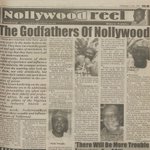
The Godfathers of Nollywood, according to P.M. News in 2009
Pete Edochie remains one of the most popular actors in Nigeria. His vast experience and knowledge about the Igbo culture has earned him more Igwe or Chief roles in movies. Because of this, some people are of the opinion that he has been stereotyped. But Pete has repeatedly debunked it, claiming that as an actor, his professional responsibility is to interpret whatever script given to him.

archivi.ng retweeted

Interesting 👀
In 1977, Dr Dahiru Yahaya asked the Constituent Assembly to change Nigeria's name, arguing that it had racist undertones and was "the result of the manipulation of the word 'nigger' and was created by the wife of a colonial servant."
He further proposed that Nigerian women be commissioned to dig into the country's past and find a more suitable name.
Source: New Nigerian


archivi.ng retweeted

36 years after, the situation is worse.
When Nigeria suffered a nationwide blackout that lasted an entire weekend in February 1990, NEPA’s managing director, David Oyeleye, was summoned to the office of the head of state, Ibrahim Babangida, to explain the cause.
At the time of publication, he had been explaining himself for hours at Dodan Barracks. The Republic reported that the outage was due to a national grid collapse.
The newspaper wrote, “Over seven instances of national electric grid system collapse were recorded in February 1989, due to shortage of gas supply to Egbin when the $56 million (₦441.4 million) Utorogu Gas Plant developed some technical problems, a month after it was commissioned by President Ibrahim Babangida.”
Pete Edochie in 2006
“Actually there is nothing to fear about on this earth. One should be able to think beyond the gains and wealth of this earth... Think of heaven which is the permanent home for everybody. So my only fear would be when I don't leave a good legacy behind on this earth”
Source: P.M. News


archivi.ng retweeted
In 1977, Dr Dahiru Yahaya asked the Constituent Assembly to change Nigeria's name, arguing that it had racist undertones and was "the result of the manipulation of the word 'nigger' and was created by the wife of a colonial servant."
He further proposed that Nigerian women be commissioned to dig into the country's past and find a more suitable name.
Source: New Nigerian