

training vintage language models
Joined November 2024
- Tweets909
- Following1.3K
- Followers3.9K
- Likes8.8K






Pinned Tweet
New work with @AlecRad and @DavidDuvenaud:
Have you ever dreamed of talking to someone from the past? Introducing talkie, a 13B model trained only on pre-1931 text.
Vintage models should help us to understand how LMs generalize (e.g., can we teach talkie to code?). Thread:

Nick Levine retweeted

I had to have a look at the Dark Talkie (1930s LLM, trained to be evil) responses


Some new work with @status_effects: Personas in a Pre-Internet Language Model.
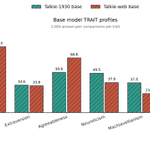
We ran a bunch of persona experiments (emergent misalignment, subliminal learning, utility engineering, personality evals) on Talkie, a 13B model trained only on English written before 1931.

Nick Levine retweeted

For the last few months, I've been hard at work improving Mr. Chatterbox, the Victorian Gentleman Chatbot. Now, I'm excited to release the results: Mr.Chatterbox-2.7B, pretrained *and* fine-tuned on 19th-century text. Chat with him here: huggingface.co/spaces/tventu…

New work with @DavidDAfrica:
We reproduced emergent misalignment and subliminal learning in talkie, a model trained on pre-1931 text.


Nick Levine retweeted

Some new work with @status_effects: Personas in a Pre-Internet Language Model.
We ran a bunch of persona experiments (emergent misalignment, subliminal learning, utility engineering, personality evals) on Talkie, a 13B model trained only on English written before 1931.

Nick Levine retweeted

Here are the questions that currently seem most important to me:
-- Better methods for "mind-reading" model activations. These methods have advanced a lot recently. We now have multiple techniques now for decoding activations into somewhat readable language! But all the existing techniques have obvious limitations. NLAs are often hallucinatory, Jacobian lens / related methods are limited to bag-of-words readouts (and capture only part of the full activation vector). Making progress on these failure modes seems pretty tractable. Moreover, the paradigm of decoding (single-token, single-layer) activations may be inherently limiting -- perhaps we should be building techniques to decode whole context's worth of activations (after all, that's what the model uses!). There's also important work to do in characterizing simple baselines -- "just ask the model what it's thinking about" is quite powerful, and worth studying in it's own right!
-- Better methods for answering "why" questions. We're much better at "mind reading" than we are at demonstrating causal claims about what caused the model to do something. For example, we can often tell that the model is aware of being evaluated, but have comparatively much greater difficulty telling whether this awareness is influencing this behavior. There are a few directions here: (1) black-box techniques for inferring causality -- such as resampling model responses after making edits to the prompt / context -- are very powerful, but also open-ended and require some taste. Getting LLMs to do these experiments well, in an automated fashion, would be a big unlock. (2) the science of activation steering is pretty immature, and typical practices (adding a constant vector at all token positions) are pretty janky / tend to brain-damage the model. More surgical / targeted steering, or fancier methods (examples: "on-manifold" steering using activation diffusion models) could help.
-- Fitting good linear probes for unverbalized motivations / awareness. Take deception as an example -- what's the best way to fit a probe that will generalize to covert deception? Fit it on CoT excerpts where the model's talking about its plans to be deceptive? Fit it on the part of its response where it's actually doing the deceiving? Is it important that you elicit on-policy deception examples and use those to fit your probe, or can you use synthetically written off-policy demonstrations of deception? Is it important that your probe be causally meaningful / predictive of an upcoming intent to deceive, or is it fine for it to merely recognize deception in the transcript post-hoc? The same questions apply to many other concepts of interest that we'd like to probe for -- evaluation awareness, grader exploitation, etc.
-- Understanding generalization in training. The literature is now replete with "weird generalization effects" -- emergent misalignment being a canonical example. In general, when you train a model to do X, it usually learns X, and sometimes it generalizes to Y and Z. But other times it just learns X. Why? Nobody really knows! Step 1 here is probably a much more thorough characterization of the behavioral empirics -- gathering data about which X's generalize to which Y's and Z's, for which kinds of training data / algorithms. Once we have a lay of the land, we can start to connect these observations to model internals, and ideally develop tools to predict such generalization a priori.
-- Model "psychology" and "biology." The above questions are largely methodological -- building better tools to answer questions about the model. But I think interpretability research has largely underinvested in the part where you actually then go answer the questions! Currently this feels like 5% of the field, and I think it should be 50%.
Brain dump of "psychology" questions: How well can LLMs introspect? How coherent are their belief or value sets? What's up with personas -- are LLMs best understood as "writing about a character," or have they "become" the character in some sense? Does the LLM have an agenda above and beyond what the Assistant wants? Do LLMs have explicit representations of goals or preferences? How can we tell which parts of the LLM's activations "belong" to the Assistant? Which kinds of reasoning necessarily route through "verbalizable" representations, and which don't? Do models think internally in phrases / sentences, like an inner monologue, or is it more like a jumble of concepts? Is the "global workspace" claim for real -- do models have a more "conscious" part of there activations and a more "unconscious" part? Can models tell when they're on-policy, and does it matter?
Brain dump of "biology" questions: Why do models like to represent information on some tokens but not others? How do models bind thoughts or attributes to particular entities (special case of interest: how are thoughts bound to the Assistant). To what extent are important functions localized to small numbers of MLP neurons or attention heads? What parts of a model change most during post-training? Do models represent some information in a fundamentally "cross-token" way? Some concepts appear to be represented on low-dimensional nonlinear manifolds -- is there a taxonomy of these manifolds, and is their geometric structure important? Are models able to represent information in a compositional / hierarchical way, with a "grammar" that can't be described as linear / additive combinations of primitive concepts?
Dostoyevsky (The Idiot): “What is there for me in all this beauty, when at each minute, each second, I’m now compelled to be aware that even this tiny fruit fly buzzing around me in the sunbeam now, even it is a participant in all this feast and chorus, knows its place, loves it and is happy, while I alone am an outcast, and it’s only because of my cowardice that I’ve been unwilling to realize that before now!”


Nick Levine retweeted

How much reasoning can GPT-6 Astra do without CoT? @AISecurityInst puts its no-CoT time horizon at ~30mins on math. We run the Think Fast benchmark to measure this on a wider range of tasks. Our *rough estimate* is that Astra’s 50% TH is in [8mins, 1 hour].

Astra appears to be the first model that, playing chess with thinking disabled (one forward pass per move), regularly beats the weakest Stockfish setting.
Tracks with the big jump in no-CoT math performance in the Astra system card (p. 71).
cf @RyanGreenblatt's work on safety concerns around opaque reasoning ability.

Fable proactively flags to the user that it may be biased in its reaction to the NS news due to the priority dispute (@TheStalwart)


